Number Cards
Product Code : LSK-ML-10126
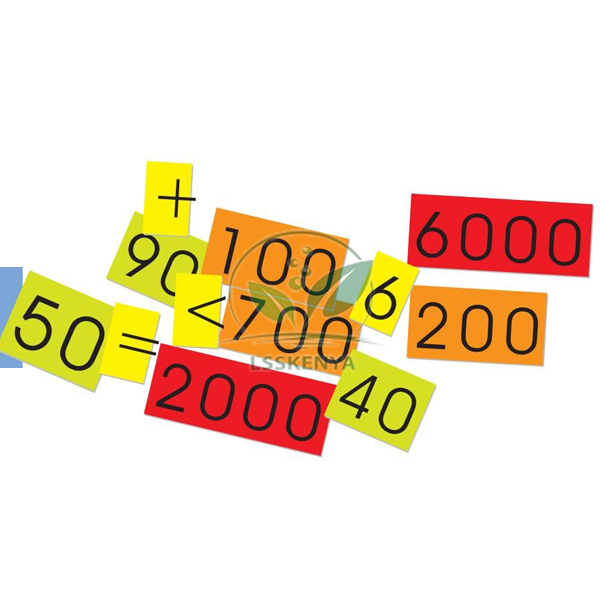
Number Cards (SKU LSK-ML-10126) are colourful, durable plastic place value cards that give a concrete representation of units, tens, hundreds and thousands. Used at the right level, they show zero acting as a placeholder and how the value of a digit changes with its position, making them a core primary maths resource. The cards are a manufactured product of Science Lab Supplies, whose factory sits at Plot 448, HSIIDC Industrial Area, Saha, Ambala, India; they are sold direct to schools, colleges, tender contractors and distributors.
Specifications
The cards are made of colourful, durable plastic and cover four place values: units, tens, hundreds and thousands. By laying cards together, learners build multi-digit numbers and see each digit's contribution, including where a zero holds a place, which makes an abstract idea concrete and easy to discuss.
| Parameter | Value |
|---|---|
| SKU | LSK-ML-10126 |
| Material | Colourful, durable plastic |
| Place values | Units, tens, hundreds, thousands |
| Concepts shown | Zero as a placeholder; changing value of a digit |
| Manufacturer | Science Lab Supplies, Saha, Ambala, Haryana |
| Country of origin | India |
Applications and Experiments for the Number Cards
Teachers use the cards to build numbers, break them into expanded form and compare how the same digit is worth more or less in different places. They are one of the simplest maths lab manipulatives for making place value concrete, and they work equally well on a pupil's desk or held up for the class.
- NCERT Classes 2–3: tens and ones, then hundreds.
- NCERT Classes 4–5: four-digit numbers up to thousands.
- Writing numbers in expanded form and back again.
- Showing zero as a placeholder in numbers such as 305 or 1,040.
Standard Scope of Supply
Number Cards are supplied as a set of colourful plastic place value cards covering units, tens, hundreds and thousands, as described above. The number of sets you need for a class is stated on the quotation, together with any related place value resources you ask to add.
Packing, MOQ and Lead Time
You are welcome to request a quotation for one set or for enough sets for pairs or groups throughout a class. It will list the packing, delivery time and price for that quantity, and base ten cubes or an abacus from the range can be added.
Science Lab Supplies, a registered exporter with an Importer-Exporter Code, can ship to buyers in the UAE, Saudi Arabia, Oman, the Philippines, Nepal and Bangladesh. Get in touch on the contact page, save the cards to your enquiry cart, or follow the lab tender page if you are responding to a tender.
Frequently Asked Questions
What do Number Cards teach?
They teach place value: units, tens, hundreds and thousands, the role of zero as a placeholder, and how the value of a digit changes with its position in a number.
What are the cards made of?
Colourful, durable plastic, which stands up to repeated handling in class better than paper cards.
Is Science Lab Supplies the manufacturer or a trader?
It is the manufacturer. The number cards are produced at the Science Lab Supplies factory in Saha, Ambala, India, and every price you receive is quoted by that factory.
Which classes use place value cards?
They suit primary classes from the first work on tens and ones up to four-digit numbers, and can be revisited whenever pupils need a concrete model of place value.
Related Place Value Resources
These four Maths Lab items show place value in other ways, with larger models for the teacher, cubes to count, beads on rods and a board of numbers to 120, so pupils can check what the cards show against different representations. All can be priced together.
- Place Value Cards Model — teaching aid for digit value, number formation and zero as a placeholder.
- Base Ten Cubes — one-centimetre cubes for place value and numeration.
- Abacus Desk Table — beads sliding on rods in a frame to represent decimal places.
- 120 Number Board — for basic operations and number patterns.
Browse the full Maths Lab range or all school lab equipment.
Last updated: 25 September 2026