Model of The Atom
Product Code : SCL-CL-11532
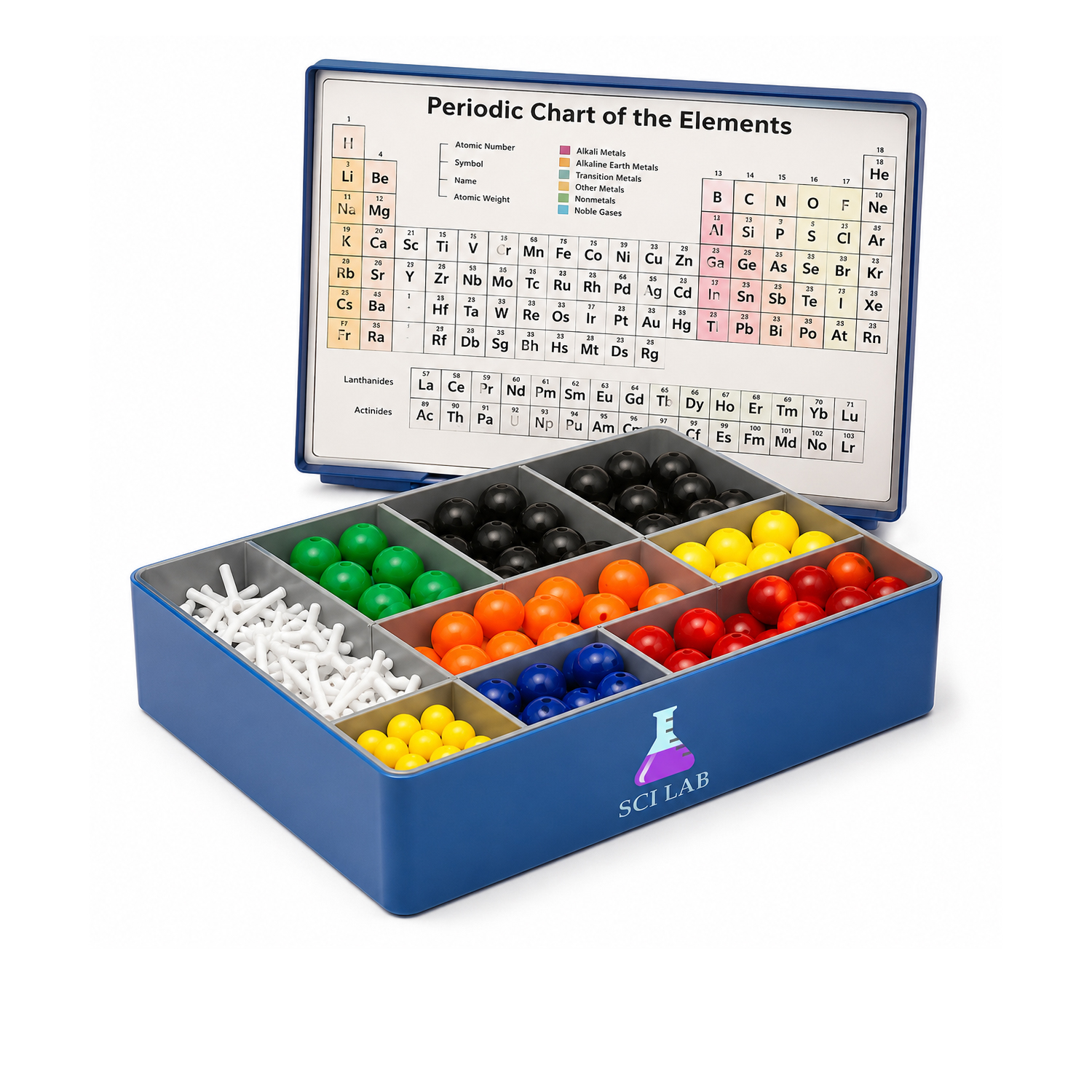
Model of The Atom (SKU SCL-CL-11532) is a hands-on teaching model made up of an atom model table and loose coloured spheres representing electrons, protons and neutrons. Teachers use it to let students build the nucleus and electron arrangement of different atoms and see how atomic number and mass number arise. Science Lab Supplies supplies the model from Ambala, India for schools, colleges, tender contractors and distributors.
Specifications
The set centres on a 475 x 475 mm atom model table on which particles are laid out. Particles are colour-coded: 48 yellow spheres for electrons, 57 red or green spheres for protons and 57 black spheres for neutrons, giving enough pieces to model many light and medium atoms in class.
| Parameter | Value |
|---|---|
| SKU | SCL-CL-11532 |
| Base | Atom model table, 475 x 475 mm |
| Electrons | 48 yellow spheres |
| Protons | 57 red or green spheres |
| Neutrons | 57 black spheres |
| Supplied by | Science Lab Supplies, Ambala, India |
Applications and Experiments for the Model of The Atom
The model turns atomic structure into a table-top activity: students place protons and neutrons in the nucleus and arrange electrons in shells, then check atomic number, mass number and valency. It supports the structure-of-the-atom chapter of CBSE/NCERT Class 9 science and introductory atomic structure in Class 11 chemistry.
- Class 9 science: Bohr model, electron distribution in shells and valency.
- Class 9–10: showing isotopes by changing only the number of neutrons.
- Class 11 chemistry: revising subatomic particles before quantum-mechanical models.
- Teacher training and science clubs: group activities on building atoms.
Standard Scope of Supply
The model consists of the atom model table together with 48 yellow electron spheres, 57 red or green proton spheres and 57 black neutron spheres, as listed above. Any storage case or teacher guide is not mentioned in the specification, so ask if you need one quoted.
Packing, MOQ and Lead Time
One model for a single classroom or several for a group of schools can be quoted. The quotation from Science Lab Supplies gives the packing, delivery time and price for your quantity, and charts or other school chemistry lab equipment in India from the range can be added to it.
As a registered exporter with an Importer-Exporter Code, Science Lab Supplies can ship to buyers in Tanzania, Uganda, the UAE, Saudi Arabia, Oman and the Philippines. Science Lab Supplies is registered for GST (GSTIN 06ADEPJ0574F2ZU). Enquiries are welcome through the contact page and the enquiry cart, and tender buyers can start from the lab tender page.
Frequently Asked Questions
What does the Model of The Atom show?
It shows how an atom is built from protons and neutrons in the nucleus and electrons around it. Students lay out coloured spheres on the table to build particular atoms and discuss their structure.
How many particles come with the model?
There are 162 spheres in all: 48 yellow electrons, 57 red or green protons and 57 black neutrons, used on a 475 x 475 mm table.
Who supplies this atom model?
Science Lab Supplies supplies the model from Ambala, India, preparing quotations directly for schools, colleges, contractors and distributors.
Which classes is it suited to?
It is aimed at Class 9 structure-of-the-atom lessons and works well for revision in Class 11 chemistry and for teacher-training demonstrations.
Related Atomic Structure Models and Charts
Atomic structure is easier to teach when a physical model is paired with a second model and wall charts. These four items continue from the table-top atom model to orbitals, electron shells and the periodic table.
- Atom Activity Model — a further hands-on atom-building activity.
- Dynamic Model for Atomic Orbital Demonstration — moves the lesson on to orbitals.
- Distribution of Electrons in Electronic Layers — chart of electron shells.
- Periodic Table of Chemical Elements — links atomic number to the periodic table.
Browse the full Chemistry Lab range or all school lab equipment.
Last updated: 25 September 2026