Metal Strip
Product Code : LSK-CL-10089
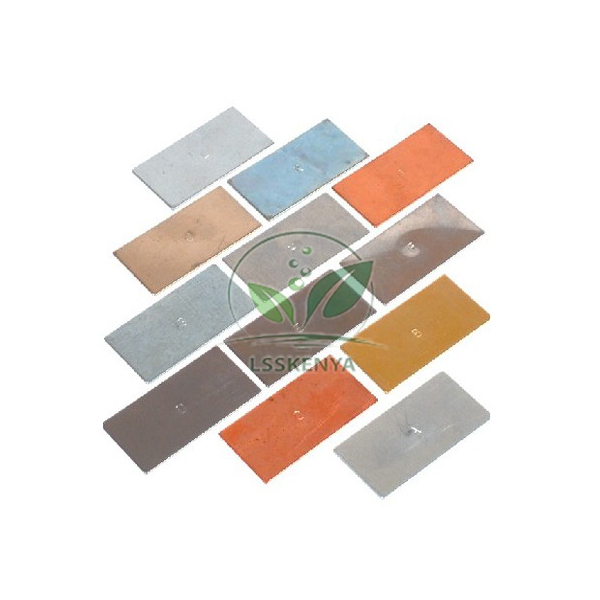
Metal Strip (SKU LSK-CL-10089) is a flat strip of metal offered in aluminium, copper, lead and zinc. Chemistry classes use the strips as electrodes to build simple cells and compare metals in electrochemistry, and physics or general science classes use them to compare how well different metals conduct heat. Science Lab Supplies sends the strips from Ambala, India to schools, colleges and training institutes, and to the contractors and distributors who equip them.
Specifications
Each strip is a single metal, so a teacher can pair any two to set up a cell or line up all four for a conduction test. The listing names the four metals but gives no length, width or thickness; the quotation states the size of the strips offered.
| Parameter | Value |
|---|---|
| SKU | LSK-CL-10089 |
| Metals available | Aluminium, copper, lead, zinc |
| Form | Strip |
| Uses | Electrodes for simple cells; thermal conductivity experiments |
| Supplied by | Science Lab Supplies, Ambala, India |
Applications and Experiments for the Metal Strip
The strips serve two families of practicals. Dipped into an electrolyte in pairs, they form simple cells whose voltage depends on how far apart the metals sit in the reactivity series. Heated at one end, they show that some metals carry heat along their length faster than others.
- Class 10 science (NCERT): comparing the reactivity of zinc, copper, aluminium and lead in salt solutions.
- Class 12 chemistry: building a simple or Daniell-type cell and relating cell voltage to electrode potentials.
- Class 7–8 science: comparing heat conduction in different metals.
- B.Sc. electrochemistry: preparing electrodes for cell and electrolysis set-ups.
Lead is toxic: students should handle the lead strip with gloves or tongs and wash their hands after the practical.
Standard Scope of Supply
The Metal Strip is supplied as strips of the metal or metals you choose from aluminium, copper, lead and zinc. The listing does not fix a set composition or strip count, so name the metals and quantities in your enquiry. Electrolytes, beakers, leads and meters are not part of this item.
Packing, MOQ and Lead Time
Ask for a handful of strips for one demonstration or a class set for every group; Science Lab Supplies replies with a quotation listing packing, delivery time and price for exactly that quantity. Salt bridges, cells and connectors can be added so the whole electrochemistry bench is priced together.
Science Lab Supplies holds an Importer-Exporter Code as a registered exporter and can ship to buyers in Rwanda, South Africa, Qatar, Sri Lanka, Vietnam and Malaysia. Enquiries go through the contact page or the enquiry cart, and institutions handling laboratory equipment tenders in India can read the lab tender page.
Frequently Asked Questions
Which metals are available?
Aluminium, copper, lead and zinc. Specify one metal or a mix of all four on your enquiry, depending on whether you are setting up cells or comparing the metals side by side.
How is a simple cell made with these strips?
Two different metals, commonly zinc and copper, are placed in an electrolyte and joined through a meter or bulb. The more reactive metal becomes the negative electrode and a small voltage is produced.
Who supplies the Metal Strip?
The strips are supplied by Science Lab Supplies of Ambala, India, which quotes them with its wider chemistry lab equipment in India for schools, colleges and contractors.
Is the lead strip safe for students?
Lead is toxic if it is swallowed or its residue is carried on the hands. Use it under teacher supervision, avoid eating in the lab and wash hands after handling.
Related Electrochemistry Equipment
Once students have seen metal strips produce a voltage, the next practicals use ready-made cells and the salt bridge that joins two half-cells. These four Chemistry Lab items extend the same topic and can be quoted alongside the strips.
- Cell Simple Copper With Zinc — a ready copper–zinc cell for first demonstrations.
- Cell Daniel Copper With Zinc — the two-compartment cell met in Class 12.
- Salt Bridge — links two half-cells built from the strips.
- Electrode Connector — attaches leads to electrodes and strips.
Browse the full Chemistry Lab range or all school lab equipment.
Last updated: 25 September 2026