
Carbon-Carbon Molecular Model
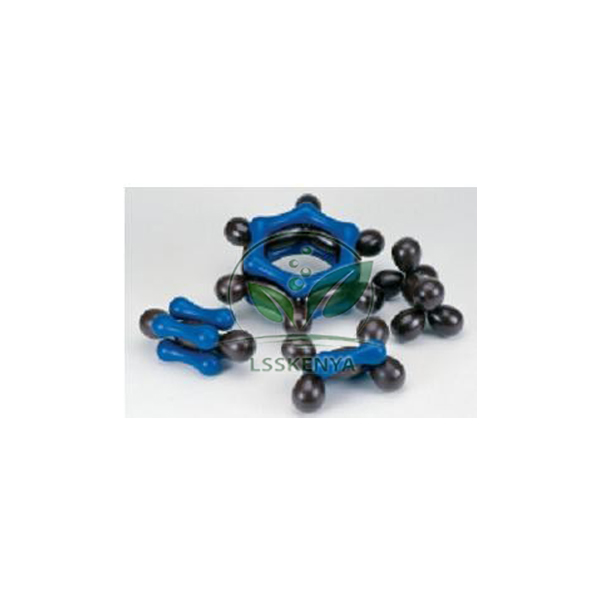
Product Code : LSK-CL-10077
Carbon-Carbon Molecular Model (SKU LSK-CL-10077) is a set of orbital models of four molecules, ethane, ethylene, acetylene and benzene, that shows the sigma and pi bonds formed between pairs of carbon atoms. It lets organic chemistry teachers compare single, double, triple and aromatic bonding side by side. The set is supplied by Science Lab Supplies from Ambala, India, for schools, colleges, teacher-training institutes, tender contractors and distributors.
Specifications
Each of the four models represents the orbitals of one molecule rather than just its atoms, so the head-on sigma overlap and the sideways pi overlap are visible. The complete set weighs 3.0 kg and measures 510 x 345 x 140 mm, a size that suits demonstration from the front bench.
| Parameter | Value |
|---|---|
| SKU | LSK-CL-10077 |
| Molecules modelled | Ethane, ethylene, acetylene, benzene |
| Bonds shown | Sigma and pi bonds in carbon-carbon pairs |
| Weight | 3.0 kg |
| Dimensions | 510 x 345 x 140 mm (51 x 34.5 x 14 cm) |
| Supplied by | Science Lab Supplies, Ambala, India |
Applications and Experiments for the Carbon-Carbon Molecular Model
The set is used to explain hybridisation and bond types in hydrocarbons: sp3 carbon in ethane, sp2 in ethylene, sp in acetylene and the delocalised pi system of benzene. It matches the hybridisation and hydrocarbons chapters of NCERT Class 11 and the structure and bonding units of B.Sc. organic chemistry.
- Class 11 chemical bonding: sigma and pi overlap and why a pi bond prevents rotation.
- Class 11 hydrocarbons: comparing alkanes, alkenes and alkynes by bond order.
- Class 12 and B.Sc.: aromaticity and the delocalised electrons of benzene.
- B.Sc. and pharmacy organic chemistry: relating bond type to reactivity.
Standard Scope of Supply
The set consists of four orbital models: ethane, ethylene, acetylene and benzene. Together they weigh 3.0 kg and occupy 510 x 345 x 140 mm. Any stand or storage option beyond this set is listed separately on the quotation if you request it.
Packing, MOQ and Lead Time
A quotation can be prepared for one set for the chemistry department or for several sets across campuses. Science Lab Supplies states the packing, delivery time and price for the quantity in each quotation, and the sp2 and sp3 orbital models can be added so the hybridisation lesson is complete.
Science Lab Supplies is a registered exporter with an Importer-Exporter Code and can ship to buyers in Kenya, Ghana, Ethiopia, Tanzania, Uganda and the UAE. For a quote, use the contact page, place the set in the enquiry cart, or visit the lab tender page for tender purchases.
Frequently Asked Questions
Which molecules are in the Carbon-Carbon Molecular Model?
Four orbital models are included: ethane, ethylene, acetylene and benzene. Together they cover single, double, triple and aromatic carbon-carbon bonding.
What are the size and weight of the set?
The set weighs 3.0 kg and measures 510 x 345 x 140 mm, so it is large enough for a teacher to show the orbitals to the whole class.
Who supplies this orbital model set?
Science Lab Supplies supplies it from Ambala, India, to schools, colleges and distributors, quoting single sets as well as tender and bulk quantities.
How does it differ from a ball-and-stick set?
A ball-and-stick set shows where atoms sit; this set shows the orbital overlap that forms sigma and pi bonds, which is what hybridisation lessons need.
Related Orbital and Molecular Models
Hybridisation lessons move from single orbitals to whole molecules, so the sp2 and sp3 orbital models pair well with this set. A ball-type molecular set and a demonstration kit then let students build the same hydrocarbons themselves and compare structure with bonding.
- Orbital Model of Sp2 Hybridization — the bonding of carbon in ethylene and benzene.
- Orbital Model of Sp3 Hybridization — the tetrahedral carbon of ethane.
- Atomic In/Organic Junior Model — ball models students assemble themselves.
- Molecular Models Demonstration Kit — larger models for class demonstration.
Browse the full Chemistry Lab range or all school lab equipment.
Last updated: 25 September 2026

.jpg)



100ml.jpg)