Laboratory Spirit Burner
Product Code : SCL-CL-11917
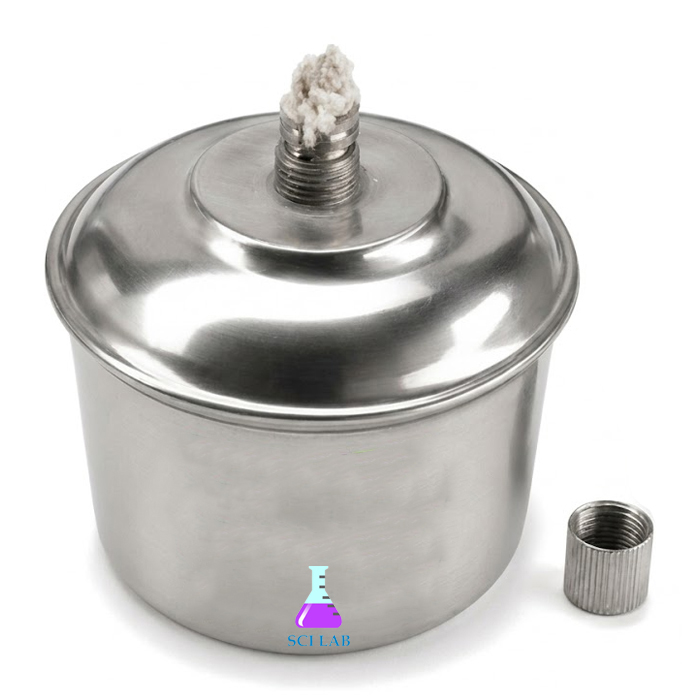
Laboratory Spirit Burner (SKU SCL-CL-11917), also called a spirit lamp, is a 100 ml metal-bodied burner that draws fuel up a cotton wick to give a clean, low-heat flame. Schools without a gas supply, microbiology benches and field labs use it for gentle heating and flame-sterilising loops. Science Lab Supplies ships it from Ambala, India, to schools, colleges, training institutes, tender contractors and distributors.
Specifications
The burner has a metal housing with a 100 ml fuel reservoir, a collar through which a cotton wick is drawn, and a small metal cap. Pulling more or less wick through the collar before lighting adjusts the flame size, and the cap snuffs the flame and stops the fuel evaporating between sessions.
| Parameter | Value |
|---|---|
| SKU | SCL-CL-11917 |
| Model no. | SCI/LSS-1645 |
| Capacity | 100 ml |
| Housing | Metal |
| Wick | Cotton, adjustable through the collar |
| Cap | Metal snuffer cap |
| Flame | Clean, low-heat |
| Supplied by | Science Lab Supplies, Ambala, India |
Applications and Experiments for the Laboratory Spirit Burner
The spirit burner provides a small, steady flame where a Bunsen burner is not available or not needed. It is used for warming test tubes and small beakers, melting wax or sulphur samples and sterilising inoculating loops and needles in biology and microbiology practicals.
- Class 6–8 science: heating small quantities of substances to observe physical and chemical changes.
- Class 9–10 science: warming test tubes in simple reaction and solubility experiments.
- Microbiology practicals: flaming inoculating loops and the necks of culture tubes.
- Rural and mobile science labs without piped gas.
Fill the burner only when it is cold and unlit, keep the fuel container away from the flame, and always extinguish it with the cap. The fuel is flammable, so students should use it under supervision.
Standard Scope of Supply
The Laboratory Spirit Burner is supplied as a single unit with its metal housing, cotton wick and snuffer cap as described above. Spirit fuel is not included; any spare wicks or accessories offered are listed on the quotation.
Packing, MOQ and Lead Time
Order a single burner for a demonstration table or one per student group for a full class. The quotation states packing, delivery time and price for your quantity, and tripods, gauzes or other school chemistry lab equipment in India can be quoted with it.
Registered as an exporter with an Importer-Exporter Code, Science Lab Supplies can ship to buyers in Qatar, Sri Lanka, Vietnam, Malaysia, Peru and Egypt. Send your requirement through the enquiry cart or contact page; the lab tender page explains tender supply.
Frequently Asked Questions
How is the flame size adjusted?
Before lighting, pull more wick through the collar for a larger flame or less for a smaller one. Adjust only when the burner is unlit and cool.
Is fuel supplied with the spirit burner?
No. The burner is supplied empty, and the laboratory fills it with a suitable spirit fuel. Store fuel away from flames and refill only when the burner is out and cold.
Who supplies the Laboratory Spirit Burner?
Science Lab Supplies supplies it from Ambala, India, for individual schools, colleges and tender contractors, and can quote it together with other bench heating items.
What is the metal cap for?
The cap is placed over the wick to snuff out the flame safely, and it also stops the fuel evaporating when the burner is not in use.
Related Burners and Heating Supports
A spirit burner is used with supports that hold the apparatus above the flame. These four items from the Chemistry Lab range give alternative burners and the standard tripod-and-gauze set-up, so a lab can equip complete heating stations on one quotation.
- Alcohol Lamp — another wick-fed lamp for bench heating.
- Brass Spirit Lamp 100ml — a brass-bodied spirit lamp option.
- Tripod Stand — holds glassware above the burner.
- Wire Gauze — spreads the flame beneath beakers and flasks.
Browse the Chemistry Lab range in full, or all school lab equipment.
Last updated: 25 September 2026