
Beakers
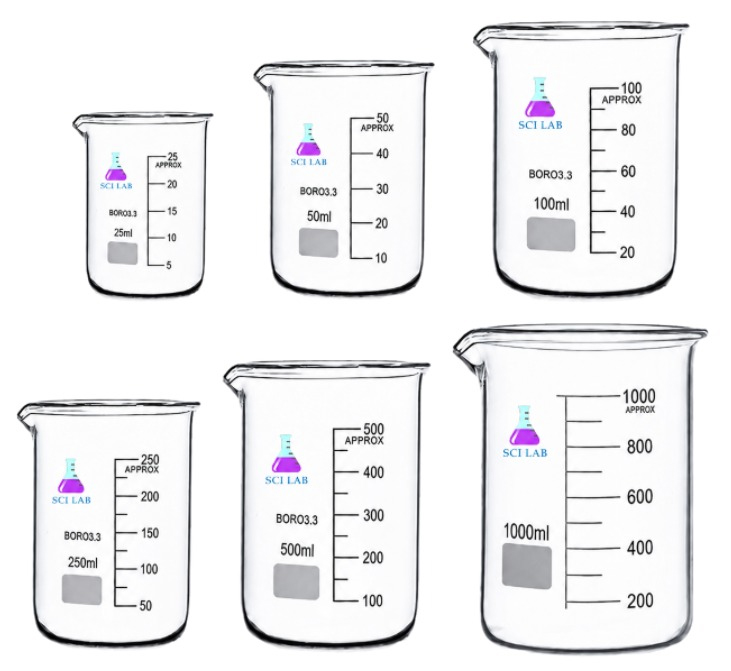
Product Code : SCL-CL-11900
Beakers (SKU SCL-CL-11900) are fire-resistant borosilicate glass beakers in six capacities from 25 ml to 1000 ml, with permanent graduations, a pouring spout and a flat, stable base. They are the everyday vessels for mixing, heating and holding liquids in school, college and training laboratories. Science Lab Supplies delivers them from Ambala, India, to schools, colleges, training institutes, tender contractors and distributors.
Specifications
Each beaker is made from fire-resistant borosilicate glass that resists acids, alkalis and solvents. Clear, permanent graduations show the volume for measuring and mixing, the controlled-pour spout reduces drips, and the flat base keeps the beaker steady on a bench or wire gauze.
| Parameter | Value |
|---|---|
| SKU | SCL-CL-11900 |
| Model no. | SCI/LSS-1602 |
| Capacities | 25 ml, 50 ml, 100 ml, 250 ml, 500 ml, 1000 ml |
| Material | Fire-resistant borosilicate glass |
| Graduations | Clear, permanent |
| Chemical resistance | Acids, alkalis and solvents |
| Design | Controlled-pour spout, flat stable base |
| Supplied by | Science Lab Supplies, Ambala, India |
Applications and Experiments for the Glass Beakers
Borosilicate beakers hold, mix and heat liquids in almost every practical, from dissolving a salt to warming a water bath. Because the glass tolerates heat and common reagents, the same beakers serve CBSE/NCERT Class 6–12 science, B.Sc. chemistry and biology labs, and laboratory-technician courses.
- Class 6–8 science: dissolving solids and separating mixtures by evaporation.
- Class 9–10 chemistry: reactions of acids and bases, and preparing solutions.
- Class 11–12 and B.Sc.: preparing reagents and heating solutions on a tripod and wire gauze.
- Biology practicals: water baths for enzyme and food-test experiments.
Standard Scope of Supply
Each beaker is supplied as a single borosilicate glass vessel in the capacity ordered, from 25 ml to 1000 ml. Mixed sets of sizes can be quoted on request; stirring rods, tripods and wire gauze are separate items.
Packing, MOQ and Lead Time
You can ask for a single size or for a full assortment across the six capacities to equip every student bench. The quotation gives packing, delivery time and price for exactly those quantities, and other borosilicate laboratory glassware in India can be added to the same list.
As a business registered with an Importer-Exporter Code, Science Lab Supplies can ship to buyers in Egypt, Iraq, Nigeria, Kenya, Ghana and Ethiopia. Science Lab Supplies is registered for GST (GSTIN 06ADEPJ0574F2ZU). The lab tender page explains tender quoting, while the enquiry cart and contact page take everyday requests.
Frequently Asked Questions
Can these beakers be heated directly?
They are made of fire-resistant borosilicate glass, so they can be heated on a tripod and wire gauze in normal lab work. Heat gradually and avoid placing a hot beaker on a cold, wet surface.
What capacities are available?
Six: 25 ml, 50 ml, 100 ml, 250 ml, 500 ml and 1000 ml. Most school benches use the 100 ml and 250 ml sizes, with the larger ones for water baths and stock solutions.
Are the graduations suitable for exact measurement?
They are permanent and clear for measuring and mixing. For an exact volume, use a measuring cylinder, pipette or volumetric flask and keep the beaker for holding and heating.
Who supplies the Beakers?
Science Lab Supplies supplies them from Ambala, India, and quotes single sizes or complete sets for schools, colleges and tender buyers.
Related Heating and Mixing Items
Beakers are usually stirred with a glass rod and heated on a tripod with wire gauze. These four Chemistry Lab items complete that set-up, and they can be quoted together with the beakers for a new or expanding lab.
- Chemical Glasses (Beaker) 50ml — a single-size 50 ml beaker listing.
- Glass Rods — for stirring solutions in the beaker.
- Wire Gauze — spreads the flame under a heated beaker.
- Tripod Stand — supports the gauze and beaker over a burner.
Browse the full Chemistry Lab range or all school lab equipment.
Last updated: 25 September 2026
50ml.jpg)


.jpg)