Electrostatics Friction Rods Set
Product Code : SCL-PL-12401
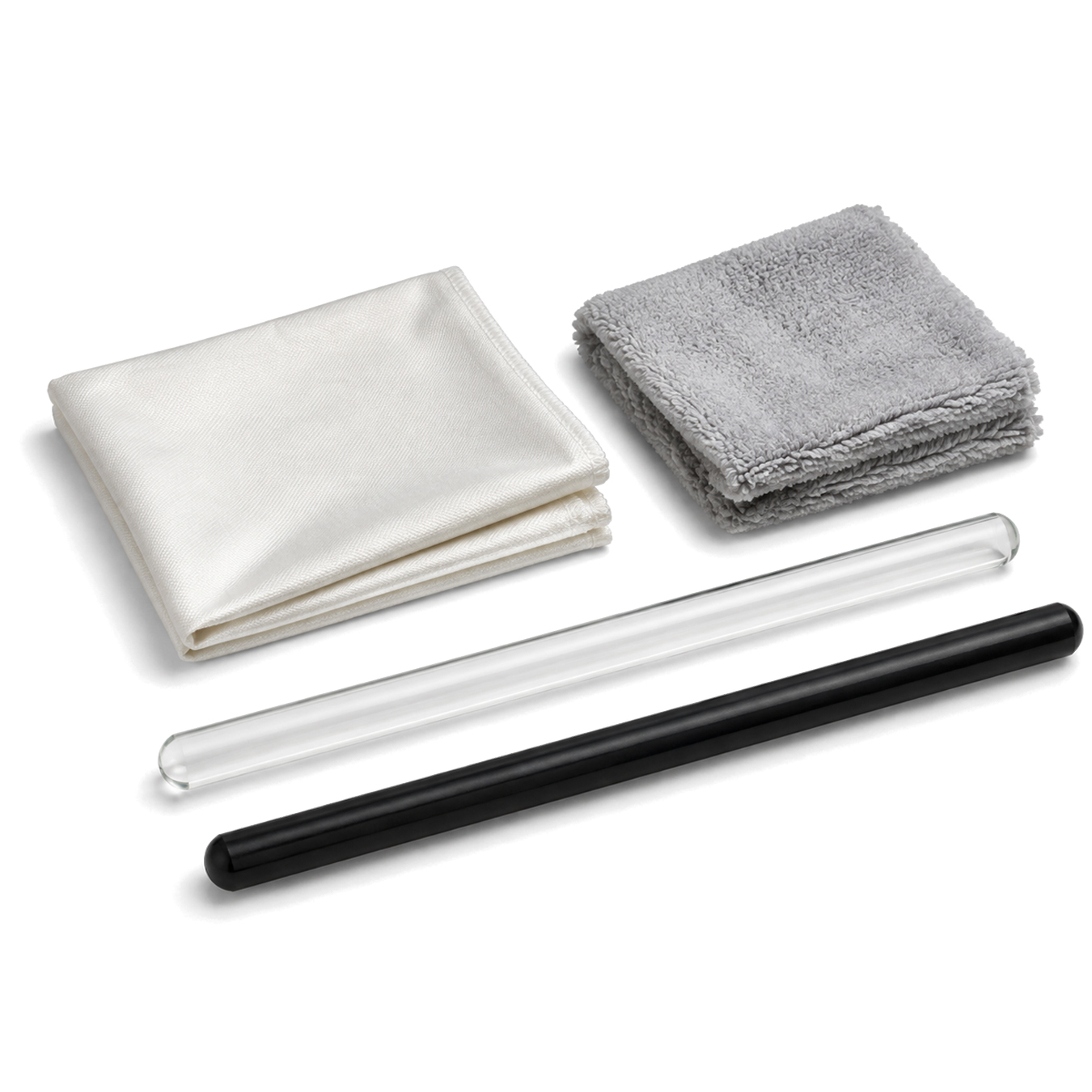
Electrostatics Friction Rods Set (SKU SCL-PL-12401) is a classroom kit for producing static charge by rubbing: glass and ebonite rods, each 12 mm in diameter and 200 mm long, with silk and synthetic-fur cloths. It suits Class 8–12 science and physics lessons on electric charge. Science Lab Supplies manufactures the kit at Plot 448, HSIIDC Industrial Area, Saha, Ambala, India, for direct supply to schools, colleges, tender contractors and distributors.
Specifications
The set combines glass and ebonite rods, each 12 mm in diameter and 200 mm long, with two rubbing cloths of silk and synthetic fur. Rubbing glass with silk and ebonite with fur gives the rods opposite charges, and the rods are sturdy and wear resistant for repeated class use.
| Parameter | Value |
|---|---|
| SKU | SCL-PL-12401 |
| Rods | Glass and ebonite |
| Rod size | 12 mm diameter x 200 mm |
| Rubbing cloths | Silk cloth, synthetic-fur cloth |
| Demonstrates | Generation of electrostatic charge by friction |
| Manufacturer | Science Lab Supplies, Saha, Ambala, Haryana |
| Country of origin | India |
Applications and Experiments for the Friction Rods Set
The rods show that rubbing transfers charge and that there are two kinds of charge. A charged rod attracts small paper pieces, bends a thin stream of water and attracts or repels a second charged rod, which makes the kit a natural starting point for electrostatics in school and college.
- Class 8 science (NCERT): charging by rubbing and the two types of charge.
- Class 12 physics: electric charge, conductors and insulators, and charging by induction.
- Charging an electroscope or pith ball for teacher demonstrations.
Standard Scope of Supply
Each set contains glass and ebonite rods of 12 mm diameter and 200 mm length together with a silk cloth and a synthetic-fur cloth for rubbing. An electroscope, pith balls and a stand for suspending a rod are separate items and can be added to the quotation.
Packing, MOQ and Lead Time
One kit or a class quantity can be quoted, and each Science Lab Supplies quotation gives the packing, delivery time and price that apply to the number requested. Electroscopes and other items for an electricity and magnetism lab kit for schools can sit on the same quotation.
Using its Importer-Exporter Code, Science Lab Supplies is able to ship to buyers in Qatar, Sri Lanka, Vietnam, Malaysia, Peru and Egypt. Questions can be sent from the contact page, several products can be combined in the enquiry cart, and public-sector buyers can refer to the lab tender page.
Frequently Asked Questions
Which rod gets which charge?
Rubbed with silk, the glass rod becomes positively charged; rubbed with fur, the ebonite rod becomes negatively charged. Bringing the two charged rods near each other shows attraction between unlike charges.
What size are the rods in this set?
Each rod measures 12 mm in diameter and 200 mm in length. The set contains glass and ebonite rods, supplied with a silk cloth and a synthetic-fur cloth.
Is Science Lab Supplies the manufacturer or a trader?
Science Lab Supplies is the manufacturer, not a trader. It makes this friction rods set at its factory in Saha, Ambala, India, and handles every quotation from the same site.
Why does the demonstration work poorly in humid weather?
Moist air lets charge leak away quickly. Keep the rods and cloths dry, rub firmly in one direction and test straight away; a dry room gives the clearest attraction and repulsion.
Related Electrostatics Equipment
Friction rods introduce charging by rubbing, and the items below take electrostatics further. An apparatus set and a charge-distribution apparatus extend the class experiments, while a Van de Graaff generator and a Wimshurst machine are electrostatic generators for teacher demonstrations. All of them can share one quotation.
- Electrostatics Apparatus Set — apparatus for class electrostatics experiments.
- Van De Graaff Generator — electrostatic generator for demonstrations.
- Wimshurst Machine — influence machine for producing static charge.
- Apparatus for Distributing Electric Charges — studying how charge spreads on conductors.
Browse the full Physics Lab range or all physics lab equipment.
Last updated: 25 September 2026