Electronegativity
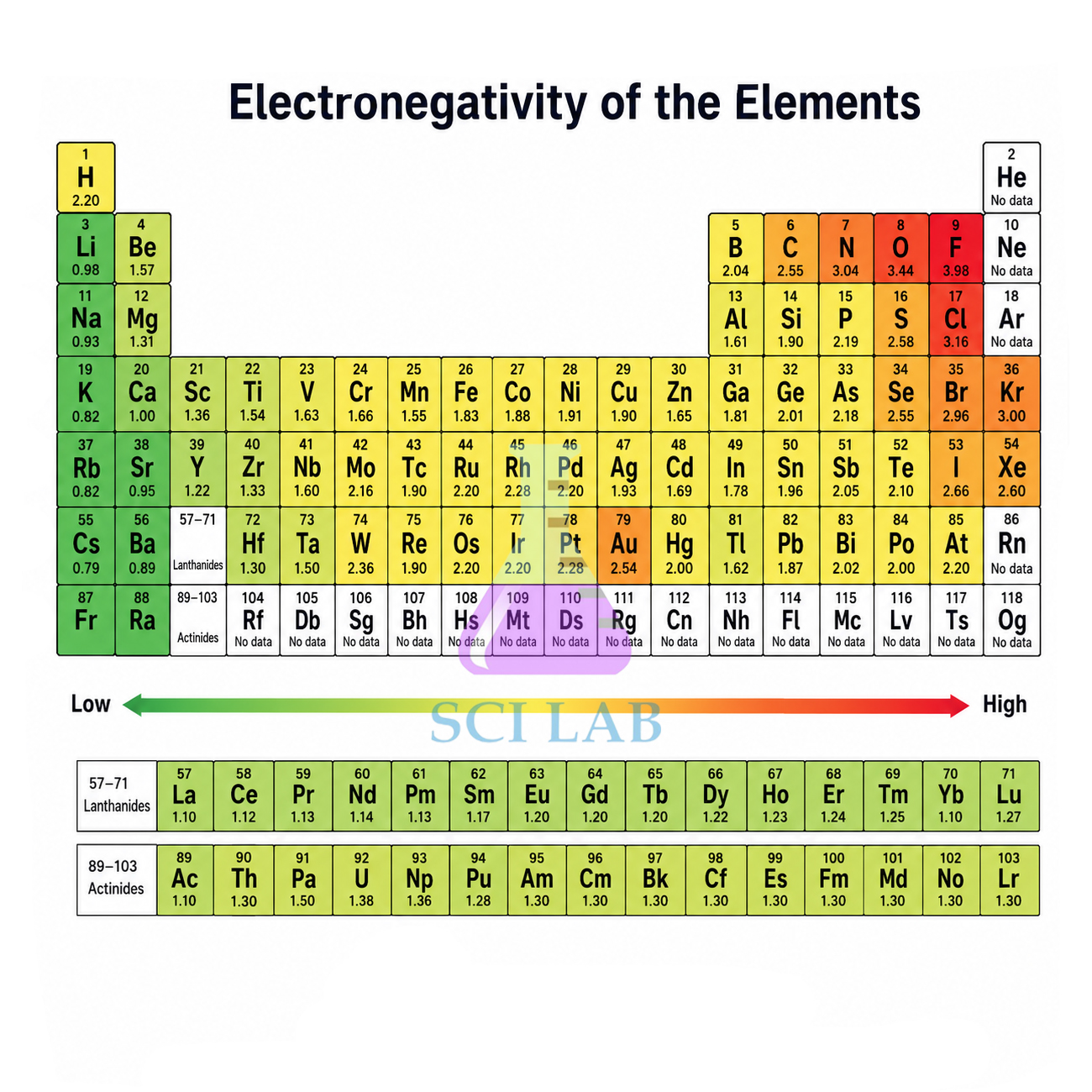
Product Code : SCL-CL-11594
Electronegativity (SKU SCL-CL-11594) is a laminated 70 x 100 cm wall chart for teaching electronegativity, the tendency of an atom in a bond to attract shared electrons towards itself. It supports lessons on periodic trends, bond polarity and oxidation numbers in senior secondary and college chemistry. Distributors, tender contractors, training institutes, colleges and schools receive it from Science Lab Supplies, which supplies it out of Ambala, India.
Specifications
The Electronegativity chart measures 70 x 100 cm and has a laminated finish that withstands everyday handling and wiping. It is supplied for wall mounting and is intended for classrooms as well as chemistry laboratories, where it can stay in view during bonding and reaction work.
| Parameter | Value |
|---|---|
| SKU | SCL-CL-11594 |
| Topic | Electronegativity |
| Size | 70 x 100 cm |
| Finish | Laminated |
| Installation | Wall mounted |
| Use | Classrooms and laboratory |
| Supplied by | Science Lab Supplies, Ambala, India |
Applications and Experiments for the Electronegativity Chart
Electronegativity lets students predict whether a bond is ionic, polar covalent or non-polar, and which atom takes a negative oxidation number. Keeping the chart on the wall means students can look up and compare elements quickly while solving bonding and redox problems in class.
- NCERT Class 11 chemistry, Classification of Elements and Periodicity: electronegativity across periods and down groups.
- NCERT Class 11 chemistry, Chemical Bonding and Molecular Structure: bond polarity and dipole moment.
- NCERT Class 11 chemistry, Redox Reactions: assigning oxidation numbers.
- B.Sc. chemistry: electronegativity scales and their use in inorganic and organic chemistry.
Standard Scope of Supply
What you receive is one Electronegativity wall chart, laminated, 70 x 100 cm, supplied as described above; any optional accessories are listed on the quotation. Related periodic-trend charts and molecular models are listed separately and can be added to your order.
Packing, MOQ and Lead Time
Quotations are prepared for any quantity, from one Electronegativity chart for a single room to multiple copies for a chain of schools. Each quotation shows packing, delivery time and price, and other items from our chemistry lab instruments supplier range can be included.
Science Lab Supplies, a registered exporter with an Importer-Exporter Code, can ship to buyers in Nigeria, Kenya, Ghana, Ethiopia, Tanzania and Uganda. If you have a question, the contact page reaches us directly; the enquiry cart bundles several products into one request, and the lab tender page explains tender supply.
Frequently Asked Questions
What is an electronegativity chart used for?
It is used to compare how strongly different atoms attract bonding electrons, which helps students predict bond type, polarity and oxidation numbers.
What size and finish does the chart have?
It is 70 x 100 cm with a laminated surface and is meant to be mounted on a classroom or laboratory wall.
Who supplies the Electronegativity chart?
Supply is handled by Science Lab Supplies from Ambala, India, for schools, colleges, contractors and distributors, with quotations for one chart or many.
Is it suitable for Class 11 chemistry?
Yes. Electronegativity is part of the periodicity and chemical bonding units in Class 11, and the chart is also useful for revision in Class 12 and B.Sc. courses.
Related Bonding and Periodicity Aids
Electronegativity sits between periodic trends and chemical bonding, so it pairs well with a periodic table, other trend charts and models of molecular shape. The four items below cover those links and can be quoted together with this chart.
- Ionization Energies of Elements According to Groups A of The Periodic System — companion trend chart.
- Geometry of Molecules — chart linking bond polarity to molecular shape.
- Periodic Table of Chemical Elements (Short Version) — the table the trends are read from.
- Molecular Models Demonstration Kit — for building polar and non-polar molecules.
Browse the full Chemistry Lab range or all school lab equipment.
Last updated: 25 September 2026
.jpg)

WithEmeryStopper100ml.jpg)