
Conical Flask (Erlenmeyer) with Stopper
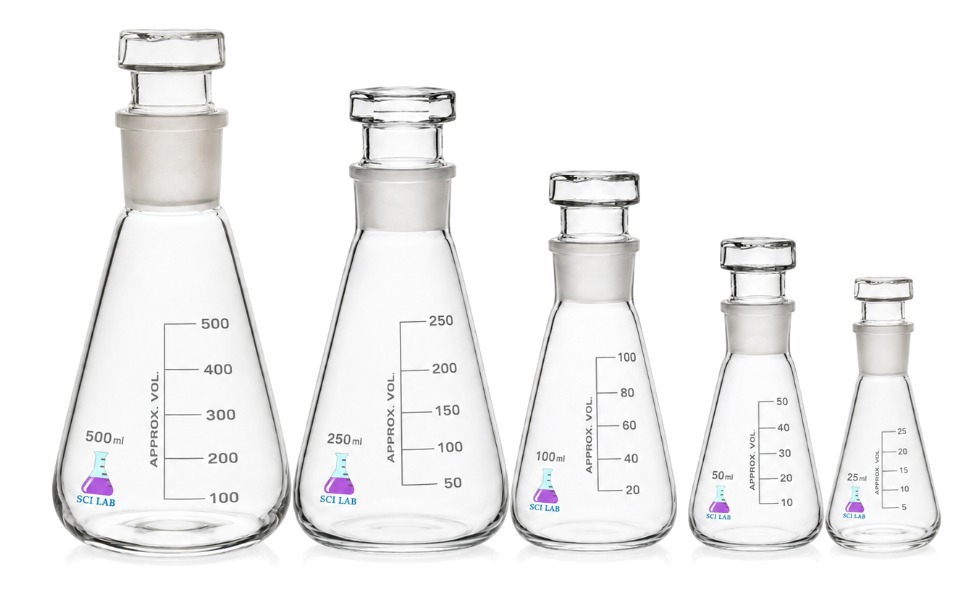
Product Code : SCL-CL-11898
Conical Flask (Erlenmeyer) with Stopper (SKU SCL-CL-11898) is a glass Erlenmeyer flask closed by a ground glass stopper, offered in 25, 50, 100, 250 and 500 ml capacities. Its conical body makes swirling and mixing easy, so it is the standard receiving flask for titrations in school and college chemistry. Science Lab Supplies ships it from Ambala, India to schools, colleges, training institutes, tender contractors and distributors.
Specifications
The flask is made of glass with good chemical resistance and thermal stability. A reinforced beaded rim adds strength and helps clean pouring, printed graduations give an approximate volume, and a marking area lets students label contents. The fitted ground glass stopper closes the neck when solutions must be kept.
| Parameter | Value |
|---|---|
| SKU | SCL-CL-11898 |
| Model no. | SCI/LSS-1587 |
| Also known as | Erlenmeyer flask |
| Capacities | 25 ml, 50 ml, 100 ml, 250 ml, 500 ml |
| Material | Glass |
| Stopper | Ground glass, fixed |
| Rim | Reinforced, beaded |
| Graduations | Printed, approximate volume, with marking area |
| Supplied by | Science Lab Supplies, Ambala, India |
Applications and Experiments for the Erlenmeyer Flask
The Erlenmeyer flask holds a solution while it is swirled, heated gently or titrated, and its narrow neck reduces splashing and evaporation. With the stopper in place it can also store a prepared solution. It is basic glassware for CBSE/NCERT Class 11–12 volumetric analysis and B.Sc. chemistry practicals.
- Class 11–12 titrations: acid–base and redox titrations with a burette above the flask.
- Class 9–10 chemistry: mixing solutions and observing reactions without spills.
- B.Sc. practicals: preparing and storing reagents under a ground glass stopper.
- Biology and microbiology labs: holding culture media or samples in the smaller sizes.
Standard Scope of Supply
Each unit is one glass conical flask with its ground glass stopper, in the capacity you choose from 25 ml to 500 ml. Tell us how many of each size you need; burettes, funnels and other titration glassware are quoted as separate items.
Packing, MOQ and Lead Time
Quotations can be prepared for a handful of flasks or for a mixed set of sizes for every bench in a titration lab. Each one gives the packing, delivery time and price for the sizes and quantities requested, and a burette and funnel can be added to build a titration apparatus set.
Because it holds an Importer-Exporter Code, Science Lab Supplies can ship to buyers in Malaysia, Peru, Egypt, Iraq, Nigeria and Kenya. Put the flasks in the enquiry cart, ask a question on the contact page, or follow the lab tender page for bulk tenders.
Frequently Asked Questions
Which capacities are available?
The flask is offered in 25 ml, 50 ml, 100 ml, 250 ml and 500 ml. The 100 ml and 250 ml sizes are the usual choice for school titrations, while the smaller sizes suit micro-scale work.
Are the graduations accurate enough for measuring?
They give an approximate volume only. For exact volumes, measure with a pipette, burette or volumetric flask and use the conical flask for mixing and titrating.
What type of stopper does it have?
A fixed ground glass stopper, which seals the neck so a prepared solution can be kept closed between practicals.
Who supplies the Conical Flask (Erlenmeyer) with Stopper?
Science Lab Supplies supplies it from Ambala, India, alongside the rest of its laboratory glassware, and can quote single sizes or full titration-lab quantities.
Related Titration Glassware
A conical flask is used with a burette, a funnel for filling and beakers for preparing solutions. These four Chemistry Lab items complete a titration bench and can share a single quotation with the flasks.
- Burette — 50 ml graduated tube with stopcock for titrations.
- Conical Pot (Erlenmeyer) With Emery Stopper 100ml — a 100 ml stoppered alternative.
- Funnel — glass funnel for filling burettes and flasks.
- Beakers — borosilicate beakers for preparing solutions.
Browse the full Chemistry Lab range or all school lab equipment.
Last updated: 25 September 2026


.jpg)