Atomic Orbital Model Pz
Product Code : SCL-CL-11538
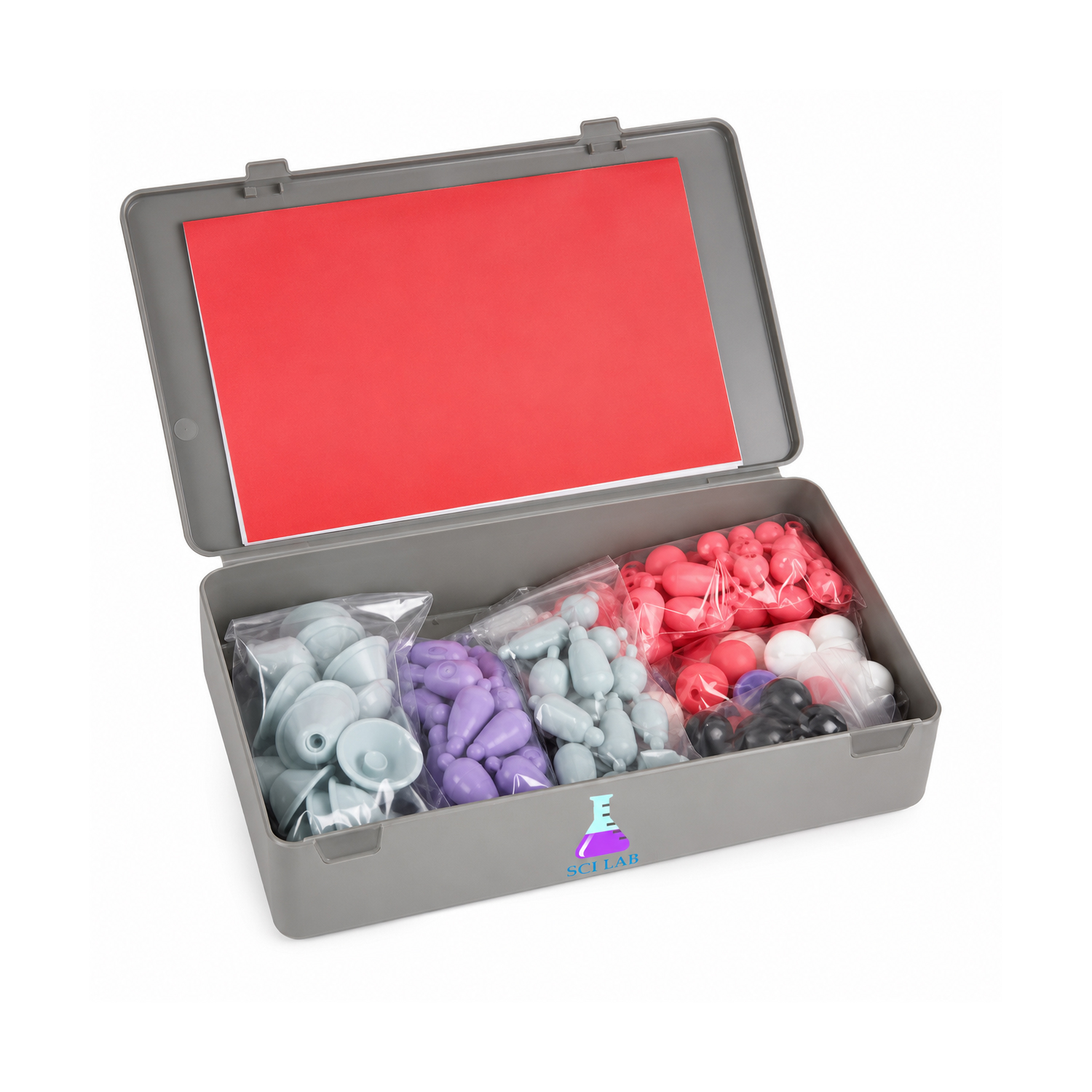
Atomic Orbital Model Pz (SKU SCL-CL-11538) models the pz orbital, the p orbital aligned with the z-axis, usually drawn vertically in textbooks. The kit is assembled from durable plastic parts and links with metal elements, stands on a grey transparent base and packs away in its own plastic storage box. It is aimed at Class 11 and B.Sc. chemistry teaching, and Science Lab Supplies supplies it from Ambala, India to schools, colleges, contractors and distributors.
Specifications
The model is plastic with metal elements, built from durable plastic parts and links. Pieces are colour-coded to national standards for easy identification. A grey transparent base is included for display, and a plastic box keeps the parts together for storage between lessons, which matters in shared laboratories.
| Parameter | Value |
|---|---|
| SKU | SCL-CL-11538 |
| Orbital shown | pz (p orbital along the z-axis) |
| Material | Plastic with metal elements |
| Parts | Durable plastic parts and links for assembly |
| Colour coding | To national standards |
| Base | Grey transparent, for display |
| Storage | Plastic box |
| Supplied by | Science Lab Supplies, Ambala, India |
Applications and Experiments for the Atomic Orbital Model Pz
The pz model is used when explaining orbital orientation and bonding, particularly the head-on overlap along the bond axis that forms sigma bonds and the sideways overlap that forms pi bonds. It fits NCERT Class 11 chemistry chapters on atomic structure and chemical bonding and B.Sc. orbital theory.
- Class 11 chemistry: the three p orbitals and the magnetic quantum number.
- Class 11 bonding: pz overlap in molecular orbital diagrams of diatomic molecules.
- B.Sc. chemistry: unhybridised pz orbitals in sp2 carbon and conjugated systems.
Standard Scope of Supply
You receive the plastic parts and links with metal elements for building the pz orbital model, a grey transparent display base, and a plastic box for storing everything. The px and py models are separate items in the chemistry range.
Packing, MOQ and Lead Time
Single models and larger sets for several departments are quoted alike. The quotation from Science Lab Supplies states the packing, delivery time and price for your quantity, and px, py or hybridisation models, along with other chemistry lab equipment in India, can go on the same list.
As a registered exporter with an Importer-Exporter Code, Science Lab Supplies can ship to buyers in Nepal, Bangladesh, Zambia, Rwanda, South Africa and Qatar. Get in touch through the contact page, use the enquiry cart to list several items, or read the lab tender page before a tender purchase.
Frequently Asked Questions
What is included with the pz model?
The parts and links to assemble the pz orbital model, a grey transparent base for display and a plastic box for storage.
Why is the pz orbital important in bonding lessons?
The pz orbital is commonly taken along the bond axis in simple molecules, so it is used to explain sigma overlap, and in sp2 carbon the unhybridised p orbital forms the pi bond.
Who supplies the Atomic Orbital Model Pz?
It is supplied by Science Lab Supplies from Ambala, India. Schools, colleges and contractors get their quotation directly from the company.
How is it different from the py model?
Both are assembled from plastic parts and links on a grey transparent base. The pz model shows the orbital along the z-axis and its listing also includes a plastic storage box.
Related Orbital Models
These four items complete an orbital teaching set around the pz model: the other two p orbitals, the sp2 hybridisation model that relies on an unhybridised p orbital, and a dynamic model for demonstrating orbitals together.
- Atomic Orbital Model Px — the x-axis p orbital.
- Atomic Orbital Model Py — the y-axis p orbital.
- Orbital Model of Sp2 Hybridization — shows how a p orbital remains beside sp2 orbitals.
- Dynamic Model for Atomic Orbital Demonstration — demonstrates several orbitals in one model.
Browse the full Chemistry Lab range or all school lab equipment.
Last updated: 25 September 2026


.jpg)