Bottles of Dark Glass with Stoppers for Reactants
Product Code : SCL-CL-11904
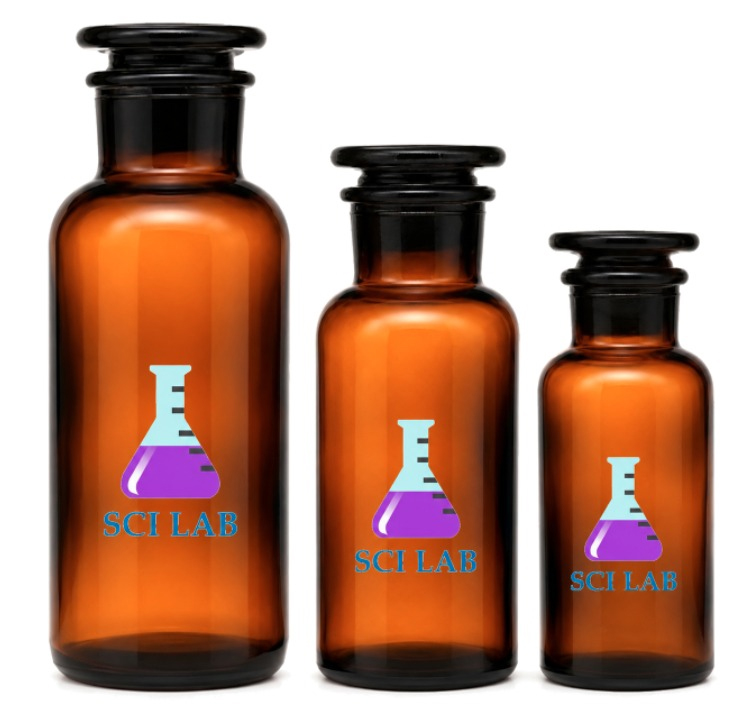
Bottles of Dark Glass with Stoppers for Reactants (SKU SCL-CL-11904) are amber glass reagent bottles with stoppers, made in four sizes: 60, 125, 250 and 500 ml. The dark glass cuts down UV light reaching the contents, so these bottles protect light-sensitive chemicals and solutions in chemistry and research labs. Institutions, tender contractors and distributors can source them through Science Lab Supplies, which supplies them from Ambala, India.
Specifications
Amber-coloured glass reduces UV light transmission, which slows the breakdown of photosensitive reagents. The bottles combine heat- and chemical-resistant construction with a stopper for safe storage, and the four sizes run from a 60 ml dispensing bottle to a 500 ml stock bottle.
| Parameter | Value |
|---|---|
| SKU | SCL-CL-11904 |
| Model no. | SCI/LSS-1608 |
| Capacities | 60 ml, 125 ml, 250 ml, 500 ml |
| Material | Glass, heat- and chemical-resistant |
| Colour | Amber (reduces UV light transmission) |
| Closure | Stopper |
| Supplied by | Science Lab Supplies, Ambala, India |
Applications and Experiments for the Amber Reagent Bottles
Amber bottles keep light-sensitive reagents such as silver nitrate, iodine and potassium permanganate solutions stable for longer than clear glass would. They belong in every CBSE/NCERT Class 11–12 chemistry lab, B.Sc. and M.Sc. practical lab, and in pharmacy or laboratory-technician training rooms.
- Class 11–12 chemistry: storing silver nitrate solution for halide tests.
- Titration work: keeping potassium permanganate or iodine solutions away from light.
- Biology labs: holding iodine solution and some stains used in slide work.
- Pharmacy practicals: storing light-sensitive preparations during a course.
Standard Scope of Supply
Each item is one empty amber glass bottle with its stopper, in 60 ml, 125 ml, 250 ml or 500 ml. Name the sizes and numbers on your enquiry; reagents and labels are not included, and clear-glass bottles can be quoted alongside.
Packing, MOQ and Lead Time
Whether you need a dozen dispensing bottles or a full storage set for a new chemistry lab, the quotation spells out packing, delivery time and price for every size requested. Other laboratory glassware from the same range can be added so everything arrives in one consignment.
Science Lab Supplies has an Importer-Exporter Code and can ship to buyers in Ghana, Ethiopia, Tanzania, Uganda, the UAE and Saudi Arabia. Science Lab Supplies is registered for GST (GSTIN 06ADEPJ0574F2ZU). For tenders, see the lab tender page; for routine orders, use the enquiry cart or the contact page.
Frequently Asked Questions
Why are these bottles dark?
The amber glass reduces UV light transmission, which protects light-sensitive liquids and chemicals from decomposing while they are stored.
Which sizes can be ordered?
Four sizes: 60 ml, 125 ml, 250 ml and 500 ml. Smaller bottles suit bench dispensing, the larger ones stock solutions.
How do these differ from the clear reagent bottles?
The clear version comes in 100 ml and 500 ml and lets you see the contents; this amber version adds light protection and offers four sizes from 60 ml upwards.
Who is the supplier of these amber bottles?
Science Lab Supplies supplies them from Ambala, India, and can combine them with its other glassware for school, college and tender orders.
Related Amber and Reagent Bottles
Light-sensitive reagents may need dropper bottles and wide-mouth bottles as well as narrow-neck bottles, and stable reagents can go in clear glass. These four Chemistry Lab items round out a storage shelf and can be quoted with the amber bottles.
- Bottles of Colorless Glass with Stoppers for Reactants — clear 100 and 500 ml bottles.
- Glass Bottle, for Liquid Reagents (Amber) — amber glass for liquid reagents.
- Glass Bottle, with Dropper (Amber) — for dispensing indicators drop by drop.
- Glass Bottle, Wide Mouth (Amber) — 60 ml amber wide-mouth bottle with a frosted cap for liquid reagents.
Browse the full Chemistry Lab range or all school lab equipment.
Last updated: 25 September 2026

.jpg)