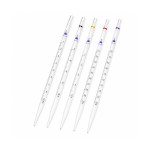
Graduated Glass Pipette, 10 mL, 0.1 mL Divisions
.jpg)
Product Code : SCL-LG-11996
The Graduated Glass Pipette, 10 mL, 0.1 mL Divisions is a borosilicate 3.3 glass measuring pipette for transferring variable volumes of liquid up to 10 mL, read on a scale divided in 0.1 mL. Permanent amber graduations are fired into the glass, a colour band at the top marks the size, and the pipette is calibrated to deliver within Class A/AS limits of ±0.05 mL at 20 °C.
Specifications of the 10 mL Graduated Pipette
| Specification | Value |
|---|---|
| Capacity | 10 mL nominal |
| Graduation interval | 0.1 mL |
| Material | Borosilicate 3.3 glass |
| Graduations | Permanent amber, fired into the glass |
| Accuracy | Class A/AS: ±0.05 mL at 20 °C, calibrated to deliver (TD, Ex) |
| Tip | Tapered, ground and polished delivery tip |
| Identification | Colour band at the top |
| Sterilisation | Can be autoclaved |
| Pack | One pipette; a five-pipette educational pack with a guide is a separate option |
| Manufacturer | Science Lab Supplies, Saha, Ambala, India |
Measuring Part Volumes with the 10 mL Graduated Pipette
Draw the liquid just above the zero line with a filler, wipe the outside of the tip and set the meniscus on zero at eye level. Run out the volume needed against the wall of the receiving vessel and read the new level on the 0.1 mL scale.
- Rate of reaction (Class 10 and 12): run 10, 8, 6 and 4 mL of Sodium Thiosulphate solution into separate flasks, make each up to 10 mL with water from a second pipette, then add acid and time how long the cloudiness takes to hide a cross.
- Equal reagent doses: add the same measured volume, such as 2.5 mL, of a reagent or catalyst solution to every group's test tube, so results can be compared fairly.
- Serial dilution: run 9.0 mL of diluent into each of a row of Test Tubes, then carry 1.0 mL along the row for 1 in 10 steps, mixing each tube and using a fresh pipette each time.
Fill only with a Pipette Filler Bulb or pump, never by mouth, and store the pipette in a Pipette Holder so the fine tip is protected.
Frequently Asked Questions
When is a glass graduated pipette chosen over a micropipette?
A 10 mL glass pipette suits millilitre volumes in labs that wash, autoclave and reuse glassware, with no disposable tips needed. A micropipette with tips is the better tool for microlitre volumes and avoids carry-over, so many labs keep both.
Can the pipette be autoclaved?
Yes. The borosilicate 3.3 glass takes repeated steam sterilisation. Clean it first so no residue bakes on, autoclave it wrapped or in a pipette can, and let it cool and dry before use.
Why is a fresh pipette used for each dilution step?
Liquid clinging inside a used pipette carries cells or solute from the stronger tube into the next one. That carry-over makes later dilutions too strong and colony counts too high, so change pipettes at every step.
Why is each dilution tube mixed before the next transfer?
Liquid just run into a tube lies as a layer and does not spread through the diluent at once. Without mixing, the next 1 mL drawn is too strong or too weak, and every later tube carries the error. Shake or roll each tube well before the next transfer.
Related Pipettes and Droppers
- Graduated Pipettes 2ml: clear graduated glass pipette, 2 mL.
- Graduated Pipettes 5ml: clear graduated glass pipette, 5 mL.
- Graduated Pipette, 10 ml: clear glass measuring pipette, 10 mL nominal, chemical and heat resistant.
- Graduated Pipettes 25ml: graduated glass pipette with a 25 mL capacity.
- Graduated Pipettes, 2 ml, 5 ml and 10 ml: graduated glass pipettes 350 mm long.
- Glass Dropper Pipette 6 inch (150 mm): tapered glass tube with a rubber bulb for drop-by-drop transfer.
- Calibrated Plastic Droppers: transparent plastic droppers in 0.5, 1 and 5 mL.
Measuring and one-mark pipettes sit together in Lab Glassware, while the Chemistry Lab section holds the titration and dilution apparatus used alongside them.
The 10 mL graduated pipette is available to laboratories in the UAE, Saudi Arabia, Oman, the Philippines, Nepal and Bangladesh through export under the Importer-Exporter Code held by Science Lab Supplies. To get a quotation, enquire from the contact page or the enquiry cart.
Last updated: 26 November 2026
.jpg)
.jpg)
.jpg)
.jpg)
.jpg)