
BOD Bottle 300ml
.jpg)
Product Code : SCL-LG-12003
The BOD Bottle 300ml is a colourless borosilicate glass bottle of 300 mL nominal capacity with a matched ground-glass pennyhead stopper. It holds a water or wastewater sample for biochemical oxygen demand (BOD) and dissolved oxygen tests, and is filled to the brim and stoppered with no trapped air before the oxygen in the sample is measured.
Specifications of the BOD Bottle
| Specification | Value |
|---|---|
| Nominal capacity | 300 mL |
| Material | Colourless Type I borosilicate glass |
| Stopper | Matched ground-glass pennyhead stopper, included |
| Size | About 70 mm outside diameter, 150 to 170 mm high with the stopper |
| Marking | Unnumbered |
| Main use | Biochemical oxygen demand (BOD) testing |
| Further use | Dissolved oxygen and water-quality analysis |
| Samples | Water, wastewater and effluent, as the chosen test method allows |
| Contents | 1 bottle with its stopper |
| Manufacturer | Science Lab Supplies, Saha, Ambala, India |
Running a BOD Test with the 300 mL Bottle
Two bottles are filled with the same sample. The dissolved oxygen in one is measured at once; the other is closed, kept in the dark and measured after the incubation period. The fall in oxygen between the two readings is the oxygen used by microbes breaking down organic matter. 300 mL is the nominal size; where a method calls for it, calculations use the measured volume of each bottle.
- Five-day BOD of pond or river water (college and environmental science): incubate the second bottle at 20 °C in an Incubator 32 L, up to 80 C and compare it with the first reading.
- Winkler dissolved oxygen (Class 11 and 12): fix the oxygen with Manganese Sulphate and alkaline iodide, acidify, then titrate the freed iodine with Sodium Thiosulphate solution using starch near the end.
- Pollution comparison: test tap water, pond water and a diluted wastewater sample side by side and rank them by oxygen demand.
Handle wastewater as possibly contaminated, wear gloves and eye protection with the Winkler reagents, and wash hands after the test.
Frequently Asked Questions
Which closure details should be checked on a BOD bottle order?
Each bottle comes with its own matched ground-glass pennyhead stopper, which closes the full bottle without trapping air. Keep every stopper with its bottle, and never use an ordinary screw-cap reagent bottle in its place, as it does not keep air out in the same way during incubation.
Why are BOD bottles often numbered or given a marking spot?
A BOD run uses many identical bottles at once, including blanks and several dilutions. A number or a writable spot keeps every bottle matched to its sample and readings over the five days. This bottle comes unnumbered, so use waterproof labels that survive the incubator; numbered sets are a separate variant.
What glass is the BOD bottle made of?
It is colourless Type I borosilicate glass, which resists the test reagents and repeated washing and lets the sample be checked for trapped bubbles. With its stopper the bottle is about 70 mm across and 150 to 170 mm tall, so check that size against incubator shelves and racks.
How is the bottle filled without trapping air?
Run the sample gently down the inside wall, or through a tube reaching the bottom, and let it overflow. Tap the sides to free any bubbles, then close the bottle so no air pocket is left under the closure.
Why is the bottle kept in the dark at 20 °C for five days?
Darkness stops algae in the sample from making oxygen by photosynthesis, which would hide the oxygen used by microbes. A fixed temperature and a fixed time make results from different samples and laboratories comparable.
Why is a polluted sample diluted before it goes into the bottle?
A strong sample can use up all the dissolved oxygen before the five days end, leaving no final value. Mixing it with aerated dilution water keeps some oxygen left at the end, and the result is then multiplied back by the dilution factor.
Related Glassware for Water Analysis
- Iodine Flask: thick-walled borosilicate flask with a stoppered ground joint, in 250 and 500 ml.
- Volumetric Flask: 100 ml Class A flask calibrated to contain at 20 °C.
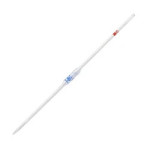
- Volumetric Pipette, Amber-Stain Marked, 5-50 ml: fixed-volume borosilicate pipettes in five capacities.
- Borosilicate Conical Flask: clear borosilicate flask with a flat base and a narrow neck.
- Amber Glass Reagent Bottles with Stoppers, 60-500 ml: amber glass in 60, 125, 250 and 500 ml sizes.
Sample bottles and other vessels for water testing are listed in Lab Glassware; reagents and titration apparatus are in the Chemistry Lab section.
Water-testing laboratories in Rwanda, South Africa, Qatar, Sri Lanka, Vietnam and Malaysia can receive BOD bottles from Science Lab Supplies, which exports under its Importer-Exporter Code. Bottle quantities for a quotation can be sent from the contact page or collected in the enquiry cart.
Last updated: 20 November 2026
.jpg)
.jpg)

.jpg)
.jpg)