Optics Kit
Product Code : SCL-PL-11843
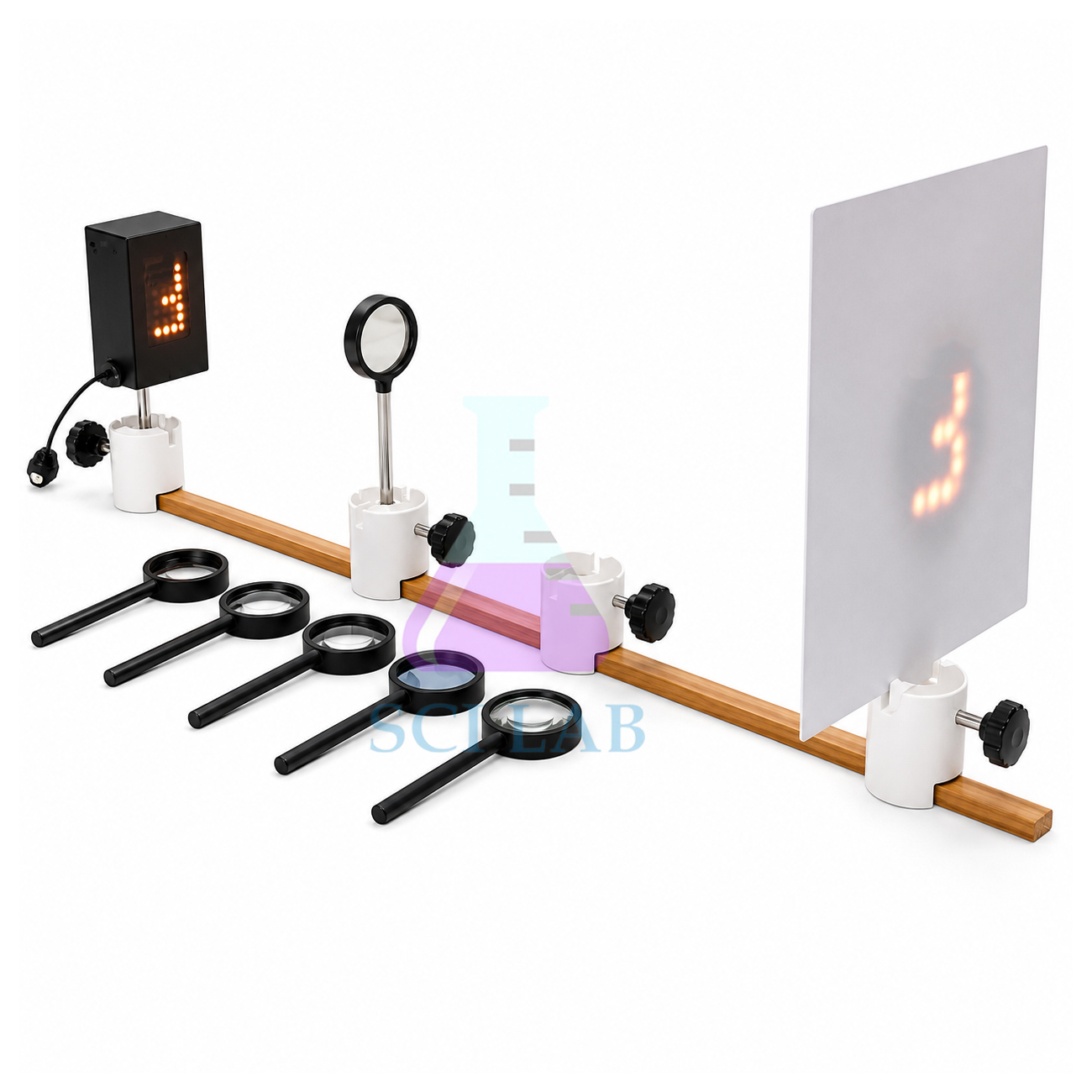
Optics Kit (SKU SCL-PL-11843) is a school optics collection built around a 2 m wooden optical bench, with a prism, lenses, mirrors, a colour disc, an eye model, a magnifier and a digital light sensor that links to a smartboard. It covers light topics from middle school to Class 12 physics. Schools, colleges, training institutes, tender contractors and distributors can obtain it from Science Lab Supplies, which supplies it from Ambala, India.
Specifications
Beside the 2 m bench, the kit includes plano-concave and plano-convex lenses, a 50 x 20 mm parallel-faced glass plate, flat and curved mirrors of 100 mm diameter and f = 65 mm, a glass prism and a 4x magnifier. The light sensor reads 0–2000 lux and 0–30,000 lux.
| Parameter | Value |
|---|---|
| SKU | SCL-PL-11843 |
| Optical bench | Wooden, 2 m |
| Light sensor | 0–2000 lux / 0–30,000 lux; resolution 0.5 lux / 10 lux; over 1000 measurements per second; smartboard connection, touchscreen control |
| Lenses and plate | Plano-concave lens; plano-convex lens; parallel-faced glass plate, 50 x 20 mm |
| Mirrors | Flat mirror; concave glass mirror; f = 65 mm, 100 mm diameter |
| Other items | Glass prism; rotating colour disc for white light; eye model on 320 x 180 mm base; 4x magnifying glass; power source |
| Supplied by | Science Lab Supplies, Ambala, India |
Applications and Experiments for the Optics Kit
On the optical bench students locate images formed by the lenses and mirrors and find focal lengths. The prism splits white light and the spinning colour disc recombines it, the eye model shows sight defects and their correction, and the lux sensor adds measured light intensity.
- Class 7–8 science: light, mirrors, lenses and the colours of white light.
- Class 10 science: spherical mirrors, lenses, dispersion by a prism and the human eye.
- Class 12 physics: ray optics, focal length of mirrors and lenses on an optical bench.
Standard Scope of Supply
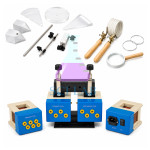
The kit contains the light sensor, a power source, a glass prism, plano-concave and plano-convex lenses, the 50 x 20 mm glass plate, flat and concave mirrors, the 2 m wooden optical bench, the colour disc, the eye model on its base, a 4x magnifying glass and an instruction manual.
Packing, MOQ and Lead Time
You can ask for one kit or a set for each optics bench in a laboratory. The quotation spells out packing, delivery time and price for that number, and further optics lab equipment for schools can be priced together with it.
With an Importer-Exporter Code in place, Science Lab Supplies can ship to buyers in Saudi Arabia, Oman, the Philippines, Nepal, Bangladesh and Zambia. The contact page and the enquiry cart both reach our sales desk, while the lab tender page covers tender enquiries.
Frequently Asked Questions
How long is the optical bench in this Optics Kit?
The kit includes a 2 m wooden optical bench, long enough to set up object, lens and screen at a wide range of distances.
What does the light sensor add?
It measures illuminance in 0–2000 lux and 0–30,000 lux ranges at over 1000 readings per second and displays results on a smartboard, so light intensity can be recorded as data.
Who supplies this optics kit?
Science Lab Supplies provides it from Ambala, India, and sends a quotation with packing and delivery details to schools, colleges and tender buyers.
How is it different from Optics Kit SCL-PL-11844?
That kit is a lens-and-mirror bench set with 5 cm optics and a 100 cm metre ruler; this one adds a lux sensor, prism, colour disc and eye model.
Related Optics Equipment
These Physics Lab items build on the same optics lessons: a second optics kit, a colour disc, a compact bench kit and an introductory optics system. Teachers can mix them to equip several benches and request them all on one quotation.
- Optics Kit (SCL-PL-11844) — 5 cm lenses and mirrors with metre ruler.
- Newton’s Colour Disc — recombining the colours of white light.
- Compact Optical Bench Kit — a smaller bench kit.
- Introductory Optics System — an entry-level optics system.
Browse the full Physics Lab range or all physics lab equipment.
Last updated: 25 September 2026