
Newton's Ring Apparatus
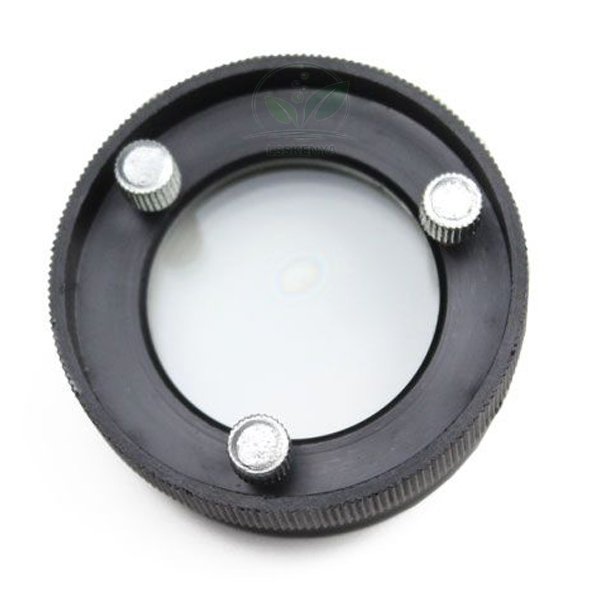
Product Code : LSK-LAO-11150
Newton's Ring Apparatus (SKU LSK-LAO-11150) is a plano-convex lens resting on a flat glass plate, both held in a plastic frame, so that the thin air film between them produces Newton’s rings in reflected light. Three thumbscrews set the pressure between lens and plate. It serves interference practicals in B.Sc. physics, engineering physics and senior school optics. Science Lab Supplies builds the apparatus in its Ambala factory at Plot 448, HSIIDC Industrial Area, Saha, India, and manufactures it for direct supply to colleges, schools, tender contractors and distributors.
Specifications
The Newton’s rings unit is described point by point in the table below. In short, a plano-convex lens sits on a flat glass plate inside a plastic frame, and three thumbscrews let the user adjust the contact pressure so that a clear, centred ring pattern forms.
| Specification | Value |
|---|---|
| SKU | LSK-LAO-11150 |
| Upper element | Plano-convex lens |
| Lower element | Flat glass plate |
| Frame | Plastic frame holding lens and plate together |
| Pressure adjustment | Three thumbscrews |
| Phenomenon shown | Interference rings from the air film between lens and plate |
| Manufacturer | Science Lab Supplies, Saha, Ambala, Haryana |
| Country of origin | India |
Applications and Experiments for the Newton's Ring Apparatus
The apparatus is used to observe interference in a wedge-shaped air film and to make quantitative measurements from the ring diameters. It is a standard item in B.Sc. and B.Tech physics labs and is also used to show thin-film interference in Class 12 wave optics.
- B.Sc. practical: wavelength of sodium light from the diameters of successive dark rings.
- B.Sc. and B.Tech: radius of curvature of the plano-convex lens when the wavelength is known.
- Refractive index of a liquid placed in the gap between lens and plate, compared with the air-film rings.
- Class 12 wave optics: thin-film interference shown beside Young’s fringes from the Adjustable Double Slit Interference Apparatus and spectra from Diffraction Gratings with Holder.
Tighten the thumbscrews only lightly: too much pressure can strain the glass and distort the rings.
Standard Scope of Supply
The apparatus is supplied as one unit: the plano-convex lens and flat glass plate assembled in the plastic frame with three pressure thumbscrews. A monochromatic light source, a 45-degree glass reflector and a travelling microscope for reading ring diameters are separate items and are not included.
Packing, MOQ and Lead Time
Quotes are available for a single apparatus or for enough units to run Newton’s rings at every bench of an optics lab. Science Lab Supplies sets out the packing, delivery time and price for that quantity on the quotation, and other wave-optics items can be listed alongside.
Holding an Importer-Exporter Code, Science Lab Supplies is able to ship to buyers in Malaysia, Peru, Egypt, Iraq, Nigeria and Kenya. Laboratories planning an interference bench can reach us via the contact page, save their picks in the enquiry cart, or submit tender papers through the lab tender page.
Frequently Asked Questions
How does the Newton's Ring Apparatus produce the rings?
Light reflected from the top and bottom of the thin air film between the curved lens and the flat plate interferes. Because the film thickness grows outwards from the contact point, bright and dark circles form around it.
What are the three thumbscrews for?
They adjust the pressure between the plano-convex lens and the glass plate. Light, even pressure gives a sharp, central dark spot and concentric rings; uneven pressure shifts or distorts the pattern.
What else is needed to measure wavelength?
A monochromatic source such as a sodium lamp, a glass plate at 45 degrees to send light down onto the lens, and a travelling microscope to measure ring diameters. These can be quoted separately on request.
Is the apparatus made in-house or sourced from a trader?
It is made in-house. Science Lab Supplies assembles the Newton’s rings unit at its factory in Saha, Ambala, India, so colleges and contractors negotiate directly with the people who build it.
Related Wave Optics Apparatus
These items cover the rest of an interference, diffraction and spectroscopy bench: a laser demonstration kit, a wave-optics experiment set, a spectrometer with its prism, a reference convex lens and polarising filters, all of which can be added to the same quotation as the Newton’s rings unit.
- Diffraction and Interference Study Kit - Teacher's Demonstration Model — 650 nm Class II 1 mW laser on a 10 mm rod with a magnetic base plate.
- Optics Set OW1, Wave Optics — a selection of 14 wave-optics experiments stored in a foam-fitted case.
- Laboratory Spectrometer — 150 mm vernier circle reading to 1 arcminute, with an 8x telescope.
- Spectrometer Prism Separates Light — equilateral flint glass prism with 32 mm faces and a 1.62 nominal index.
- Convex Lens 50mm — crown glass biconvex lens with 60/40 scratch-dig surfaces.
- Polarizing Filters — linear polarisers in 35 mm square frames for visible and near-infrared light.
Browse the full Light and Optics range, the Physics Lab range for wave-optics sets, or all physics lab equipment.
Last updated: 9 October 2026


 (1).jpg)
.jpg)
.jpg)
.jpg)

 (1).png)