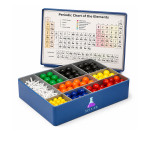
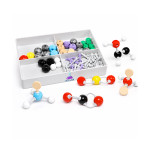
Elements, Compounds and Mixtures Kit
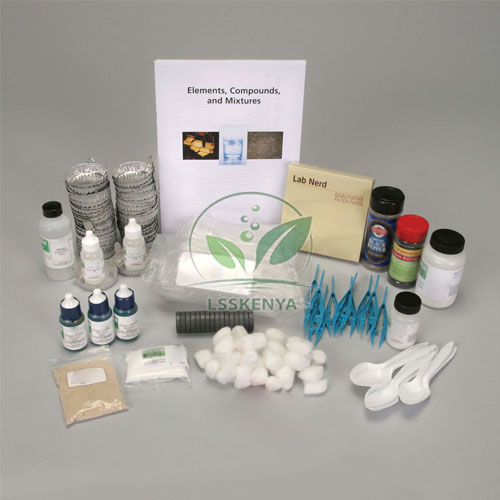
Product Code : LSK-CL-10063
The Elements, Compounds and Mixtures Kit is a study unit in which students investigate the three kinds of matter, with the focus on how new compounds form in chemical reactions. They watch for precipitates, colour changes and gases. Worksheets are included, and the experiments can be repeated twice.
Specifications of the Elements, Compounds and Mixtures Kit
| Specification | Value |
|---|---|
| Topic | Elements, compounds and mixtures, with emphasis on new compounds formed in reactions |
| Observations | Formation of precipitates, colour changes, production of gases |
| Repeats | Experiments can be repeated twice |
| Included | Worksheets |
| Supplied by | Science Lab Supplies, Ambala, India |
Investigating Elements, Compounds and Mixtures
Students mix the reagents named on the worksheet in small amounts, record what they see, and decide whether a new substance has formed. The worksheet then asks them to classify each material.
- Precipitate test: mix two clear solutions, watch a solid form, then separate it on Filter Paper to show it is a new substance.
- Colour change and gas: note any colour change or bubbles and link each sign to a chemical change.
- Mixture or compound: as a follow-on demonstration, pull iron filings out of an iron and sulfur mixture with a Horseshoe Shaped Magnet. After heating, the compound formed no longer responds the same way.
Common errors: calling dissolving a chemical change, and using too much reagent so the colour change is hard to see.
Frequently Asked Questions
How can students tell an element, a compound and a mixture apart?
An element has one kind of atom. A compound has two or more elements joined chemically in a fixed ratio. A mixture is a physical blend whose parts keep their own properties.
What are the signs that a chemical change has happened?
A precipitate forms, the colour changes, a gas is given off, or the temperature changes. These signs show a new substance has formed, which is the focus of this kit.
Can a mixture be separated without a chemical reaction?
Yes. Mixtures separate by physical methods such as filtration, evaporation, magnetism or distillation. A compound can only be broken down by a chemical reaction.
Why does a compound have a fixed composition?
Its atoms join in a set ratio, so water is always H2O. A mixture such as air or salt water can have any ratio of its parts.
Which syllabus topics does the kit support?
It supports school chemistry units on elements, compounds and mixtures. Students see precipitates form, colours change and gases given off, and use these signs to judge when a new compound has formed in a reaction. Worksheets are included, and the experiments can be repeated twice.
What should an importer check for the chemicals in the kit?
Chemical kits are normally handled with a safety data sheet for each chemical. Some countries also limit which chemicals schools may hold or how they are shipped, so check the local school and transport rules against the chemical list before ordering.
Related Separation and Chemistry Charts
- Methods of Separation of Substances: laminated wall chart, 500 x 350 mm.
- Chemical Symbols and Formulas: laminated wall chart, 70 cm x 100 cm.
- Glass Funnel, 75 mm, Short Stem: short-tail glass funnel, 75 mm diameter.
- Glass Crystallizing Dish, 180 x 90 mm: glass dish, 180 mm diameter and 90 mm high, with grip.
- Test Tube with L-Shaped Delivery Tube: 18 mm test tube, 150 mm long, with an L-shaped glass tube and holed stopper.
Other student chemistry kits are listed in the Chemistry Lab range, one section of School Lab Equipments.
Science Lab Supplies can export this study kit to the Philippines, Nepal, Bangladesh, Zambia, Rwanda and South Africa, trading under an Importer-Exporter Code. Ask Science Lab Supplies for a quotation on this kit using the contact page or the enquiry cart.
Last updated: 15 November 2026