
Distillation Apparatus, 500 ml Flask, 19/26 Joints
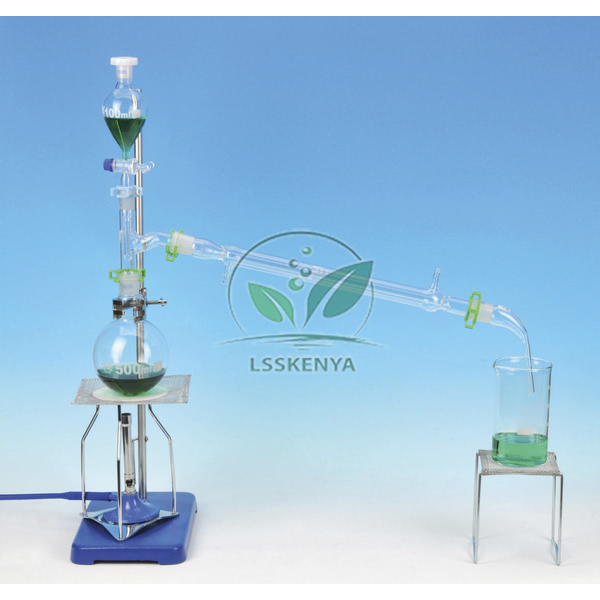
Product Code : LSK-CL-10240
The Distillation Apparatus is a borosilicate glass set for simple distillation, with 19/26 joints. It has a 500 ml round-bottom boiling flask, still head, Liebig condenser and receiver adapter, plus a separating funnel with stopper. Stands, beaker, burner and tripod are not included.
Specifications of the Distillation Apparatus
| Specification | Value |
|---|---|
| Material | Borosilicate glass |
| Joint size | 19/26 |
| Boiling flask | Round-bottom, 500 ml |
| Distillation parts | Still head, Liebig condenser, receiver adapter |
| Also included | Separating funnel with stopper |
| Not included | Glass beaker, metal stands, retort stand, burner and tripod |
| Supplied by | Science Lab Supplies, Ambala, India |
Simple Distillation with the Glass Set
The flask is clamped above the heat source with the still head on top. Vapour passes into the condenser, cools and drips through the receiver adapter into a collecting vessel. A thermometer in the still head reads the vapour temperature.
Clamp the flask and condenser to a Laboratory Retort Stand with a Three Prong Glassware Holding Clamp.
- Pure water from salt water (Class 9–10): heat the solution in the 500 ml flask on a Flask Heating Mantle, collect the distillate and show that the salt stays behind.
- Boiling point of a liquid: record the steady vapour temperature with an alcohol thermometer from Laboratory Thermometers while the distillate drips.
- Immiscible liquids: use the separating funnel to split an oil and water mixture, then distil the water layer.
Common errors: filling the flask more than half full, leaving out anti-bumping granules, running condenser water in at the top and heating a closed system. Never boil the flask dry.
Frequently Asked Questions
Which way should the condenser water flow?
Connect the cold water to the lower inlet and let it leave from the upper outlet. The jacket then stays full of water and cools the vapour along its whole length.
Where should the thermometer bulb sit?
Place the bulb just below the side arm of the still head, where the vapour turns toward the condenser. Higher or lower positions give readings that do not match the boiling point of the distillate.
Should the 19/26 joints be greased?
A very thin smear on the upper part of each cone stops the joints sticking or leaking vapour. Too much grease spreads into the flask and the distillate. Wipe the grease off before washing the glass.
How full should the 500 ml flask be?
Fill it between one-third and one-half full, so about 170 to 250 ml. A fuller flask can boil over into the condenser and spoil the distillate.
Why add anti-bumping granules?
Liquids can overheat and then boil in a sudden burst, called bumping. A few porous granules give small bubbles a place to form, so boiling stays smooth. Add them before heating, never to hot liquid.
What else is needed to run the set?
You need a retort stand with clamps, a heat source such as a burner with tripod and gauze or a flask heater, a thermometer, rubber tubing for the condenser water and a beaker or flask to collect the distillate.
Related Distillation Glassware
- Fractional Distillation Assembly: 250 ml boiling flask, Vigreux column and four 19/26 joint clips.
- Liebig Condenser: borosilicate condenser with a narrow 200 mm jacket.
- Distillation Apparatus, Ground-Joint Set: borosilicate distillation set that includes a fractionating column.
- Apparatus for Distilling Liquids: 250 ml distillation flask with side arm and a 300 mm straight condenser.
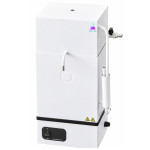
- Distiller for Distilled Water: electric distiller giving 1–2 litres per hour.
Browse the Chemistry Lab range or the wider school lab equipment section.
Science Lab Supplies holds an Importer-Exporter Code and can ship to buyers in Nepal, Bangladesh, Zambia, Rwanda, South Africa and Qatar. For a quotation, use the contact page or the enquiry cart.
Last updated: 14 November 2026

.jpg)


.jpg)