Demonstration Faraday Rage
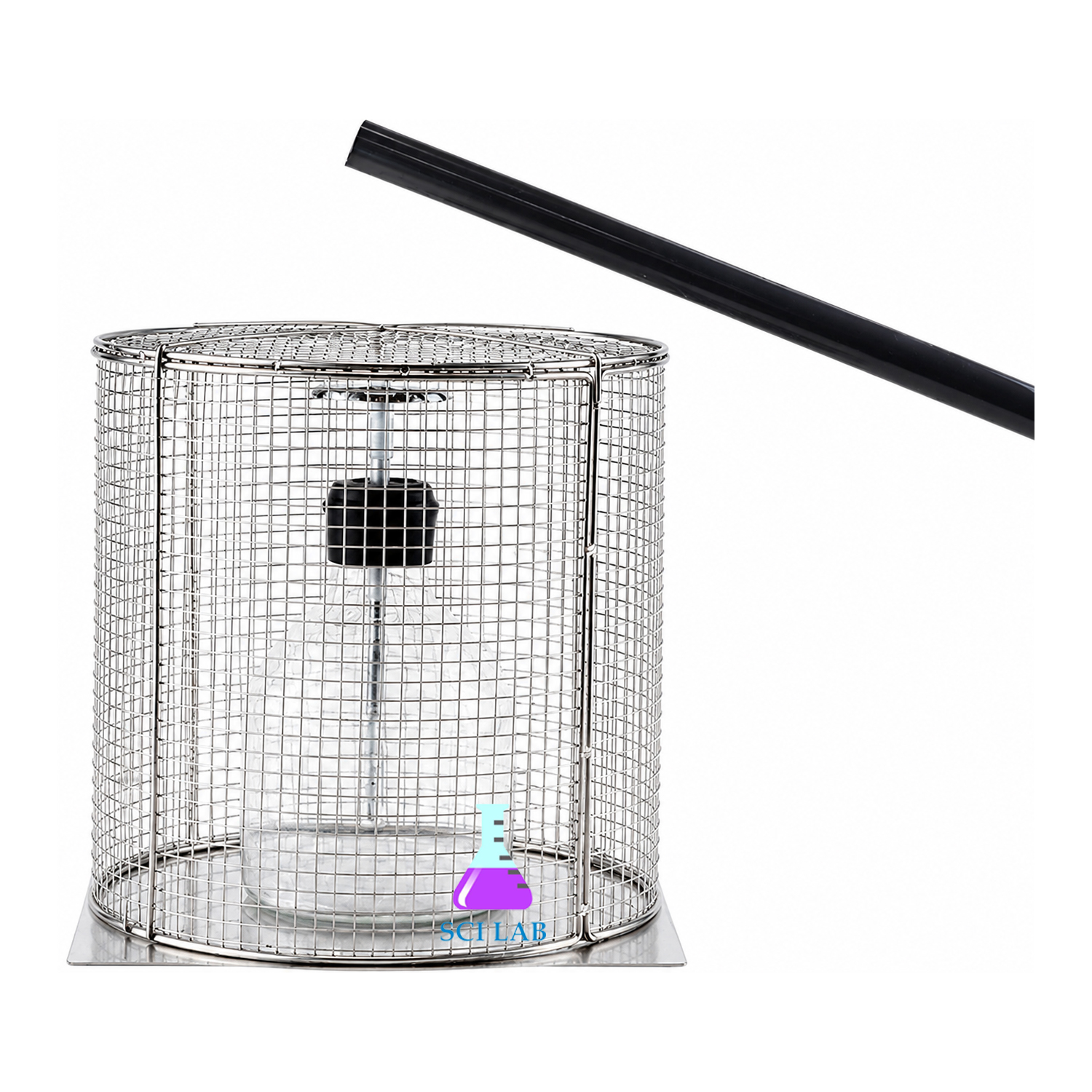
Product Code : SCL-CL-11892
Demonstration Faraday Rage (SKU SCL-CL-11892) is a demonstration Faraday cage: a cylindrical mesh body on a flat bottom plate that shows how a conducting enclosure blocks external electric fields from its interior. It suits electrostatics lessons in school science labs and college physics. Science Lab Supplies arranges supply from Ambala, India, pricing one cage or several for schools, colleges, training institutes, contractors and distributors.
Specifications
The demonstration Faraday cage's details fill the table below, one per row. In short, a cylindrical mesh body stands on a flat bottom plate; charge placed on the conducting mesh stays on its outer surface, so the space inside is shielded from external electric fields, the effect the apparatus is designed to show.
| Specification | Value |
|---|---|
| SKU | SCL-CL-11892 |
| Also known as | Faraday cage (demonstration) |
| Body | Cylindrical mesh |
| Base | Flat bottom plate |
| Demonstrates | Electrostatic shielding |
| Function | Blocks external electric fields from the interior |
| Application | Educational demonstrations in school science labs |
| Supplied by | Science Lab Supplies, Ambala, India |
Applications and Experiments for the Faraday Cage
A demonstration Faraday cage shows that charge resides on the outer surface of a conductor and that the field inside a closed conductor is zero. It supports CBSE/NCERT Class 12 physics (electric charges and fields; electrostatic shielding), B.Sc. electrostatics and school science club work on why cars and aircraft protect occupants from lightning.
- Class 12 physics: demonstrating electrostatic shielding inside a conductor.
- Showing with an electroscope that charge collects on the outside of the mesh.
- Charging the cage from the glass and ebonite rods of the Electrostatics Friction Rods Set, rubbed with its silk and synthetic-fur cloths.
- Explaining why a car body or shielded cable blocks external electric fields.
- B.Sc. electrostatics: introducing Gauss's law applied to conductors.
A rubbed rod is enough to charge the cage; where an electrostatic generator is used, the teacher should run it, keep students clear of the terminals and discharge the dome afterwards with a 10 cm stainless steel Discharge Sphere.
Standard Scope of Supply
The item is supplied as the cylindrical mesh body with its flat bottom plate. Charging rods, an electroscope or an electrostatic generator can be quoted with it, so the complete shielding demonstration for the class is priced on a single document.
Packing, MOQ and Lead Time
You can request one cage for a demonstration or several for group practicals, and the quotation will state the packing, delivery time and price for that quantity. Electroscopes and rubbing rods can be added to the same document for one combined order.
With an Importer-Exporter Code, Science Lab Supplies can ship to buyers in Zambia, Rwanda, South Africa, Qatar, Sri Lanka and Vietnam. Science Lab Supplies is registered for GST (GSTIN 06ADEPJ0574F2ZU). To build an electrostatics order around the cage, send your list via the contact page, collect the parts in the enquiry cart, or read the lab tender page for tender rules.
Frequently Asked Questions
What is this Faraday cage used to demonstrate?
It demonstrates electrostatic shielding: the conducting mesh keeps external electric fields out, so the space inside stays field-free while charge sits on the outer surface.
What parts make up the cage?
It consists of a cylindrical mesh body and a flat bottom plate. Charging and detecting equipment, such as rods and an electroscope, can be added to the same quotation.
Who supplies the Demonstration Faraday Rage?
The cage is quoted by Science Lab Supplies, Ambala, India, for schools, colleges and contractors fitting out physics rooms, and electroscopes, rubbing rods or a generator can join it on one quotation.
Which class level is it suitable for?
It suits Class 12 physics electrostatics and undergraduate practicals, and it can also serve science club demonstrations in secondary schools, where the shielding effect can be shown with an electroscope placed inside and outside the mesh.
Related Electrostatics Equipment
A Faraday cage needs a way to create and detect charge. These Chemistry Lab and Physics Lab items supply the charge, detect it and extend the lesson to charge distribution, completing an electrostatics bench for Class 12 and college demonstrations on one quotation.
- Electroscope — sheet metal case on an insulated base with sliding glass panels, a disc electrode and an earthing terminal.
- Ebonite Rod — rod with its own rubbing cloth for charging by friction and use with an electroscope.
- Glass Rod with Rubbing Material — glass rod and cloth; rubbing leaves the rod positively charged.
- Van De Graaff Generator — motor-driven belt charges a conducting sphere; comes with an accessory kit and dust cover.
- Wimshurst Machine — 200 mm plates and two Leyden jars, sparks up to 50 mm in air, no electrical power needed.
- Electrostatics Apparatus Set — 30 mm conducting spheres, electrode vessels, a paper-strip rod, bells and chains.
- Apparatus for Distributing Electric Charges — four metal spheres on insulating handles with a 200 mm gold leaf electroscope.
Browse the full Chemistry Lab range, the Physics Lab range, or all school lab equipment.
Last updated: 9 October 2026


.jpg)