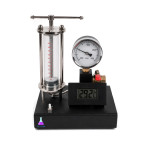
Charles's Law Apparatus (Combined)

Product Code : LSK-POM-11200
The Charles's Law Apparatus (Combined), also called Jolly's apparatus, shows that the pressure of a fixed mass of air rises with temperature when its volume is kept constant. An air bulb is joined by rubber tubing to a sliding mercury reservoir on a wooden stand with a 0–100 cm metre rule.
Specifications of the Jolly's Apparatus
| Specification | Value |
|---|---|
| Gas vessel | Jolly's air bulb |
| Reservoir | Glass mercury reservoir on a sliding bracket |
| Connection | Flexible rubber tubing |
| Stand and base | Polished wooden stand, heavy cast metal base with levelling screw |
| Scale | Metre rule, 0–100 cm, 1 mm divisions, numbered both ways |
| Mercury | Supplied without mercury |
| Manufacturer | Science Lab Supplies, Saha, Ambala, India |
Gas-Law Practicals with Jolly's Apparatus
The air bulb sits in a water bath. At each temperature the reservoir is raised until the mercury returns to a fixed mark, so the air volume stays the same. The difference in mercury levels on the scale, added to the room pressure, gives the gas pressure.
- Pressure law (Class 11–12): heat the bulb in a Water Bath, 7 L, read the temperature on a Glass Thermometer and plot pressure against temperature.
- Pressure coefficient of air (B.Sc.): find the slope of the graph and divide by the pressure at 0 °C.
- Absolute zero: extend the straight line back to zero pressure, then compare with the constant-temperature result on the Boyle's Law Apparatus.
Common errors: stirring too little, so the bath and the air are at different temperatures; reading the mercury level with the eye above or below it; and forgetting that the air in the tubing outside the bath stays cooler.
Frequently Asked Questions
Why is the mercury brought back to the same mark every time?
That keeps the volume of air constant. Only then does the change in mercury height measure the change in pressure caused by heating alone.
How is the gas pressure worked out from the readings?
Add the difference between the two mercury levels, in cm of mercury, to the atmospheric pressure read from a barometer. If the reservoir level is below the mark, subtract it instead.
Why does the line not pass through zero on a Celsius graph?
Pressure is proportional to absolute temperature, not Celsius temperature. Extended back, the line meets zero pressure close to −273 °C, which is absolute zero.
Why is mercury used and not water?
Mercury is dense, so pressure changes give short, readable height differences, and it evaporates far less than water, so the air sample stays dry. The set comes without mercury; fill it only under teacher supervision and your institution's safety rules.
Is it the same as Charles's law or the pressure law?
The catalogue name says Charles Law. The experiment itself, pressure against temperature at constant volume, is usually called the pressure law or Gay-Lussac's law.
Why should the water bath be heated slowly?
The air in the bulb must reach the temperature of the bath before you read. Heat in small steps, stir well, and wait until the mercury stops moving before you bring it back to the mark.
Related Gas-Law and Heat Apparatus
- Charles's Law Apparatus, Basic: U-shaped glass tube with a graduated limb in a 1000 ml tall beaker with stirrer.
- Boyle's Law Apparatus, Advanced with Oil: oil chamber with Bourdon gauge and a 0–65 cm³ glass tube.
- Bourdon Gauge: dial reading 0–50 lb/in² and 0–3.5 kg/cm² on a cast metal base.
- Kinetic Theory Apparatus: motor-driven piston shakes metal spheres to model gas molecules.
- Linear Expansion Apparatus: metal rod in a steam jacket with an expansion indicator.
Browse the Properties of Matter range or the Heat range.
Science Lab Supplies holds an Importer-Exporter Code and can ship to buyers in Kenya, Ethiopia, Nigeria, Oman, Nepal and the Philippines. To ask for a quotation, use the contact page or the enquiry cart.
Last updated: 14 November 2026