Beakers Tall Form, with Spout
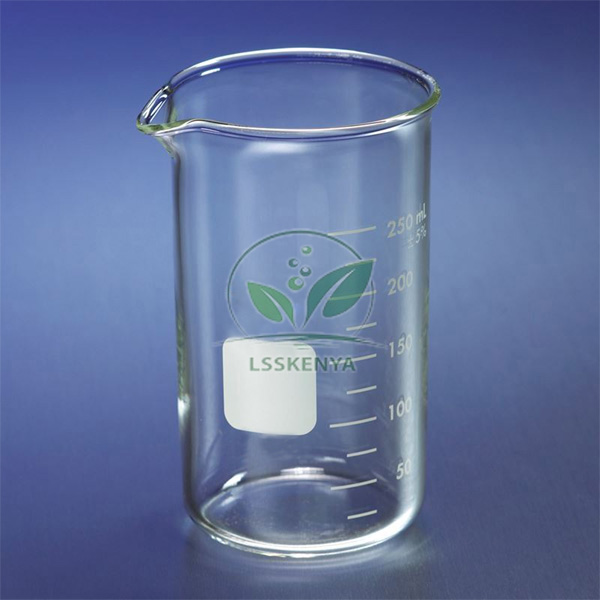
Product Code : LSK-GB-10386
Beakers Tall Form, with Spout are tall, narrow beakers in borosilicate glass 3.3 with a pouring spout and a reinforced rim, made in 50, 100, 150, 250, 500 and 1000 ml sizes. They have uniform wall thickness, clear approximate metric graduations, a large labelling field and high resistance to chemical attack, and they suit heating liquids.
Specifications of the Tall-Form Beakers with Spout
| Specification | Value |
|---|---|
| Material | Borosilicate glass 3.3 |
| Capacities | 50, 100, 150, 250, 500 or 1000 ml, each a separate size |
| Form | Tall form, with spout |
| Rim | Reinforced |
| Wall | Uniform wall thickness |
| Heating | Suited to heating liquids |
| Graduation | Clear, approximate metric scale |
| Marking | Large labelling field |
| Chemical resistance | Highly resistant to chemical attack |
| Manufacturer | Science Lab Supplies, Saha, Ambala, India |
Precipitation and Heating Work in Tall Beakers
The deep, narrow body holds a hot solution with room above it, so a reagent can be stirred in without loss. The spout then lets the clear liquid be decanted off a settled solid.
- Gravimetric precipitation: heat the sample solution, add the precipitating reagent slowly while stirring with a Glass Stirring Rod, 200 x 4 mm, and keep the beaker under a Watch Glass, Pack of 12 while the solid settles.
- Collecting the precipitate: decant the clear liquid through Filter Paper, 120 mm Diameter in a Borosilicate Filter Funnel, or collect the solid in a Gooch Crucible.
- Heating solutions: boil or warm larger volumes in the 500 and 1000 ml sizes, heating evenly on a gauze or hot plate.
Common errors: adding the reagent too fast, which gives fine particles that clog or pass the filter, and scratching the base with the stirring rod. Heat the beaker evenly and never stand a hot beaker on a cold or wet surface: sudden cooling can crack the glass.
Frequently Asked Questions
Which capacities does the tall spouted range include?
Six capacities: 50, 100, 150, 250, 500 and 1000 ml, each ordered as its own size. All share the same tall form in borosilicate glass 3.3, with a spout, a reinforced rim, uniform walls, an approximate metric scale and a labelling field, so small samples and litre-scale heating use one beaker shape.
Which beaker dimensions matter when the beakers must fit racks or baths?
The outside diameter and overall height of each size. Compare them with the rings of a water bath, the clearance under a burette or stirrer, and shelf heights. A tall form is narrower and taller than a low form of the same capacity.
How should a precipitating reagent be added in the beaker?
Heat the sample solution first, then add the reagent slowly, drop by drop or in a thin stream, while stirring all the time. Slow addition to a hot solution gives larger particles that settle and filter well.
How can a student tell that precipitation is complete?
Let the solid settle until the liquid above it is clear, then add one or two drops of the reagent down the side of the beaker. If no new cloudiness forms where the drops meet the liquid, precipitation is complete.
Related Beakers for Analysis Work
- Beakers, Tall Form, Without Spout: the spoutless tall version, with uniform wall thickness and a labelling field.
- Beakers, Low Form with Spout: low, wide Griffin beakers in borosilicate glass 3.3, from 25 to 2000 ml.
- Glass Beaker, Low Form, 100 ml: graduated low-form glass beaker of 100 ml with a flared rim.
- Glass Beakers, Assorted Capacities: set of four borosilicate 3.3 beakers of 50, 100, 250 and 500 ml.
- Beaker Tongs, Stainless Steel: curved jaws in a silicone sleeve for up to 280 °C, for beakers of 100 mL to 1 litre.
Other capacities and beaker forms are shown in the Glassware Beaker list, and filtration glass such as funnels and crucibles in Lab Glassware.
Export of tall spouted beakers to Ghana, Ethiopia, Tanzania, Uganda, the UAE and Saudi Arabia is possible under the Importer-Exporter Code of Science Lab Supplies. To receive a quotation, send details from the contact page or place the beakers in the enquiry cart.
Last updated: 26 November 2026