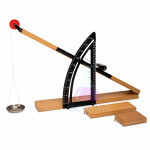
Wave Motion Apparatus Physics Lab
.jpeg)
Product Code : SCL-PL-12129
The Wave Motion Apparatus Physics Lab is a mechanical laboratory demonstration instrument used for visualizing the propagation of transverse and longitudinal waves in academic environments. Designed for physics educators, lab instructors, and science students, this durable apparatus provides a clear physical model of harmonic motion, phase shifts, and wave dynamics.
Product Description
The Wave Motion Apparatus Physics Lab from Science Lab Supplies is engineered to provide an engaging, hands-on understanding of mechanical wave characteristics. The device is constructed with a series of heavy-duty, interconnected metallic levers and cams mounted symmetrically onto a robust horizontal steel frame. When operated, it converts rotary kinetic energy into smooth vertical or horizontal oscillations, producing a continuous wave envelope.
This apparatus serves as an essential teaching aid in secondary and tertiary physics laboratories. By replacing complex abstract computer animations with tangible, physical movement, it bridges the pedagogical gap between structural wave equations and physical reality. The rugged construction ensures long-term resistance to classroom wear and tear while providing highly repeatable visual data for group tracking exercises.
Key Features
- Dual Wave Modeling: Symmetrically demonstrates both transverse waveforms and longitudinal density compressions within one comprehensive unit.
- Precision Crankshaft Matrix: Outfitted with a high-durability steel crankshaft that ensures smooth, continuous rotation without mechanical binding.
- High-Contrast Marker Rods: Features brightly color-coded indicator tips to simplify tracking from the back of the lecture hall.
- Rugged Structural Steel Base: Weighted cast-alloy platform eliminates desktop vibrations and prevents sliding during manual operation.
- Battery-Free Operation: Fully mechanical design operates entirely without electrical power or electronic synchronization systems.
- Curriculum Integration: Fully compatible with global educational curricula for acoustics, fluid dynamics, and general mechanics.
Technical Specifications
|
Specification |
Detail |
|
Product Name |
Wave Motion Apparatus Physics Lab |
|
Brand |
Science Lab Supplies |
|
Wave Types Demonstrated |
Transverse profiles and longitudinal pulses |
|
Drive Mechanism |
Manual hand-crank rotation system |
|
Frame Material |
Hardened structural steel and powder-coated alloy |
|
Indicator Count |
Array of 30 vertically tracking rods |
|
Dimensions |
600 mm x 150 mm x 300 mm (nominal) |
|
Application |
Mechanical wave theory, acoustics, and optics studies |
What's Included in the Kit
- 1 x Wave Motion Apparatus Physics Lab main assembly frame
- 1 x Detachable heavy-duty manual operating crank handle
- 1 x Calibration alignment key
- 1 x Instructional manual with structured laboratory experiments
Applications / Uses
- Demonstrating structural parameters of waves including amplitude, frequency, and phase difference.
- Investigating node and antinode formations within simulated wave boundaries.
- Serving as a baseline visual aid inside advanced acoustics apparatus modules.
- Supplementing custom interactive STEM projects and institutional science kits.
How to Use the Wave Motion Apparatus Physics Lab
- Set Up the System: Place the horizontal steel base flat on a level, sturdy physics laboratory benchtop.
- Install the Handle: Slide the detachable manual operating handle into the matching key slot on the driving crankshaft terminal.
- Isolate a Marker Tip: Instruct students to focus visually on a single color-coded tracking rod to observe its independent vertical or horizontal path.
- Rotate the Crank: Rotate the handle clockwise at a slow, deliberate speed to generate a smooth, traveling progressive wave down the rod matrix.
- Vary the Operational Frequency: Turn the crank at a faster velocity to demonstrate how increasing the frequency decreases the physical distance between wave crests.
Safety Note: Do not reverse the crank rotation sharply or apply vertical forces to the tracking rods, as severe impacts can misalign the underlying cam linkages.
Care & Maintenance
- Periodic Cleaning: Wipe down the tracking guide slots and metal rods with a clean, lint-free cloth to prevent dust accumulation.
- Bearing Lubrication: Apply a drop of low-viscosity machine lubricant to the internal crankshaft bearing assemblies every six months.
- Proper Storage: Keep the apparatus cataloged inside a dry storage cabinet to isolate it from excessive ambient laboratory humidity.
Why Choose Science Lab Supplies
Science Lab Supplies is a premier global manufacturer and exporter of elite scientific educational gear, didactic models, and durable laboratory systems. With decades of rigorous manufacturing experience, our production units maintain strict compliance with global institutional quality benchmarks. Every mechanical structure undergoes comprehensive load and stress validation testing to deliver extreme field longevity. We serve schools, universities, and international wholesale distributors with flexible, scalable supply chain logistics worldwide.
Frequently Asked Questions
How does the Wave Motion Apparatus Physics Lab generate wave models?
The apparatus utilizes an internal series of offset eccentric cams fixed to a shared horizontal crankshaft. As you turn the crank, the cams lift the indicator rods sequentially, producing a physical traveling wave-front.
Can this apparatus demonstrate longitudinal waves?
Yes, the indicator rod linkages are cross-engineered to display classic transverse sinusoids along the top profile while executing corresponding horizontal compressions along the parallel tracking grid.
Does the machine require an external electrical power adapter?
No, the unit features a fully mechanical design driven purely by manual hand-crank rotation, ensuring it remains battery-free and highly reliable.
What materials are used in the main frame assembly?
The primary frame is fabricated entirely from heavy-duty structural steel and powder-coated alloy elements to provide a robust, stable baseline weight.
How can students calculate wavelength using this model?
Students can measure the physical distance between two consecutive wave crests along the indicator rod array using a standard laboratory meter rule.
Equip your mechanics and wave theory workspaces with premium training setups by browsing our complete physics lab equipment portfolio, or connect with our technical specialists for bulk institutional orders of durable laboratory instruments.


.png)
.jpeg)