
Two-Shaft Gas Turbine
Product Code : LSK-E-10495
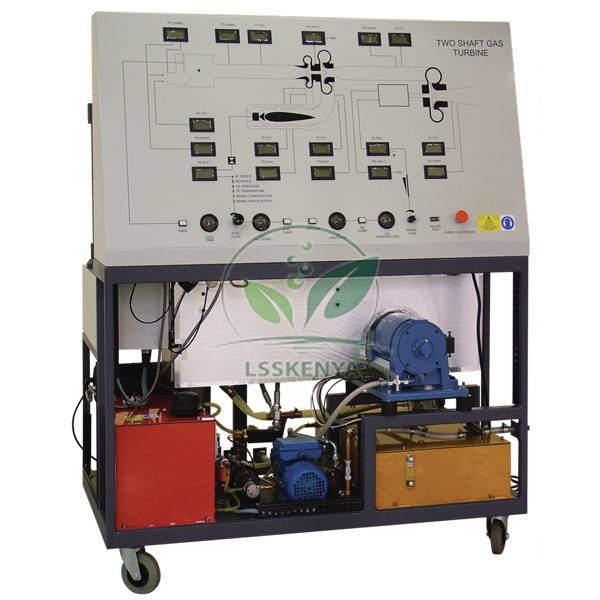
Two-Shaft Gas Turbine (SKU LSK-E-10495) is a self-contained, fully instrumented educational gas turbine in which a gas generator drives a separate power turbine, the layout used in helicopters and electrical power generators. It suits practical investigations into gas turbine principles and performance in mechanical and aeronautical engineering programmes. Science Lab Supplies quotes the unit from Ambala, India, for universities, engineering colleges, tender contractors and distributors.
Specifications
Every subsystem of the two-shaft turbine is listed as a separate row below. In short, a steel frame carries the gas generator, power turbine, combustion chamber, tanks and pumps under a labelled control panel, and the power turbine drives an eddy current dynamometer with a load cell and speed sensor, so true shaft power can be calculated.
| Specification | Value |
|---|---|
| SKU | LSK-E-10495 |
| Configuration | Two-shaft: gas generator turbine plus separate power turbine |
| Frame | Steel frame with gas generator, power turbine, combustion chamber, oil and fuel tanks, pumps, ancillaries and guards |
| Control panel | Labelled, with mimic diagram, instrument displays, controls and warning lights |
| Air path | Calibrated nozzle and air box, then compressor and combustion chamber |
| Fuel supply | Pump sprays fuel through a nozzle into the combustion chamber |
| Ignition | High-energy spark |
| Speed control | Fuel flow control valve; design reduces overspeed risk |
| Inter-turbine duct | Short duct to the power turbine, reducing heat loss |
| Load | Eddy current dynamometer, direct coupled, no belts; load set from the panel |
| Torque and speed | Load cell on the dynamometer and speed sensor |
| Indicators | Digital and analogue: pressures, temperatures, fuel flow and level |
| Lubrication | Oiling system with filters and water-cooled oil |
| Control and protection | PLC start-up and shut-down, shutdown on user error, cooling fans after running |
| Data | Computer connection, data acquisition software and connection cable |
| Exhaust | Discharges to a suitable exhaust system |
| Supplied by | Science Lab Supplies, Ambala, India |
Applications and Experiments for the Two-Shaft Gas Turbine
Air passes through the calibrated nozzle into the compressor and combustion chamber, where sprayed fuel is ignited. Hot gas drives the gas generator turbine, then the power turbine. Students vary fuel flow and dynamometer load, and record pressures, temperatures, fuel flow, torque and speed for performance calculations.
- B.Tech/B.E. mechanical: gas turbine performance and the Brayton cycle.
- Aeronautical engineering: turboshaft principles with a free power turbine.
- Thermal engineering: shaft power, fuel consumption and efficiency, with nozzle air-flow theory linked to the Venturi Flowmeter.
- Loading methods: eddy current braking compared with the band brake of the Turbine Dynamometer.
Standard Scope of Supply
The unit comes complete on its steel frame with gas generator, power turbine, combustion chamber, tanks, pumps, guards, control panel, eddy current dynamometer, oiling system and PLC, plus data acquisition software and cable. The software runs on your own computer, and the exhaust gases discharge to a suitable exhaust system at your site.
Packing, MOQ and Lead Time
You can request one unit or one for each of several laboratories; the quotation gives the packing, delivery time and price for the units and anything added to them. Engine test sets and other engineering lab equipment in India can go on the same quotation.
As a registered exporter with an Importer-Exporter Code, Science Lab Supplies can ship to buyers in Kenya, Ghana, Ethiopia, Tanzania, Uganda and the UAE. Describe your thermal lab and site exhaust on the contact page, or shortlist the turbine in the enquiry cart; public tenders follow the lab tender page.
Frequently Asked Questions
Why is it called a two-shaft gas turbine?
The gas generator turbine and the power turbine sit on separate shafts. The first drives the compressor; the second delivers output power to the dynamometer, as in helicopter engines and generator sets.
How is the turbine protected against operator error?
A PLC controls start-up and shut-down, shuts the turbines down if the user makes an error, and switches on cooling fans after running. A fuel flow control valve regulates speed and reduces overspeed risk.
What does the installation need?
Exhaust gases must discharge to a suitable exhaust system, and a computer is needed for the data acquisition software. Hot gases and fast-moving parts mean trained staff should supervise every run.
Who supplies the Two-Shaft Gas Turbine?
Science Lab Supplies, from its Ambala base in India, answers enquiries for the turbine and sets out the unit and any additions as separate lines in its quotation.
Related Engine, Turbine and Dynamometer Equipment
The gas turbine can sit beside piston-engine tests, a turbojet trainer, a water turbine and an electric dynamometer, so students compare how different machines turn energy into shaft power. Any of these items can be quoted with the turbine.
- Small Engine Test Set — trunnion-mounted hydraulic dynamometer on a trolley bed.
- 4 Stroke Diesel Engine — compression-ignition test engine with self-sealing fuel couplings.
- 4 Stroke Petrol Engine — spark-ignition engine with essential hoses and fittings.
- Exhaust Gas Calorimeter — finds energy lost to exhaust from four-stroke test engines.
- Educational Turbojet Engine Trainer — demonstrates intake, compression, combustion, turbine action and thrust.
- Universal Dynamometer — inverter-driven unit displaying speed, torque and shaft power.
- Pelton Wheel (turbine) — impulse turbine with variable spear jet and viewing window.
Browse the full Engines range, the Fluid Mechanics range for turbines and dynamometers, or all engineering laboratory equipment.
Last updated: 22 October 2026


