
Visual Acuity Eye Chart
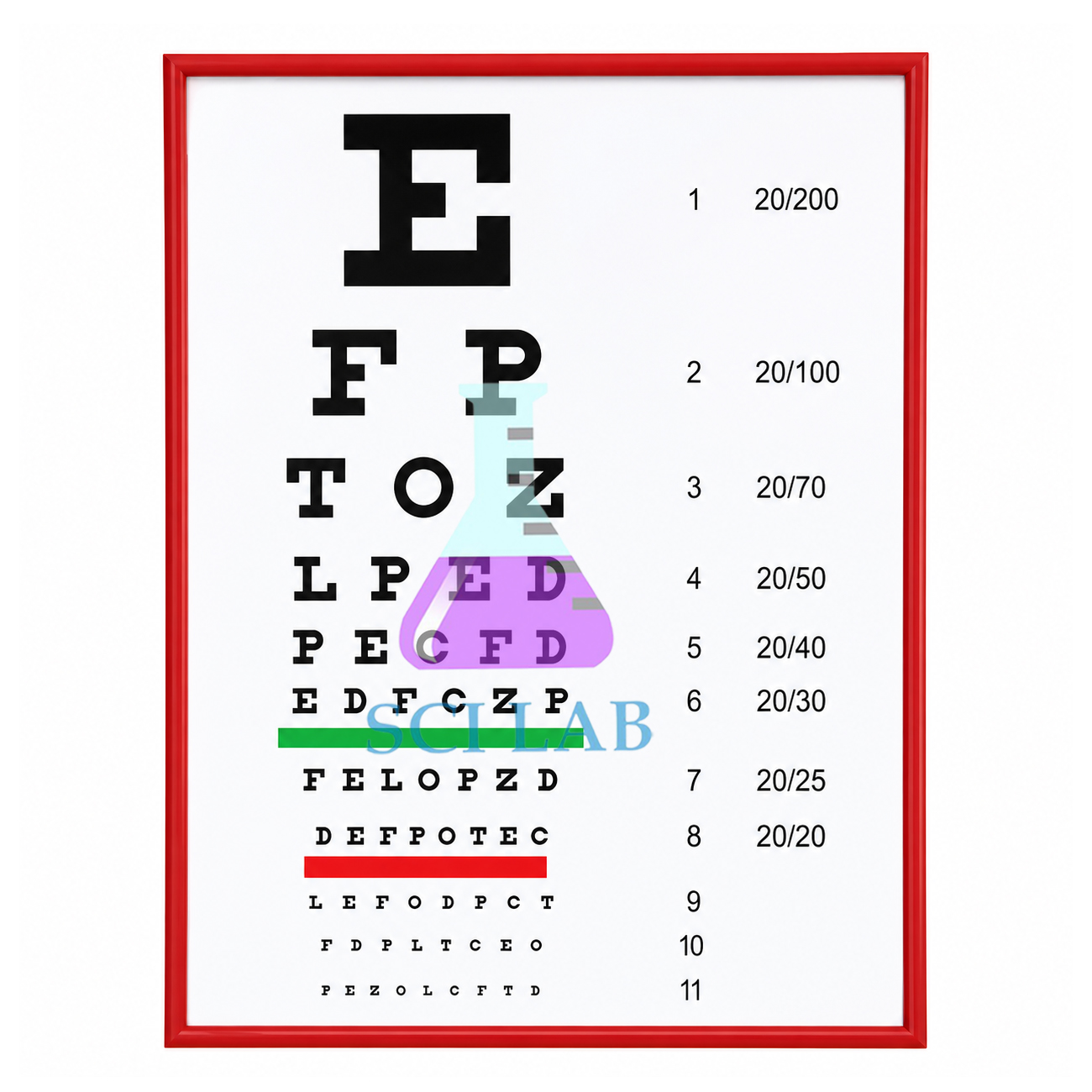
Product Code : SCL-BLE-11746
The Visual Acuity Eye Chart is a chart for measuring visual acuity, the sharpness of distance sight. The reader names rows of characters that get smaller down the chart, and the smallest row read correctly gives the acuity score used in vision screening.
Specifications of the Eye Chart
| Specification | Value |
|---|---|
| Measures | Visual acuity (sharpness of sight) |
| Use | Vision screening and repeat checks of acuity |
| Supplied by | Science Lab Supplies, Ambala, India |
Carrying Out an Acuity Check with the Eye Chart
Hang the chart at eye level in even, bright light and mark the test distance on the floor. Test one eye at a time with the other covered, then both eyes together.
- Recording: note the smallest row read correctly for each eye as a fraction, such as 6/6 or 6/12.
- Eye structure: link the result to focusing by the cornea and lens onto the retina, using the Human Eye Model.
- Short and long sight: the Functional Human Eye Model Kit focuses an image on its retina and demonstrates both defects and their correction.
Common errors: standing nearer than the chart's design distance, pressing on the covered eye, and letting the reader peep with both eyes during a one-eye test.
Frequently Asked Questions
Which kind of eye chart suits children or people who cannot read letters?
Letter charts suit readers. Tumbling E charts, where the reader shows which way the E faces, and picture or symbol charts are used for young children and for people who cannot read the alphabet. The listing does not state the character type, so check the chart face before ordering.
What room length does an eye chart need?
Standard distance charts are made to be read from 6 m (20 ft), and some are drawn for 3 m rooms. The listing does not state the design distance, so confirm that it matches the space where the chart will hang before ordering.
What does 6/6 or 20/20 vision mean?
The first number is the test distance; the second is the distance at which normal sight reads the same row. 6/6 means the reader sees at 6 m what is normally seen at 6 m. A larger second number, such as 6/18, means lower acuity.
Why is each eye tested on its own?
The two eyes can differ, and a good eye can hide a weak one when both are open. Covering one eye at a time, without pressing on it, gives a separate score for each, after which both eyes are tested together.
Is a distance chart the same as a near vision chart?
No. A distance chart hangs across the room and checks sight far away. A near vision chart is held at reading distance and checks close work, which often changes with age. The two measure different things.
Related Diagnostic and Eye Items
- Hearing Aid: classroom amplifier with 6 adjustable volume levels and a wired earpiece.
- Aneroid Sphygmomanometer, 4-Wheel Stand Model: 147 mm round dial with 360 degree swivel, on an adjustable-height stand.
- Cardiology Stethoscope: chrome-plated chest piece, external non-chill rim and soft sealing ear tips.
- Neurological Hammer: T-shape, double ended, with reflex point and brush.
This chart sits with the screening items in Diagnostic Equipment; eye anatomy models for teaching are under Head and Facial Model.
Science Lab Supplies, registered under an Importer-Exporter Code, can include this eye chart in export orders bound for Egypt, Iraq, Nigeria, Kenya, Ghana and Ethiopia. Write in through the contact page for a quotation, or gather this chart and other items in the enquiry cart first.
Last updated: 15 November 2026


