
Test Tubes
.jpg)
Product Code : SCL-LG-11993
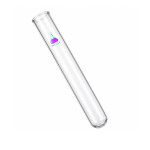
Test Tubes is a bulk pack of 100 round-bottom test tubes of borosilicate glass 3.3, each 16 mm in outside diameter and 150 mm long, with a nominal capacity of about 15 to 20 ml. They hold, mix and gently heat small amounts of liquids and solids, and the clear glass shows colour changes, precipitates and gas bubbles in school and college qualitative tests.
Specifications of the Test Tubes, Pack of 100
| Specification | Value |
|---|---|
| Pack | 100 test tubes; stoppers and racks are separate items |
| Size | 16 mm outside diameter x 150 mm overall length; wall about 1.0 to 1.2 mm |
| Capacity | About 15 to 20 ml nominal each (approximate, not a measured volume) |
| Material | Borosilicate glass 3.3, transparent |
| Bottom | Round |
| Heating | Gentle heating of open tubes in good condition; never heat a closed tube |
| Use | Small-scale reactions, qualitative tests and holding samples |
| Care | Reusable after cleaning; discard cracked or chipped tubes |
| Manufacturer | Science Lab Supplies, Saha, Ambala, India |
Test-Tube Work in the Chemistry and Biology Lab
Tubes stand in a rack between steps and are held in a holder whenever they are heated or shaken. Reagents go in a few drops at a time, and each result is read against a white background.
- Gas tests (Class 7 to 10): collect hydrogen, oxygen or carbon dioxide in a tube and test it with a lighted splint, a glowing splint or limewater.
- Ion tests (Class 10 and 11): add dilute sodium hydroxide drop by drop and note the colour of each metal hydroxide precipitate.
- Food tests (biology): warm Benedict's test samples in a Water bath, 7 L rather than over a flame, and run the iodine and biuret tests cold.
Hold heated tubes in a Test Tube Holder with Handle, let them cool in a Laboratory Apparatus Test Tube Stand and never heat a stoppered tube.
Frequently Asked Questions
Which details should be checked on a bulk pack of test tubes?
Check the outside diameter and length against the racks and holders already in use, the wall thickness and the glass type if the tubes will go into a flame. This pack holds 100 borosilicate 3.3 tubes, 16 x 150 mm, with walls about 1.0 to 1.2 mm thick.
Can glass test tubes be reused?
Yes. Rinse them soon after use, scrub with a test tube brush and detergent, rinse with distilled water and drain them upside down. Discard any tube that is chipped, cracked or badly scratched, because it can break when heated.
Why does the glass type matter if tubes will be heated?
Borosilicate glass expands little when heated, so it takes direct flame and sudden temperature changes far better. Soda-lime tubes suit cold tests, storage and water-bath warming but can crack in a flame. These tubes are borosilicate 3.3, so open tubes in good condition can be heated gently.
How full should a test tube be for heating?
For liquids, no more than about a third full, so boiling liquid cannot reach the mouth. A solid should form a thin layer at the bottom, well below half the tube, so that it heats evenly.
Where should the flame touch the tube?
Hold the tube at an angle in a holder with the mouth pointing away from everyone. Heat gently near the top of the liquid and move the tube in and out of the flame, so vapour escapes without throwing liquid out.
When should a boiling tube or a water bath be used instead?
Use a wider boiling tube when the volume or a vigorous reaction would overfill a test tube. Warm flammable liquids such as ethanol in a hot water bath, never over a naked flame.
Related Test-Tube Accessories
- Wooden Test Tube Holder: wooden holder for gripping a hot test tube.
- Brush for Washing Test Tubes: soft white nylon brush, 12 mm in diameter.
- Test Tube Brush, Nylon, 8 inch (Pack of 12): flexible wire stem with radial bristles for narrow tubes.
- Test Tube Rack, 12 Places, Autoclavable: holds 12 tubes upright, with drainage holes at the base.
- Rubber Stoppers of Various Diameters with Holes: bottom diameters of 11, 13, 14 and 15 mm.
- Bunsen Burner (Pack of Two): pair of gas burners with an adjustable open flame.
Racks, holders and burners for tube work are in the Chemistry Lab section, while Lab Glassware lists further glass vessels.
Bulk test tube packs can leave India for Ethiopia, Tanzania, Uganda, the UAE, Saudi Arabia and Oman under the Importer-Exporter Code of Science Lab Supplies. Send the number of packs needed via the contact page, or add them to the enquiry cart to request a quotation.
Last updated: 20 November 2026
.jpg)
.png)
.jpg)
.jpg)

.jpg)