
Seeker Steel
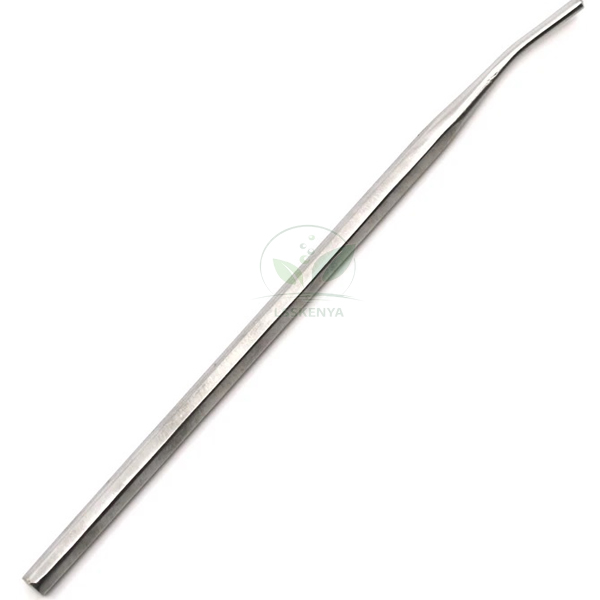
Product Code : LSK-DAS-10912
Seeker Steel (SKU LSK-DAS-10912) is an all-stainless-steel dissecting seeker: a 125 mm needle with a blunt end, offered straight or bent. The blunt tip lets students trace nerves, blood vessels and ducts and separate organs without cutting them, which suits school biology, B.Sc. zoology and nursing or paramedical anatomy practicals. Science Lab Supplies, working out of Ambala, India, can quote it for schools, colleges, training institutes and distributors.
Specifications
The seeker's details are set out row by row below. In brief, it is made entirely of stainless steel, measures 125 mm and ends in a blunt point, and buyers choose between a straight pattern for general probing and a bent pattern for reaching under or behind structures.
| Specification | Value |
|---|---|
| SKU | LSK-DAS-10912 |
| Material | Stainless steel throughout |
| Tip | Blunt end |
| Length | 125 mm |
| Pattern 1 | Seeker, steel, straight |
| Pattern 2 | Seeker, steel, bent |
| Supplied by | Science Lab Supplies, Ambala, India |
Applications and Experiments for the Steel Seeker
A seeker is the probing tool of a dissection: its blunt end pushes tissue aside, follows a vessel or nerve to its origin and lifts structures for labelling, all without puncturing them. With it, students can explore a specimen carefully before any cut is made, in school and college biology labs.
- Class 11–12 biology: tracing the digestive and nervous systems of a specimen pinned out on a Dissecting Board.
- B.Sc. zoology: separating organs and following blood vessels in specimens laid in a Dissecting Tray with Wax.
- Nursing and paramedical anatomy sessions: pointing out structures during a demonstration without damaging the specimen.
- Botany practicals: opening flowers and spreading floral parts for study under a Hand Lens with White Plastic Handle.
The bent pattern helps when a structure lies beneath another; the straight pattern covers general probing. Rinse and dry the seeker after each practical.
Standard Scope of Supply
Each seeker is supplied as one 125 mm stainless steel instrument in the pattern you order, straight or bent. Mixed quantities of both patterns can be requested on one enquiry, and scissors, forceps or a full dissecting set for the same practical can be added to that quotation.
Packing, MOQ and Lead Time
You may request pricing for a handful of seekers or for enough to give every student pair its own instrument. Each Science Lab Supplies quotation confirms packing, delivery time and price for the quantity named, and other school biology lab equipment in India can be listed alongside.
Science Lab Supplies holds an Importer-Exporter Code and can ship to buyers in Nigeria, Kenya, Ghana, Ethiopia, Tanzania and Uganda. Science Lab Supplies is registered for GST (GSTIN 06ADEPJ0574F2ZU). Seeker orders can start on the contact page or in the enquiry cart, while public-sector buyers will find the bid route on the lab tender page.
Frequently Asked Questions
Why is the end of the seeker blunt?
A blunt end lets you push tissue apart and follow nerves or vessels without cutting or piercing them, so the structures stay intact for observation, drawing and labelling during the practical.
Should I order the straight or the bent seeker?
The straight seeker suits general probing and separating tissue. The bent seeker reaches under or around a structure more easily. Both are 125 mm stainless steel, and you can order a mix of the two.
Who supplies the Seeker Steel?
Supply of this stainless steel seeker is arranged by Science Lab Supplies in Ambala, India, which prepares quotations for institutions, tender contractors and distributors and can combine it with other dissecting instruments on one order.
How is a seeker different from a dissecting needle?
A dissecting needle has a pointed tip for teasing and piercing, whereas this seeker has a blunt end for probing and separating. A practical bench can keep both, and either can be quoted on the same enquiry.
Related Dissecting Instruments and Sets
These instruments sit beside the seeker in a dissection: needles and an awl for piercing, a section lifter for moving thin material, cutting and gripping tools, and complete sets. All of them can be listed on one quotation to equip a biology practical class.
- Needle with Handle — sharp-pointed steel needles, straight, bent or arrow-head, with hardwood or plastic handles.
- Needle Holder — metal chuck that grips a needle, in metal type or with a phenolic resin handle.
- Dissecting Awl — wooden-handled awl with a 50 mm stainless steel spike.
- Section Lifter — 100 mm single-ended stainless steel lifter with a bent-up blade.
- Dissecting Scissor Curved — 110 mm curved stainless steel scissors with a fine point, for educational use.
- Forceps — stainless steel forceps in 14 cm and 20 cm lengths with serrated tips.
- Student Dissecting Set — PVC-cased set of ten instruments with a seeker, magnifier and No. 3 scalpel handle.
- Dissection Kit — economy kit of 18 instruments in a plastic box, with a chain hook and watch glass.
Browse the full Dissecting and Surgical range, the Biology Lab Equipment range, or all Biology Lab products.
Last updated: 9 October 2026


