Orbit Tellurium 2
Product Code : LSK-PL-10299
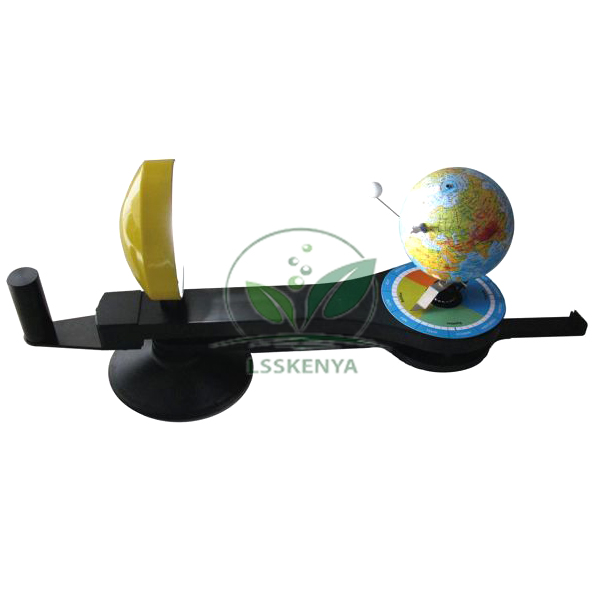
Orbit Tellurium 2 (SKU LSK-PL-10299) is a Sun, Earth and Moon model, geared to show each month as the Earth orbits the Sun, with a bright lamp standing in for the Sun. Teachers use it to demonstrate night and day, seasons, the length of days, shadows, phases of the Moon and eclipses in primary, middle and secondary classes. Science Lab Supplies provides it from Ambala, India for schools, colleges, tender contractors and distributors.
Specifications
The tellurium measures 650 x 250 mm (length x height) and is correctly geared so the Moon and Earth move in step as each month passes. It runs from a 6 V transformer, which is supplied, and comes with a sundial, stick-on model person, Moon phase indicator, eclipse shadow card, date indicator and teaching guide.
| Parameter | Value |
|---|---|
| SKU | LSK-PL-10299 |
| Type | Geared Sun, Earth and Moon model (tellurium) |
| Sun | Bright lamp |
| Electrical operation | 6 V transformer, supplied |
| Dimensions (L x H) | 650 x 250 mm |
| Earth and Moon | Two Earths and two Moons |
| Supplied by | Science Lab Supplies, Ambala, India |
Applications and Experiments for the Orbit Tellurium 2
With the lamp lit, the model shows why one side of the Earth has day while the other has night, how the tilted axis produces seasons and changing day length, and how the Moon's position creates phases and eclipses. The sundial and model person let pupils watch shadows change during a day and a season.
- Primary science and geography: day and night and the Sun's apparent motion.
- NCERT Class 6 geography: motions of the Earth and seasons.
- Middle-school science: phases of the Moon and solar and lunar eclipses.
- Shadow studies: changing length and direction of shadows over a day and a season.
Standard Scope of Supply
The set includes the tellurium model, a model sundial, an Earth axis extension, a stick-on model person, a phase of the Moon indicator, an eclipse shadow card, a date indicator, two Earths and Moons, the teaching guide and the 6 V transformer for electrical operation.
Packing, MOQ and Lead Time
You may request a price for one tellurium or for a set for several classrooms. Every quotation spells out packing, delivery time and price for the requested quantity, and an orrery or other school physics lab equipment in India can be added so the astronomy corner is priced in one document.
Science Lab Supplies has an Importer-Exporter Code as a registered exporter and can ship to buyers in Ethiopia, Tanzania, Uganda, the UAE, Saudi Arabia and Oman. Send us a message via the contact page or place items in the enquiry cart; for tenders see the lab tender page.
Frequently Asked Questions
What can the Orbit Tellurium 2 demonstrate?
The Sun's apparent motion, changing length and direction of shadows during a day and a season, night and day, changing length of days, seasons, phases of the Moon, and eclipses of the Moon and Sun.
How is the model powered?
The lamp that represents the Sun works from a 6 V transformer, which is supplied with the model. As with any mains-connected equipment, the transformer should be plugged in by the teacher.
Who supplies the Orbit Tellurium 2?
It is supplied by Science Lab Supplies from Ambala, India, and can be quoted alone or together with other teaching models for a science or geography room.
Why are there two Earths and Moons?
The set includes two Earths and Moons as part of its contents; the teaching guide explains how each is used in the demonstrations.
Related Astronomy Models
The tellurium focuses on the Earth, Moon and Sun; these items widen or support the topic. The orrery shows the full solar system, a second geared model of the Earth-Moon-Sun system covers seasons, Moon phases and eclipses, a light source models sunlight, and a compass helps line up the sundial.
- Orbit Orrery — solar system model with a battery-lit sun.
- Sun-Earth-Moon Model — another model of the same system.
- Parallel Beam Light Source — parallel light like sunlight.
- Pocket Compass — finding north for sundial work.
Browse the full Physics Lab range or all physics lab equipment.
Last updated: 25 September 2026