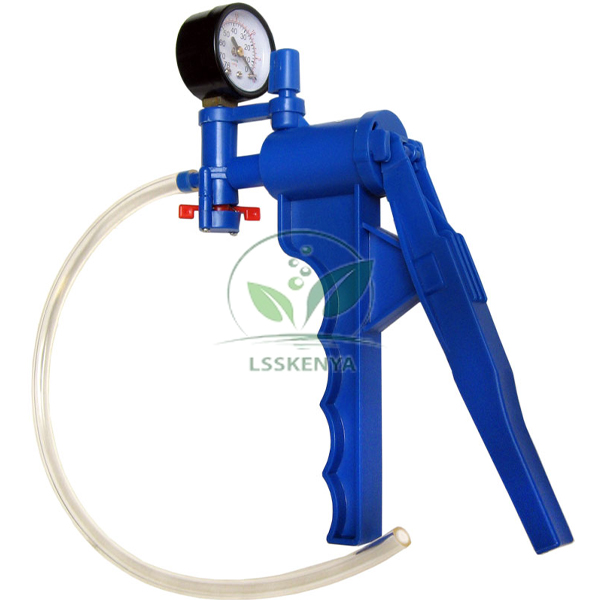
Hand Vacuum Pump
Product Code : LSK-PL-10338
Hand Vacuum Pump (SKU LSK-PL-10338) is a lightweight, hand-operated pump that draws 15 cm³ of air per stroke and reaches a maximum vacuum of 50 mmHg. Worked the other way, it can also produce positive gauge pressures up to 2 atm. Physics teachers use it for air-pressure and vacuum demonstrations in school and college labs. It comes from the Science Lab Supplies factory at Plot 448, HSIIDC Industrial Area, Saha, Ambala, India, where the company manufactures it for schools, colleges, tender contractors and distributors.
Specifications
This is a compact manual pump for evacuating small vessels or pressurising them. Each stroke moves 15 cm³ of air, it reaches a maximum vacuum of 50 mmHg, and in pressure mode it builds up to 2 atm gauge, which covers most school vacuum and air-pressure experiments.
| Parameter | Value |
|---|---|
| SKU | LSK-PL-10338 |
| Operation | Hand operated, lightweight |
| Displacement | 15 cm³ per stroke |
| Maximum vacuum | 50 mmHg |
| Positive pressure | Up to 2 atm gauge |
| Manufacturer | Science Lab Supplies, Saha, Ambala, Haryana |
| Country of origin | India |
Applications and Experiments for the Hand Vacuum Pump
The pump is used wherever a teacher needs to remove air from, or push air into, a small closed vessel: showing that sound needs a medium, that water boils at lower pressure, or that the atmosphere exerts force. It is a practical addition to school physics lab equipment in India.
- NCERT Class 8 science, force and pressure: effects of atmospheric pressure.
- Class 9 sound: a bell in an evacuated jar grows fainter as air is removed.
- Class 11 physics, mechanical properties of fluids: pressure and gauge pressure.
- Positive-pressure demonstrations up to 2 atm gauge.
Standard Scope of Supply
The Hand Vacuum Pump is supplied as a single unit as described above. Vessels to evacuate, such as a bell jar, and any connecting tubing you need for your own apparatus are separate items, and they can be listed as optional lines on the quotation.
Packing, MOQ and Lead Time
Ask for one pump or a set for every practical group; either way, the quotation gives packing, delivery time and price for exactly that quantity. A bell jar or crushing can may be quoted on the same sheet so the whole air-pressure bench arrives together.
With an Importer-Exporter Code on record, Science Lab Supplies can ship to buyers in Egypt, Iraq, Nigeria, Kenya, Ghana and Ethiopia. Orders and questions go through the contact page or the enquiry cart, and institutional buyers can read the lab tender page.
Frequently Asked Questions
How much vacuum does the Hand Vacuum Pump reach?
The specification gives a maximum vacuum of 50 mmHg, with 15 cm³ of air removed per stroke, so the rate of evacuation depends on the size of the vessel.
Can it be used to pressurise as well?
Yes. The pump can produce positive gauge pressures up to 2 atm, which is useful for simple pressure demonstrations as well as vacuum work.
Who makes this pump?
Science Lab Supplies makes it at its own Saha, Ambala plant rather than buying it in, so the price and delivery on your quotation are set by the factory.
Is a bell jar included?
No bell jar is listed with the pump, which is supplied on its own. The Bell Jars item below, with its baseplate and tap, can be added to the same quotation so the vacuum demonstration arrives complete.
Related Air Pressure and Vacuum Apparatus
These four Physics Lab items turn the pump into a complete air-pressure bench: vessels to evacuate, a can that shows atmospheric force, and an apparatus for the gas laws. Each covers a different part of the pressure topic and all four can be quoted together.
- Bell Jars — baseplate with tap, glass jar and battery bell for vacuum demonstrations.
- School Vacuum-Pump Set — vacuum chamber set for boiling under reduced pressure and more.
- Crushing Can — tin plate can with screw cap showing atmospheric pressure.
- Gas-Law Apparatus — pressure, volume and temperature relationships with manometer.
Browse the full Physics Lab range or all physics lab equipment.
Last updated: 25 September 2026
.jpeg)

 (1).png)