Vibrating Table
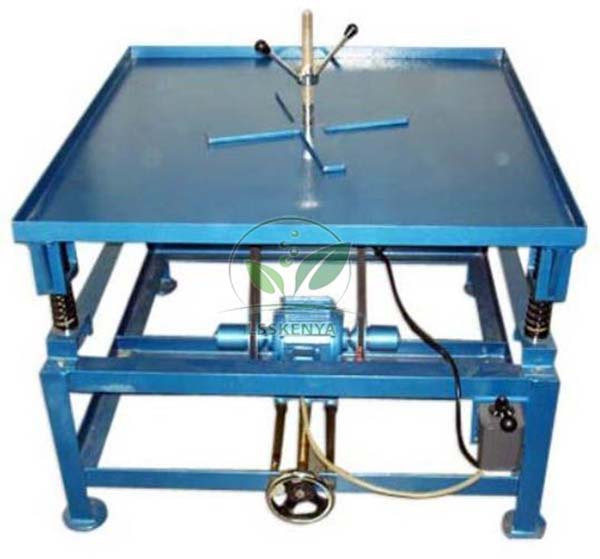
Product Code : LSK-WT-10538
Vibrating Table (SKU LSK-WT-10538) is a motor-driven table that vibrates filled moulds to compact cement concrete while test cubes are being cast, removing trapped air so the cubes are dense and uniform. Civil engineering concrete labs and construction training workshops use it in ITI, polytechnic and TVET courses. Science Lab Supplies supplies the table from Ambala, India to colleges, training institutes, tender contractors and distributors.
Specifications
Every technical detail of the table is listed in the table below. In short, it has a 500 x 500 mm top with elevated edges, carries up to 140 kg, vibrates at a fixed amplitude with frequency set between 2600 and 3600 RPM by a variable pitch pulley, and starts from a starter switch.
| Specification | Value |
|---|---|
| SKU | LSK-WT-10538 |
| Table top size | 500 x 500 mm |
| Table edges | Elevated |
| Maximum load | 140 kg |
| Amplitude | Fixed |
| Frequency range | 2600–3600 RPM |
| Frequency adjustment | Variable pitch pulley arrangement |
| Control | Starter switch |
| Use | Compaction of cement concrete when casting cubes |
| Supplied by | Science Lab Supplies, Ambala, India |
Applications and Experiments for the Vibrating Table
The table is used to compact fresh concrete in cube moulds before curing and compressive strength testing. Clamping the moulds on the table and vibrating them for a set time gives consistent compaction from one batch to the next, which makes students' strength results comparable.
- B.Tech/B.E. and diploma civil engineering concrete labs: casting cubes for compressive strength tests.
- ITI and TVET construction trades: compaction of concrete and effect on strength, after checking aggregates with the Coarse Aggregate Density Test Set and Los Angeles Abrasion Machine.
- Comparing hand-compacted and vibrated cubes to show the effect of trapped air.
- Producing small precast items and samples in a construction materials workshop.
Switch off at the starter before placing or removing moulds, secure moulds to the top, and keep the load within 140 kg.
Standard Scope of Supply
The Vibrating Table is supplied as a single unit as described above, with its 500 x 500 mm top, drive with variable pitch pulley and starter switch. Cube moulds and other optional accessories are not part of the table and are listed on the quotation if requested.
Packing, MOQ and Lead Time
Quotations can be for one table or for a full concrete lab or construction workshop. Each states packing, delivery time and price for the quantity you ask for, and related TVET workshop equipment such as mixers and vibrators can go on the same quotation.
As a registered exporter with an Importer-Exporter Code, Science Lab Supplies can ship to buyers in Nigeria, Kenya, Ghana, Ethiopia, Tanzania and Uganda. Concrete labs can request the vibrating table via the contact page or enquiry cart, and tender buyers can turn to the lab tender page.
Frequently Asked Questions
What is a vibrating table used for?
It compacts cement concrete in moulds while test cubes are cast, driving out air so the cubes give reliable compressive strength results. Secure the moulds on the elevated-edge top before switching on at the starter.
Can the vibration frequency be adjusted?
Yes. The amplitude is fixed, but the variable pitch pulley lets you set the frequency anywhere between 2600 and 3600 RPM. Note the setting used so later batches of cubes are compacted the same way.
Who supplies the Vibrating Table?
Science Lab Supplies supplies it from Ambala, India to engineering colleges, ITI and TVET institutes, tender contractors and distributors, and other concrete workshop items can be priced alongside it on one quotation.
How much can it carry?
The table top is 500 x 500 mm and takes a maximum load of 140 kg, including the filled moulds. Keep the combined weight of moulds and fresh concrete within that limit for safe operation.
Related Concrete Workshop Tools
These items from the Workshop Tools and Concrete Laboratory ranges cover mixing, workability testing, site and laboratory compaction, block production and cube strength testing around the vibrating table, and any of them can be quoted together with it for a concrete training bay.
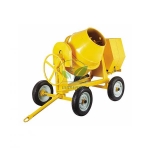
- Concrete Mixer — diesel-engine mixer with an approx. 240 L drum at 16–26 rpm.
- Poker Vibrator — internal compaction of concrete specimens, in petrol, mains or battery versions.
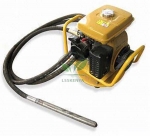
- Builders Vibrator — 5.5 hp petrol unit with a 45 mm poker and 6 m flexible drive.
- Block Making Machine — 100-ton hydraulic press making four 230 x 110 x 75 mm bricks per stroke.
- Laboratory Concrete Mixer — 55 or 110 litre tilting steel vessel turning at 20–22 rpm for mix design.
- Slump Test Apparatus — cone of 20 cm base, 10 cm top and 30 cm height, with a 16 mm graduated rod.
- Motorized Compression/Tension Machine — 2000 kN compression and 500 kN tension tests with a digital indicator.
Browse the full Workshop Tools range, the Concrete Laboratory range for concrete and aggregate testing, or all TVET lab equipment.
Last updated: 9 October 2026