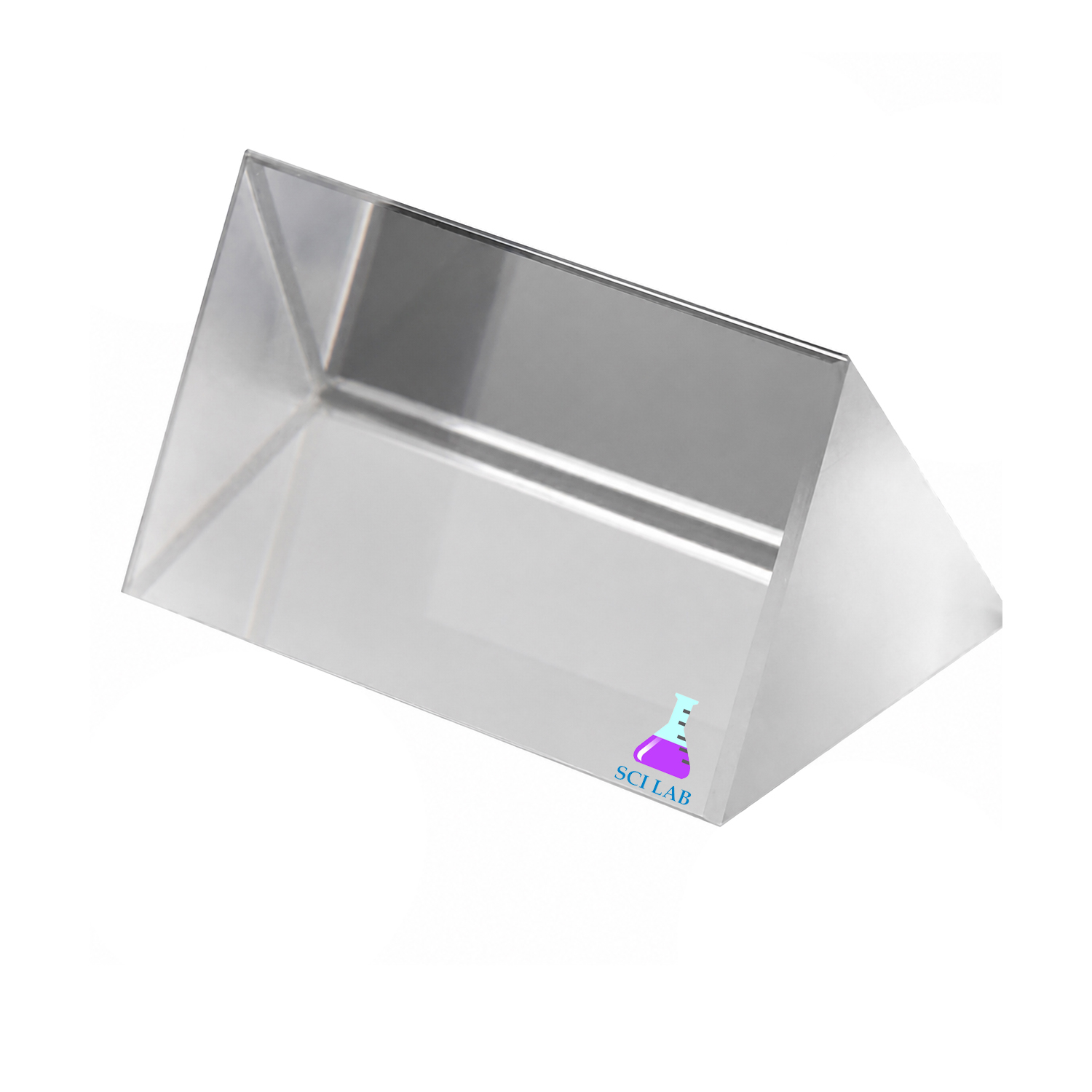
Triangular Prism
Product Code : SCL-CL-11879
Triangular Prism (SKU SCL-CL-11879) is a three-sided optical prism, 5 cm high and 3 cm wide, with flat polished rectangular faces for bending and dispersing light. Passing white light through it splits the beam into the seven visible colours, while a narrow ray shows refraction and deviation. It is standard kit for light chapters from Class 7 to Class 12. Science Lab Supplies quotes the prism from Ambala, India to schools, colleges, training institutes, distributors and tender contractors.
Specifications
The prism has a triangular cross-section with three flat, polished rectangular faces, 5 cm high and 3 cm wide. Light entering one face is refracted, deviated and dispersed as it passes through and leaves by another, giving a clear demonstration of basic optics.
| Parameter | Value |
|---|---|
| SKU | SCL-CL-11879 |
| Model no. | SCI/LSS-1496 |
| Shape | Triangular cross-section, three flat polished rectangular faces |
| Height | 5 cm |
| Width | 3 cm |
| Demonstrates | Refraction, deviation and dispersion into a spectrum |
| Supplied by | Science Lab Supplies, Ambala, India |
Applications and Experiments for the Triangular Prism
Students use the prism to trace how a ray bends at each face, to measure the angle of deviation, and to see white light split into a spectrum. These are core practicals in the light chapters of NCERT Class 10 science and ray optics in Class 12 physics.
- Class 7–8 science: splitting white light into colours.
- Class 10 science: tracing the path of a ray through a triangular prism with pins and marking the angle of deviation.
- Class 12 physics: angle of deviation against angle of incidence, and minimum deviation.
- Dispersion and the spectrum in general science demonstrations.
Handle the prism by its triangular ends so fingerprints do not mark the polished faces.
Standard Scope of Supply
The Triangular Prism is supplied as a single unit as described above, 5 cm high and 3 cm wide with polished faces. A light source, pins and drawing board are separate items, and any optional accessories you request are itemised on the quotation.
Packing, MOQ and Lead Time
Prisms are often ordered one per student pair for ray-tracing practicals, though a single piece can also be quoted. Each quotation gives packing, delivery time and price, and as a laboratory glassware supplier in India, Science Lab Supplies can add slabs and other optics items.
Under an Importer-Exporter Code, Science Lab Supplies can ship to buyers in Iraq, Nigeria, Kenya, Ghana, Ethiopia and Tanzania. You can reach the team from the contact page, gather items in the enquiry cart, and find tender guidance on the lab tender page.
Frequently Asked Questions
What size is the prism?
It is 5 cm high and 3 cm wide, with a triangular cross-section and three polished rectangular faces.
Why does white light split into colours in a prism?
Each colour is refracted by a slightly different amount, so the colours leave the prism at different angles and spread into a spectrum of seven visible colours.
Who supplies the Triangular Prism?
Science Lab Supplies supplies the prism from Ambala, India, preparing quotations for schools, colleges, training institutes, distributors and tender contractors in any quantity.
Is it suitable for the Class 10 prism ray-tracing practical?
Yes. Its flat polished faces let students trace an incident ray, the refracted ray and the emergent ray with pins, then measure the angle of deviation.
Related Optics Apparatus
A prism practical needs a light source or pins to trace rays, and it sits beside the glass-slab and lens experiments in the same syllabus. These four items build a basic optics bench around the prism and can go on one quotation.
- White Light Source Ray Box — white-light beams for refraction demonstrations.
- Optics Experiment Parallax Pin — pins for ray tracing.
- Plane Glass Optical Slab — refraction through a rectangular slab.
- Lens Kit with Stands and Storage Box — converging and diverging lenses.
Browse the full Chemistry Lab range or all school lab equipment.
Last updated: 25 September 2026