
The Relationships of The Mole
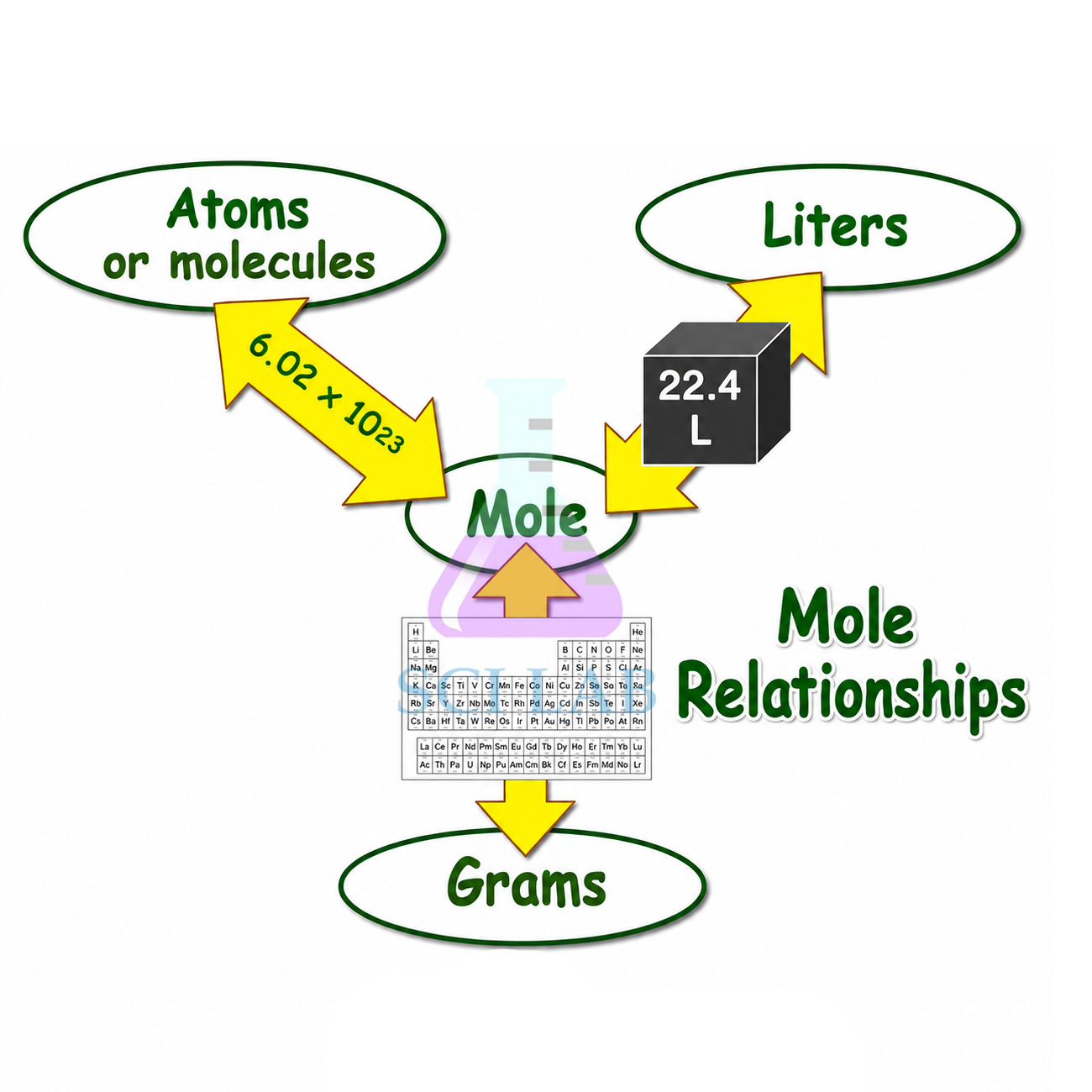
Product Code : SCL-CL-11602
The Relationships of The Mole (SKU SCL-CL-11602) is a laminated wall chart, 70 x 100 cm, for teaching the mole concept: how amount of substance links to mass, number of particles and gas volume. Chemistry teachers use it for stoichiometry lessons from Class 9 to first-year college. Orders from schools, colleges, training institutes, tender contractors and distributors are supplied by Science Lab Supplies out of Ambala, India.
Specifications
The mole relationships chart is printed at 70 x 100 cm and laminated, which makes it hard-wearing and easy to wipe. It is intended for wall mounting and suits both theory classrooms and laboratories, where students convert between grams, moles and particles while preparing solutions or analysing results.
| Parameter | Value |
|---|---|
| SKU | SCL-CL-11602 |
| Topic | Relationships of the mole (mole concept) |
| Size | 70 x 100 cm |
| Finish | Laminated |
| Mounting | Wall mounted |
| Use | Classrooms and laboratory |
| Supplied by | Science Lab Supplies, Ambala, India |
Applications and Experiments for the Mole Relationships Chart
The mole is the bridge between what students weigh on a balance and what happens at the level of atoms and molecules. A wall chart of mole relationships gives the class one consistent route for converting between mass, amount, particle number and gas volume in every calculation.
- NCERT Class 9 science, Atoms and Molecules: molar mass and the mole concept.
- NCERT Class 11 chemistry, Some Basic Concepts of Chemistry: stoichiometry, limiting reagent and molarity.
- Class 11–12 practicals: calculating the mass of solute needed to prepare standard solutions for titration.
- B.Sc. and diploma chemistry: quantitative analysis and yield calculations.
Standard Scope of Supply
One laminated wall chart, The Relationships of The Mole, measuring 70 x 100 cm, is included per unit ordered, as described above; any optional accessories are listed on the quotation. Balances and volumetric glassware for mole-based practicals are separate products.
Packing, MOQ and Lead Time
Quotations are available for a single mole chart as well as for bulk orders covering many classrooms or schools. Each one gives packing, delivery time and price for the requested quantity, and as a school laboratory equipment supplier in India we can add balances or other charts to it.
Holding an Importer-Exporter Code, Science Lab Supplies is a registered exporter able to ship to buyers in Oman, the Philippines, Nepal, Bangladesh, Zambia and Rwanda. You are welcome to write via the contact page, gather your list in the enquiry cart, or look at the lab tender page for tender-based buying.
Frequently Asked Questions
Which classes use a mole concept chart?
It is introduced in Class 9 science and used heavily in Class 11 chemistry for stoichiometry, then throughout Class 12 and college quantitative work.
How big is the chart and how is it finished?
The chart is 70 x 100 cm with a laminated surface, intended for mounting on a classroom or laboratory wall.
Who supplies The Relationships of The Mole chart?
Science Lab Supplies supplies it from Ambala, India, and can quote for one chart or larger orders from schools, colleges, contractors and distributors.
Can it be ordered with the SI Base Units chart?
Yes. The mole is one of the seven SI base units, so the two charts are often bought together and can share one quotation.
Related Stoichiometry Charts and Apparatus
Mole calculations draw on SI units, chemical formulas, relative atomic masses from the periodic table and accurate weighing. The four items below cover each of those needs and can be combined with this chart on a single quotation for a complete stoichiometry teaching set.
- SI Base Units — 70 x 100 cm chart that includes the mole among the base units.
- Chemical Symbols and Formulas — for writing the formulas used in mole calculations.
- Periodic Table of Chemical Elements (Short Version) — source of atomic masses for molar mass.
- Technical-Chemical Scale with Box of Weighing Stones — for weighing out measured amounts.
Browse the full Chemistry Lab range or all school lab equipment.
Last updated: 25 September 2026




100ml.jpg)
