Spoon for Substances
Product Code : SCL-CL-11552
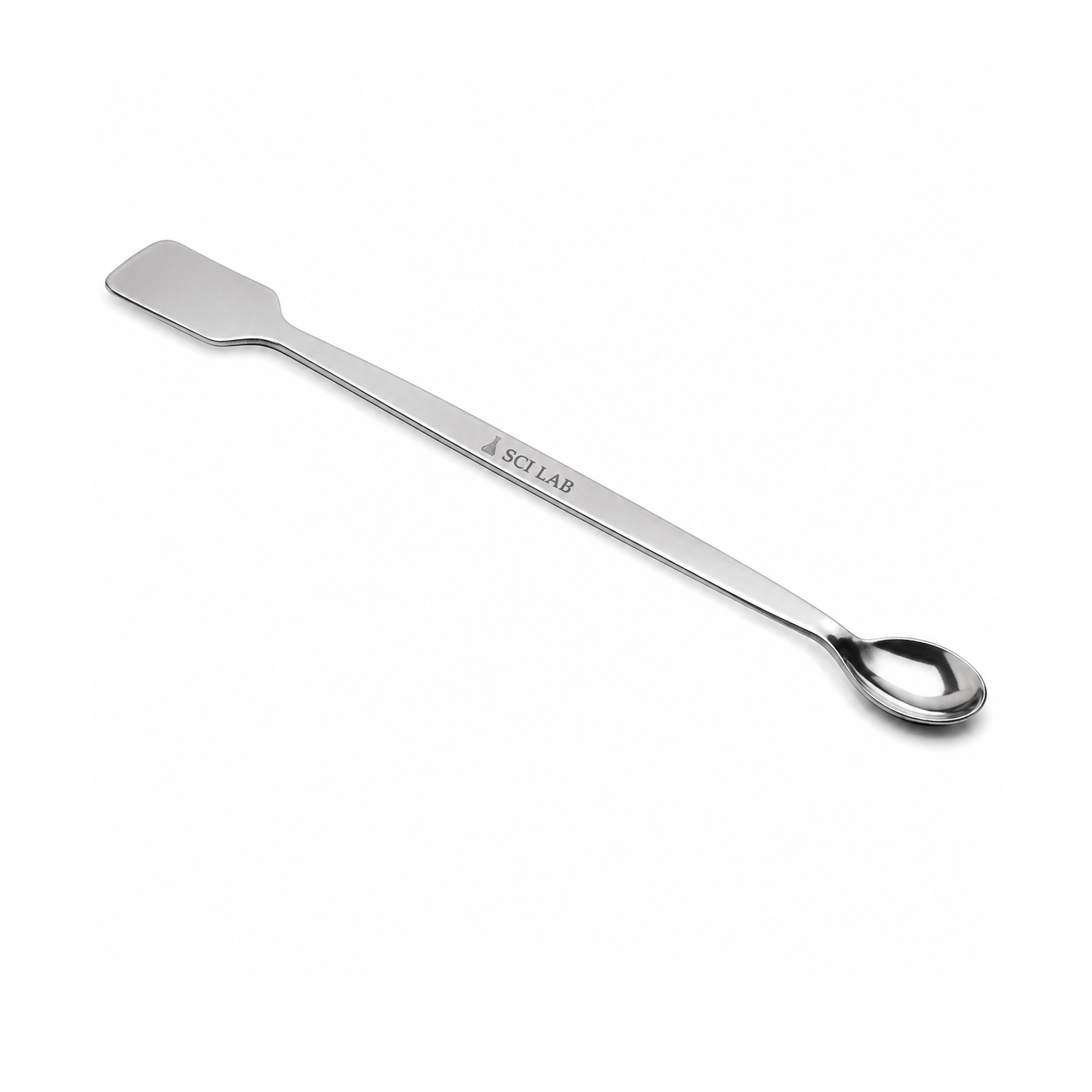
Spoon for Substances (SKU SCL-CL-11552) is a 120 mm polished steel spoon with a shoulder, used to take small quantities of powders, crystals and granules out of reagent bottles and transfer them to a weighing pan, test tube or beaker. Often called a chemical spoon or spatula spoon, it is found at every student station in school and college chemistry labs. Science Lab Supplies, located in Ambala, India, supplies it to schools, colleges, training institutes, tender contractors and distributors.
Specifications
The spoon is made of steel with a polished, silver finish and measures 120 mm overall. A shoulder between bowl and handle adds stiffness and helps the user judge a level spoonful. The metal is chemical resistant and rust resistant, so it can be wiped and reused across many practical sessions.
| Parameter | Value |
|---|---|
| SKU | SCL-CL-11552 |
| Also known as | Chemical spoon, spatula spoon |
| Material | Steel |
| Design | With shoulder |
| Total length | 120 mm |
| Resistance | Chemical resistant, rust resistant |
| Finish / colour | Polished / silver |
| Supplied by | Science Lab Supplies, Ambala, India |
Applications and Experiments for the Spoon for Substances
A chemical spoon is used every time a solid reagent is measured out: adding a pinch of salt to a test tube, transferring crystals to a watch glass, or loading a balance pan. Using a clean, dedicated spoon also stops reagents being contaminated by fingers or other chemicals.
- Class 6–10 science: adding solids to water to study solubility, mixtures and reactions.
- Class 11–12 chemistry: taking the salt sample for qualitative analysis and weighing solids for preparations.
- B.Sc. practicals: transferring reagents during gravimetric and preparative work.
- Pharmacy and testing labs: handling small amounts of powders at the balance.
Standard Scope of Supply
The Spoon for Substances is supplied as a single 120 mm steel spoon as described above. It is sold without any container or case; the number of spoons per pack and any optional accessories appear on the quotation you receive.
Packing, MOQ and Lead Time
Quote requests can cover a few spoons or one for every reagent bottle in the lab. The quotation lists packing, delivery time and price for your quantity, and a balance, reagent bottles or other bench tools can be priced alongside to complete a school chemistry lab equipment order.
As a registered exporter with an Importer-Exporter Code, Science Lab Supplies can ship to buyers in Ghana, Ethiopia, Tanzania, Uganda, the UAE and Saudi Arabia. Science Lab Supplies is registered for GST (GSTIN 06ADEPJ0574F2ZU). Get in touch using the contact page or the enquiry cart, and see the lab tender page for tender supply.
Frequently Asked Questions
How long is the spoon?
The total length is 120 mm, a convenient size for reaching into standard reagent bottles and for use at a balance.
Will it rust after contact with chemicals?
The steel is described as chemical resistant and rust resistant. Clean and dry it after each use, and use separate spoons for different reagents.
Who supplies the Spoon for Substances?
Science Lab Supplies supplies it from Ambala, India, and quotes schools, colleges, laboratories, dealers and tender contractors directly.
What does the shoulder do?
The shoulder stiffens the joint between bowl and handle, so the spoon does not bend when scooping firm or caked powders.
Related Weighing and Handling Tools
A chemical spoon is used between the reagent bottle and the balance. These four Chemistry Lab items connect those steps: a wide-mouth reagent bottle, a technical scale for weighing solids, a combustion spoon for burning tests, and a small blade for loosening caked material.
- Technical-Chemical Scale with Box of Weighing Stones — 100 g scale for weighing solids.
- Glass Bottle, Wide Mouth — 60 ml colourless wide-mouth reagent bottle with a frosted stopper.
- Spoon for Burning — wire-handled spoon for combustion tests.
- Dagger — stainless steel blade tool for loosening solids.
Browse the full Chemistry Lab range or all school lab equipment.
Last updated: 25 September 2026

.jpg)