
Solar & Lunar Eclipse
.png)
Product Code : SCL-ALE-11950
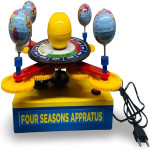
The Solar & Lunar Eclipse Model supports visual explanation of two distinct astronomical events. During a solar eclipse, the Moon passes between the Sun and Earth and casts a shadow on Earth. During a lunar eclipse, Earth moves between the Sun and Moon, causing Earth's shadow to fall on the Moon.
The model can help students compare these two alignments and understand the role of light, shadow, and relative position. Exact construction material, dimensions, weight, scale, movement mechanism, light source, markings, and movable components have not been specified, so no unsupported technical claims are made.
Key Features
- Demonstrates two eclipse concepts: Supports explanation of both solar and lunar eclipses within one educational topic.
- Visualizes celestial alignment: Helps students understand the relative positions of the Sun, Earth, and Moon.
- Supports light and shadow learning: Provides a practical reference for discussing how shadows produce eclipse phenomena.
- Suitable for classroom demonstrations: Useful for teacher-led astronomy, geography, Earth science, and general science lessons.
- Encourages comparative learning: Helps learners distinguish between the alignment that produces a solar eclipse and the alignment that produces a lunar eclipse.
- Honest technical positioning: No claim regarding exact scale, material, illumination, dimensions, or astronomical precision is made without verified product data.
Technical Specifications
|
Specification |
Detail |
|
Product Name |
Solar & Lunar Eclipse |
|
Brand |
Science Lab Supplies |
|
Product Category |
Astronomy Lab Equipment / Educational Eclipse Demonstration Model |
|
Primary Educational Function |
Demonstration of solar and lunar eclipse alignments |
What's Included in the Kit
- 1 × Solar & Lunar Eclipse educational model
Applications / Uses
- Demonstrating how a solar eclipse occurs when the Moon moves between the Sun and Earth.
- Explaining how a lunar eclipse occurs when Earth moves between the Sun and Moon.
- Teaching the role of celestial alignment, light, and shadow in eclipse formation.
- Supporting astronomy, Earth science, geography, and general science lessons.
- Complementing astronomy lab equipment, educational lab equipment, geography lab equipment, and physics lab equipment.
How to Use the Solar & Lunar Eclipse Model
- Place the model on a stable surface where students can clearly observe the represented celestial bodies.
- Identify the Sun, Earth, and Moon components actually included in the supplied model.
- For a solar eclipse demonstration, position or operate the model so the Moon is represented between the Sun and Earth.
- For a lunar eclipse demonstration, arrange the represented bodies so Earth is between the Sun and Moon.
- Use the model to discuss which object casts the shadow in each eclipse.
- Compare both arrangements and ask students to explain the difference between solar and lunar eclipses.
Safety and handling note: Use the product only as an educational demonstration model. Never look directly at the Sun during a real solar eclipse without appropriate certified solar-viewing protection. Handle movable components gently and do not force the mechanism.
Care & Maintenance
- Remove dust with a soft, dry cloth suitable for the confirmed construction material.
- Do not force rotating, adjustable, or movable components.
- Store the model in a dry, protected location away from impacts and excessive moisture.
- Inspect the model before classroom use and secure any loose components according to its actual design.
Why Choose Science Lab Supplies
Science Lab Supplies manufactures and exports scientific laboratory instruments, experiment setups, science kits, mathematics kits, didactic models, and STEM models and kits. Its educational portfolio covers astronomy, geography, physics, and general laboratory teaching requirements. Institutional buyers should confirm the model's material, dimensions, mechanism, scale, supplied components, packing, and project-specific requirements before ordering.
Frequently Asked Questions
What is a Solar & Lunar Eclipse Model used for?
It is used as an educational teaching aid for demonstrating the different Sun-Earth-Moon alignments associated with solar and lunar eclipses.
What is the difference between a solar eclipse and a lunar eclipse?
A solar eclipse occurs when the Moon passes between the Sun and Earth and casts a shadow on Earth. A lunar eclipse occurs when Earth is between the Sun and Moon and Earth's shadow falls on the Moon.
Is the Solar & Lunar Eclipse Model suitable for schools?
Yes. It is suitable for guided lessons in astronomy, Earth science, geography, and general science.
Does this model include a built-in light source?
No built-in lamp, electrical supply, or illumination system has been specified in the supplied product data. These features should be confirmed before publication or procurement.
What material is the Solar & Lunar Eclipse Model made of?
The construction material has not been specified in the supplied product information and should be confirmed before making a technical claim.
Is the model made to an exact astronomical scale?
No scale or dimensional accuracy has been verified. The product should therefore be presented as an educational demonstration model rather than a precision astronomical scale replica unless supporting documentation confirms otherwise.
Explore the complete range of astronomy lab equipment from Science Lab Supplies for additional educational models and classroom astronomy teaching solutions.
 (1).png)
 (1).png)
.jpg)
.jpeg)
.jpg)
.jpg)
.jpg)