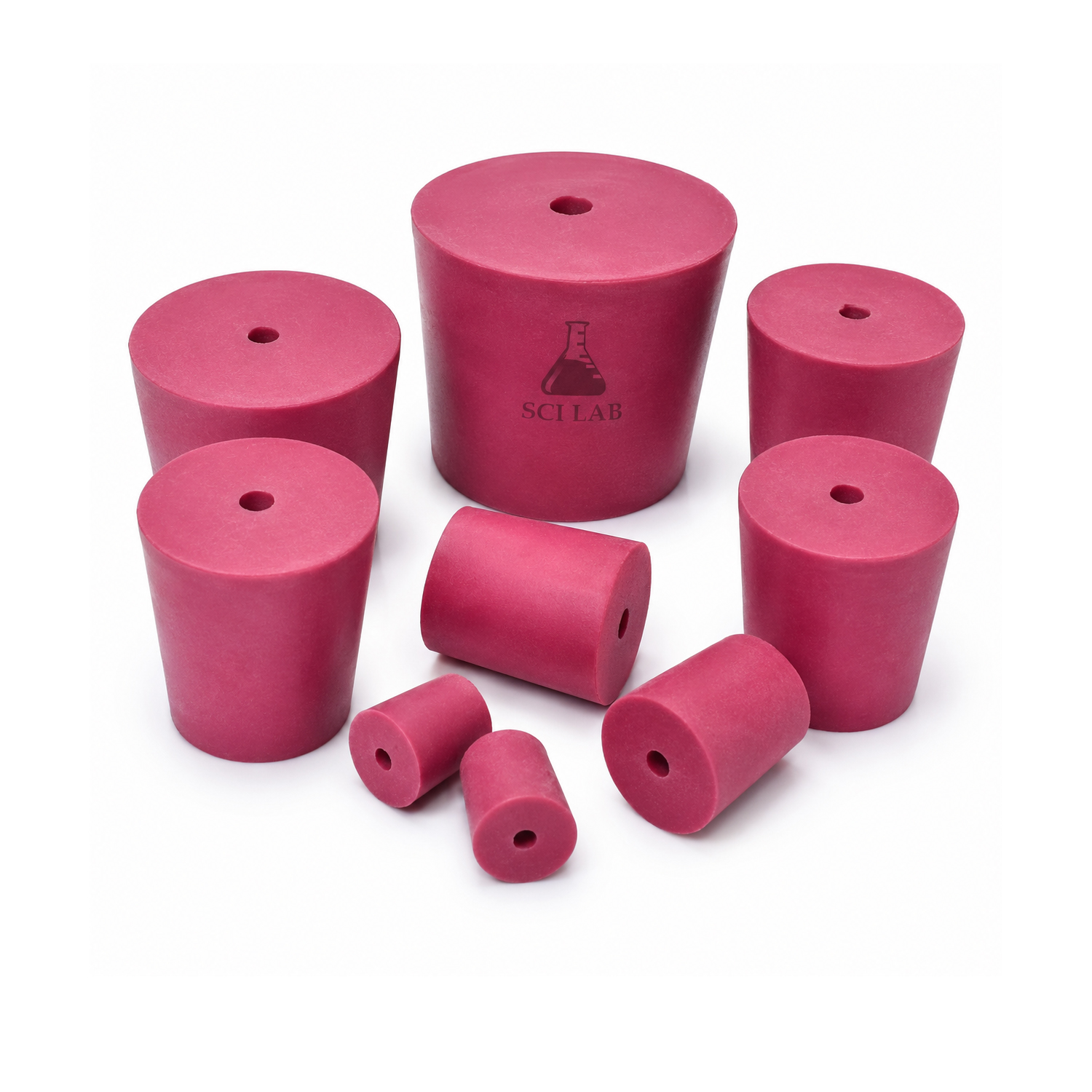
Rubber Stoppers of Various Diameters with Holes
Product Code : SCL-CL-11546
Rubber Stoppers of Various Diameters with Holes (SKU SCL-CL-11546) are round, bored rubber corks that close a test tube or flask while letting a glass delivery tube, thermometer or funnel pass through the hole. They are used in gas preparation, distillation and apparatus-building practicals in schools, colleges and teaching labs. Science Lab Supplies offers them from Ambala, India, supplying schools, colleges, training institutes, tender contractors and distributors.
Specifications
These stoppers are moulded in chemical-resistant rubber in a round, tapered shape and come in four bottom diameters: 11 mm, 13 mm, 14 mm and 15 mm. Each has a hole bored through its centre so glass tubing can be pushed in to make a gas-tight joint.
| Parameter | Value |
|---|---|
| SKU | SCL-CL-11546 |
| Also known as | Bored rubber corks, holed rubber bungs |
| Material | Rubber, chemical resistant |
| Shape | Round |
| Bottom diameters | 11 mm, 13 mm, 14 mm, 15 mm |
| Hole | With hole |
| Supplied by | Science Lab Supplies, Ambala, India |
Applications and Experiments for the Rubber Stoppers with Holes
Holed stoppers turn a test tube or flask into a closed apparatus with an outlet. Students fit a delivery tube to collect a gas, a thermometer to follow a temperature, or a funnel to add liquid, which covers many NCERT gas-preparation activities and college organic set-ups.
- Class 7–10 science: preparing and collecting carbon dioxide, hydrogen or oxygen through a delivery tube.
- Class 11–12 chemistry: fitting thermometers and tubes in simple distillation and heating experiments.
- B.Sc. practicals: assembling gas generators, wash bottles and suction set-ups.
- Biology labs: respiration and fermentation experiments using a sealed tube with an outlet.
Wet the glass tube and protect your hand with a cloth when pushing it into the hole; never force dry glass through rubber.
Standard Scope of Supply
The stoppers are supplied with holes in the bottom diameters 11 mm, 13 mm, 14 mm and 15 mm. Tell us which sizes you need and how many of each; the quotation confirms the size mix and pack quantity. Glass tubing is not included.
Packing, MOQ and Lead Time
Stoppers can be quoted by size in small numbers or in bulk for a full laboratory stock. Each quotation specifies the packing, delivery time and price for your quantities, and glass tubes, rubber tubing or flasks can be added so the complete set-up arrives in one shipment.
Science Lab Supplies, a registered exporter with an Importer-Exporter Code, can ship to buyers in Malaysia, Peru, Egypt, Iraq, Nigeria and Kenya. List your sizes on the enquiry cart or write via the contact page; the lab tender page covers institutional orders.
Frequently Asked Questions
Which sizes are available?
The stoppers come in bottom diameters of 11 mm, 13 mm, 14 mm and 15 mm. Measure the inner mouth of your tube or flask and choose the size that fits snugly.
What is the hole used for?
The hole takes a glass delivery tube, thermometer or thistle funnel, so the vessel stays closed while gas or liquid passes in or out.
Who supplies these rubber stoppers?
Science Lab Supplies sends them from Ambala, India, to schools, colleges, dealers and tender contractors, with the rest of the chemistry order.
Do you also have stoppers without holes?
Yes. Solid rubber stoppers in the same diameters are listed separately and can be quoted together with these.
Related Tubing and Stoppers
A holed stopper is only half of a gas-tight joint. The four items below from the Chemistry Lab range supply the glass tubes, branch pieces, flexible tubing and solid stoppers that complete gas-preparation and distillation set-ups, so students can build full assemblies from one quotation.
- Rubber Stoppers of Various Diameters Without Holes — solid stoppers for sealing.
- Glass Tubes of Different Diameters — tubing to pass through the hole.
- T-Shaped Glass Tubes — branch connectors for gas lines.
- Rubber Tube (Laboratory) — flexible link between glass pieces.
Browse the full Chemistry Lab range or all school lab equipment.
Last updated: 25 September 2026
forLiquids.jpg)
.jpg)
.jpg)

.jpg)