
Metal Filings/ Powder
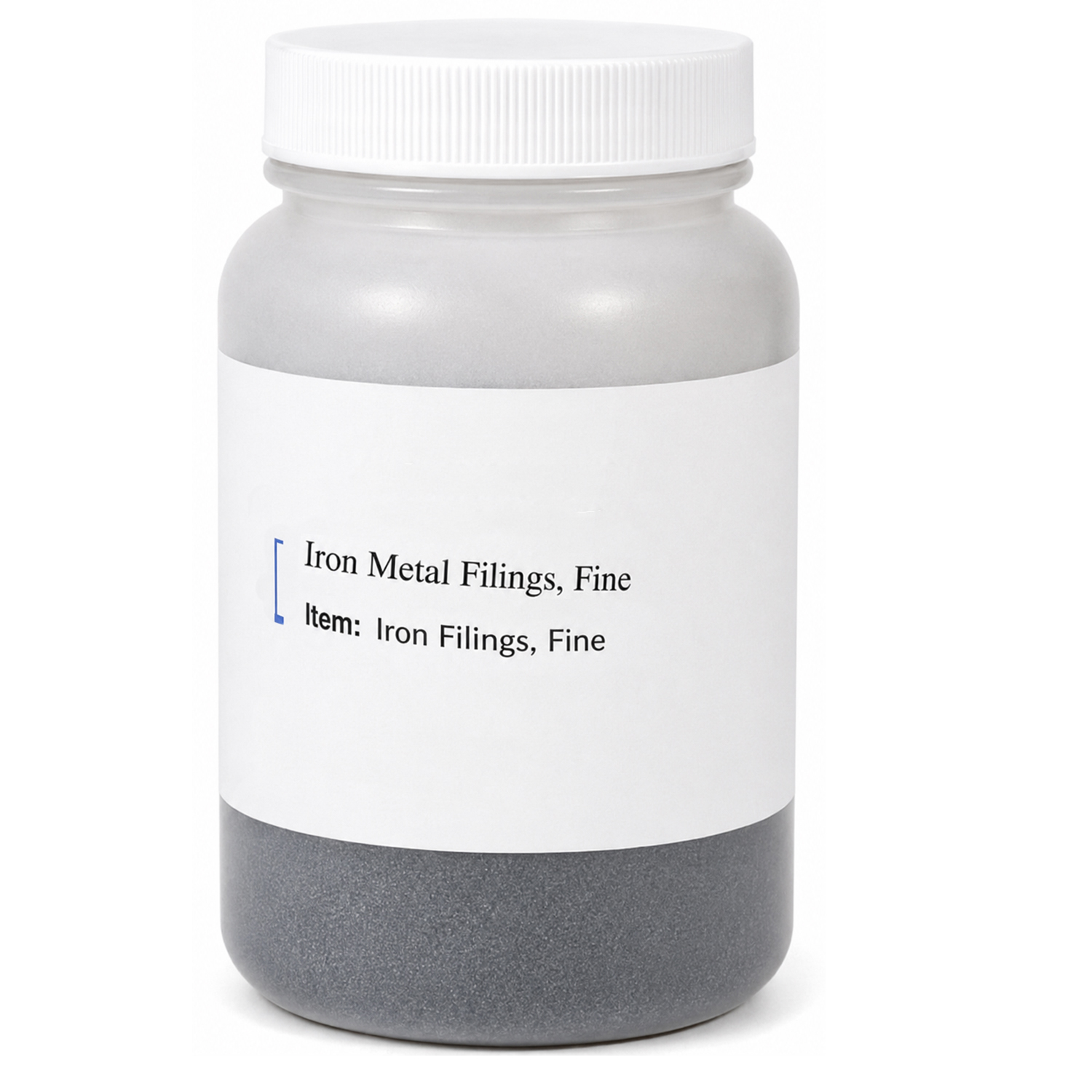
Product Code : SCL-CL-11885
Metal Filings/ Powder (SKU SCL-CL-11885) are fine, powdery shavings of ferromagnetic iron, packed 300 g to a plastic jar. Sprinkled around a magnet or current-carrying wire, the iron filings line up along the field and make invisible magnetic field lines visible, which is why they appear in almost every school magnetism lesson. Science Lab Supplies, Ambala, India, supplies them to schools, colleges, tender contractors and distributors.
Specifications
The filings are very small, powder-like particles of ferromagnetic iron. Because each particle becomes a tiny magnet in a field, the filings arrange themselves along field lines and show both the direction and relative strength of the field. The 300 g quantity comes in a plastic jar for storage.
| Parameter | Value |
|---|---|
| SKU | SCL-CL-11885 |
| Model no. | SCI/LSS-1526 |
| Material | Ferromagnetic iron filings (powder) |
| Quantity | 300 g |
| Container | Plastic jar |
| Purpose | Visualising magnetic field direction and strength |
| Supplied by | Science Lab Supplies, Ambala, India |
Applications and Experiments for the Iron Filings
Iron filings are used to map magnetic fields around bar and horseshoe magnets, between like and unlike poles, and around coils and straight conductors carrying current. They support the magnetism chapters of CBSE/NCERT Class 6 and Class 10 science and Class 12 physics, as well as mixture-separation activities in Class 9 chemistry.
- Class 6 science: showing the field pattern and poles of a bar magnet.
- Class 10 science (Magnetic Effects of Electric Current): field lines around a straight wire, loop and solenoid.
- Comparing attraction and repulsion patterns between like and unlike poles.
- Class 9 chemistry: separating iron from sulphur or sand with a magnet.
Place a sheet of card or glass over the magnet before sprinkling so filings do not cling to the magnet itself, tap gently to form the pattern, and return the filings to the closed jar. Keep them away from eyes and wash hands after use.
Standard Scope of Supply
One plastic jar containing 300 g of iron filings is supplied per unit. Magnets, coils and cards for the field experiments are separate items and can be listed on the same quotation.
Packing, MOQ and Lead Time
A single jar may be enough for a demonstration, while several jars suit student group work across a lab. Every quotation states the packing, delivery time and price for the number of jars requested, and magnets or compasses can be added.
Science Lab Supplies has an Importer-Exporter Code and is able to ship to buyers in Uganda, the UAE, Saudi Arabia, Oman, the Philippines and Nepal. For prices, write via the contact page or submit an enquiry cart; tender details are on the lab tender page.
Frequently Asked Questions
How much iron filings come in one jar?
Each unit is 300 g of fine ferromagnetic iron filings in a plastic jar, enough for repeated magnetic field demonstrations.
How do I stop filings sticking to the magnet?
Cover the magnet with a sheet of card, paper or glass and sprinkle the filings on top. The field still passes through, and the filings can be poured back into the jar afterwards.
Who supplies these iron filings?
Science Lab Supplies supplies them from Ambala, India, as part of its school chemistry lab equipment in India range, quoted singly or in bulk.
How should the filings be stored?
Keep the jar tightly closed in a dry place so the iron stays free-flowing and does not rust from moisture.
Related Magnetism Equipment
Iron filings need a magnetic field to work with, so they are usually ordered together with magnets, compasses and coils. These four items complete a magnetism bench for field-line, pole-identification and electromagnet practicals from middle school to senior secondary level.
- Permanent Magnet Bar and Horseshoe — the two classic field shapes to map.
- Horseshoe Shaped Magnet — a strong field between close poles.
- Compass — plotting field direction point by point.
- Set of Coils with Removable Iron Core — electromagnet and solenoid field work.
Browse the full Chemistry Lab range or all school lab equipment.
Last updated: 25 September 2026
.png)




.jpg)