Electroscope
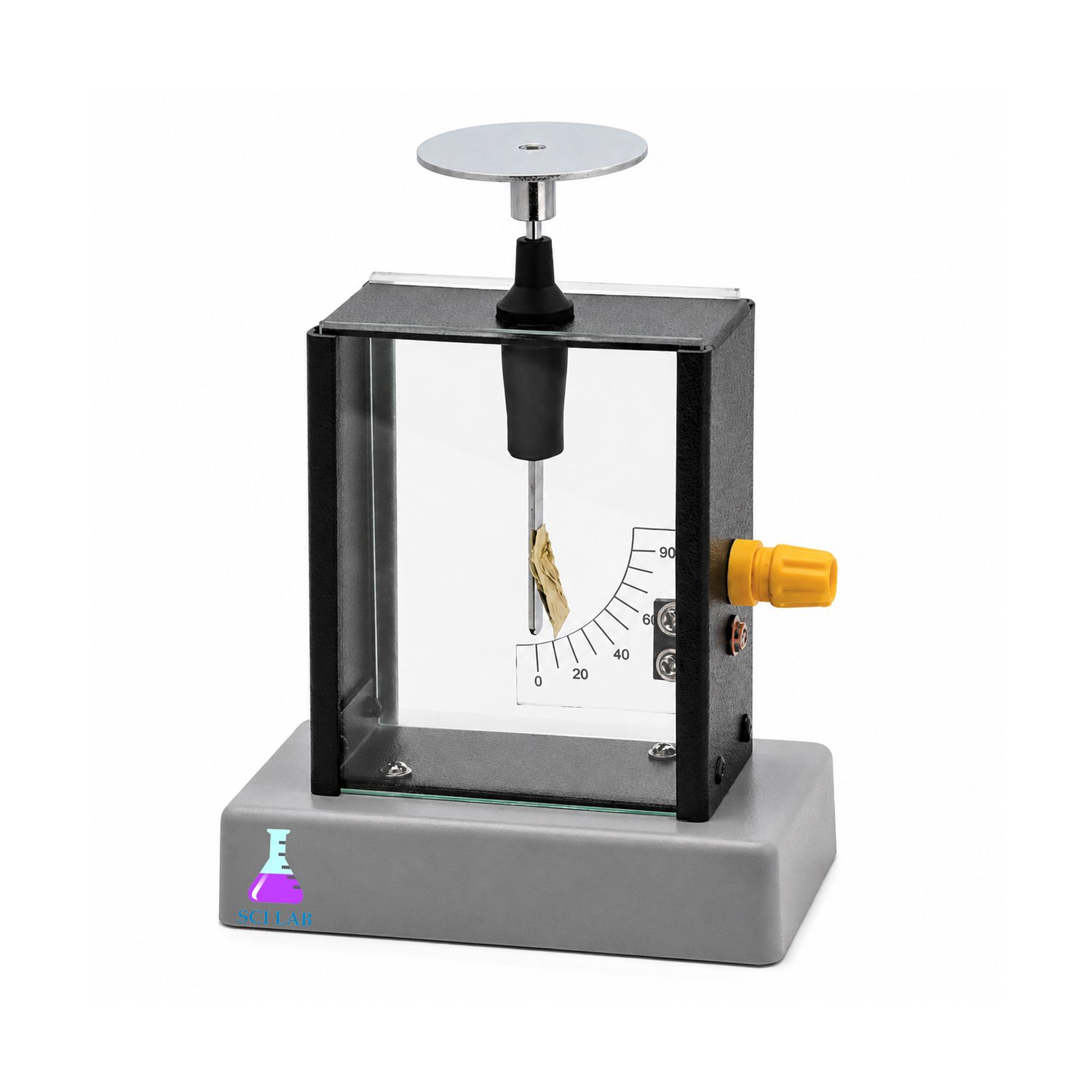
Product Code : SCL-CL-11872
Electroscope (SKU SCL-CL-11872) is a pointer-type instrument that detects electric charge: when a charged object touches or nears its top disc, the aluminium arrow inside the case swings away from its support. It is housed in a sheet metal case with glass viewing panels and an earthing terminal, for Class 8–12 and college electrostatics. Science Lab Supplies quotes the instrument from Ambala, India for schools, colleges, training institutes, distributors and tender contractors.
Specifications
A rectangular sheet metal case stands on an insulated base, with removable sliding glass panels front and back: one clear for viewing, the other ground glass for a plain background. The removable disc electrode passes through an insulated moulded plastic bush to limit charge leakage, and a plated metal blade below carries the aluminium arrow.
| Parameter | Value |
|---|---|
| SKU | SCL-CL-11872 |
| Case | Rectangular sheet metal on an insulated base |
| Panels | Removable sliding glass, front and back; one clear, one ground glass |
| Electrode | Removable disc through an insulated moulded plastic bush |
| Indicator | Aluminium arrow on a plated metal blade |
| Earthing | Side terminal |
| Supplied by | Science Lab Supplies, Ambala, India |
Applications and Experiments for the Electroscope
The electroscope makes invisible charge visible, so it anchors most school and college electrostatics practicals: detecting charge, telling its sign, and showing induction and leakage. It supports NCERT Class 8 science, the electric charges chapter of Class 12 physics and first-year B.Sc. electricity labs.
- Class 8 science: detecting charge on rubbed rods.
- Class 12 physics: charging by conduction and by induction, then earthing via the side terminal.
- Comparing charges: a known charge first, then observing whether the arrow rises further or falls.
- Ionisation demonstrations: the front window slides upward so ionising material can be placed in the chamber to show the charge leaking away.
Any ionising source is a separate item; handle it only under teacher supervision and your institution's radiation-safety rules.
Standard Scope of Supply
The Electroscope is supplied as a single unit as described above: case on insulated base, sliding clear and ground glass panels, disc electrode with insulating bush, blade and aluminium arrow, and earthing terminal. Charging rods and any ionising source are not included; optional accessories are listed on the quotation.
Packing, MOQ and Lead Time
Quotations are available for one demonstration instrument or a set for student benches, each giving packing, delivery time and price for that number. Charging rods and other school chemistry lab equipment in India can be priced on the same quotation.
Holding an Importer-Exporter Code, Science Lab Supplies can ship to buyers in South Africa, Qatar, Sri Lanka, Vietnam, Malaysia and Peru. Science Lab Supplies is registered for GST (GSTIN 06ADEPJ0574F2ZU). To ask for a price, reach the team on the contact page, place the item in the enquiry cart, or follow the lab tender page.
Frequently Asked Questions
How does this electroscope show charge?
Charge on the top disc spreads to the metal blade and the aluminium arrow. Like charges repel, so the arrow swings away from the blade; the larger the charge, the wider the deflection.
Why are there two different glass panels?
One panel is clear so students can watch the arrow; the other is ground glass, which gives a plain background and makes the arrow easier to see.
Who supplies the Electroscope?
Science Lab Supplies, based in Ambala, India, supplies it and quotes schools, colleges, training institutes, distributors and tender contractors directly for single instruments or class sets.
How is the electroscope discharged?
Connect the side terminal to earth or touch the disc with a finger. The charge flows away and the arrow falls back to rest.
Related Electrostatics Apparatus
An electroscope needs charged objects to test and benefits from other electrostatics demonstrations. These four items supply positive and negative charge, light test objects and a shielding demonstration, and all can go on one enquiry.
- Ebonite Rod — charges by friction with its cloth.
- Glass Rod with Rubbing Material — gives a positive charge.
- Demonstration Faraday Rage — mesh cage for shielding experiments.
- Balls Styrofoam — light spheres for attraction tests.
Browse the full Chemistry Lab range or all school lab equipment.
Last updated: 25 September 2026