Distiller for Distilled Water
Product Code : SCL-CL-11567
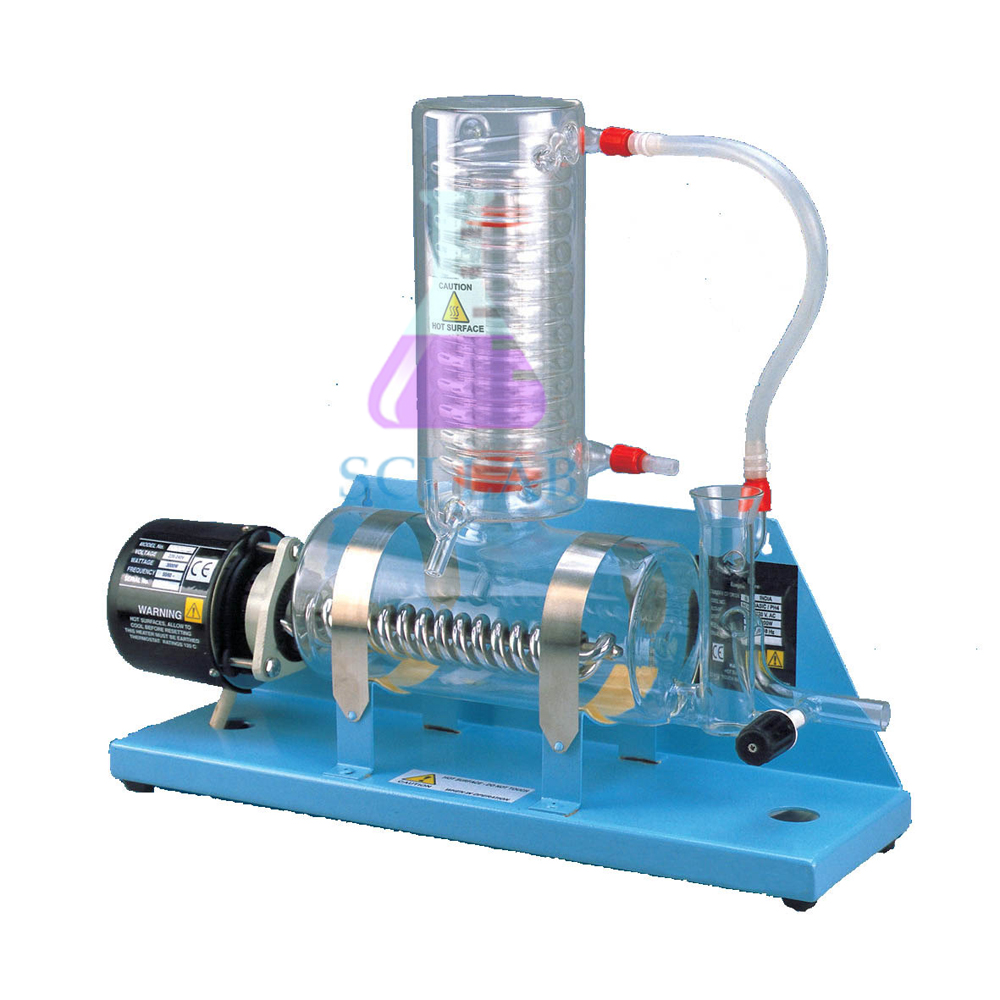
Distiller for Distilled Water (SKU SCL-CL-11567) is an electric water still that produces 1–2 litres of distilled water per hour for making up reagents, rinsing glassware and topping up instruments. It runs on single-phase 220 V power at 700–900 W, which suits a school or college preparation room. Science Lab Supplies delivers it from Ambala, India to schools, colleges, training institutes, tender contractors and distributors.
Specifications
The unit boils ordinary water and condenses the steam to give distilled water at 1–2 litres per hour. It draws 700–900 W from a single-phase 220 V supply, so it can run from a normal laboratory power point rather than an industrial connection.
| Parameter | Value |
|---|---|
| SKU | SCL-CL-11567 |
| Also known as | Laboratory water still |
| Output | 1–2 litres per hour |
| Power supply | Single phase, 220 V |
| Power | 700–900 W |
| Supplied by | Science Lab Supplies, Ambala, India |
Applications and Experiments for the Distiller for Distilled Water
Distilled water is needed in almost every chemistry and biology practical, because tap water carries dissolved salts that affect results. A small still lets a laboratory make its own supply for solutions, titrations and final rinsing, and it also shows students distillation in action alongside other laboratory distillation apparatus in India.
- Class 9–12 chemistry: preparing standard solutions and indicator solutions with pure water.
- Class 11–12 and B.Sc. labs: final rinsing of burettes, pipettes and flasks before titration.
- Biology labs: preparing stains and mounting solutions.
- Class 9 science: demonstrating purification of water by distillation.
The still works with boiling water and mains electricity: keep it on a stable bench, never let it run dry, and allow it to cool before cleaning.
Standard Scope of Supply
The Distiller for Distilled Water is supplied as a single unit as described above, rated 1–2 litres per hour at 220 V. Storage bottles for the distillate are separate; any optional accessories are listed on the quotation.
Packing, MOQ and Lead Time
You can request a quotation for a single still for one preparation room or several for a group of schools. It shows the packing, delivery time and price for that quantity, and distilled-water bottles or wash bottles can be priced on the same document.
With its Importer-Exporter Code, Science Lab Supplies is a registered exporter that can ship to buyers in Vietnam, Malaysia, Peru, Egypt, Iraq and Nigeria. Check the voltage of your site before ordering, then reach us through the contact page or enquiry cart; tenders are handled via the lab tender page.
Frequently Asked Questions
How much distilled water does it produce?
The still produces 1–2 litres of distilled water per hour, enough for the daily needs of a typical school or college teaching laboratory.
What power supply does it need?
It runs on single-phase 220 V power and draws 700–900 W, so it works from a standard laboratory socket on a 220 V supply.
Who supplies the Distiller for Distilled Water?
Science Lab Supplies supplies it from Ambala, India, preparing quotations for single laboratories, distributors and tender contractors.
Can distilled water replace deionised water?
For most school and college practicals, yes. Both remove dissolved salts; distillation also removes many non-ionic impurities, while a deioniser gives water faster without heating.
Related Water-Purification Items
Producing pure water is only the first step; it also has to be stored and dispensed without contamination. These items cover an alternative purification method, a condenser for glass distillation and containers for storing and using the water.
- Mariot Bottle (for Distilled Water) — storage bottle for distilled water.
- Deioniser Lab — an alternative way to purify water.
- Liebig Condenser for Distillation of Water — for glass distillation demonstrations.
- Plastic Washing Bottle (Pisetta) — for dispensing water at the bench.
Browse the full Chemistry Lab range or all school lab equipment.
Last updated: 25 September 2026
.jpg)


forLiquids.jpg)