Block with Hook
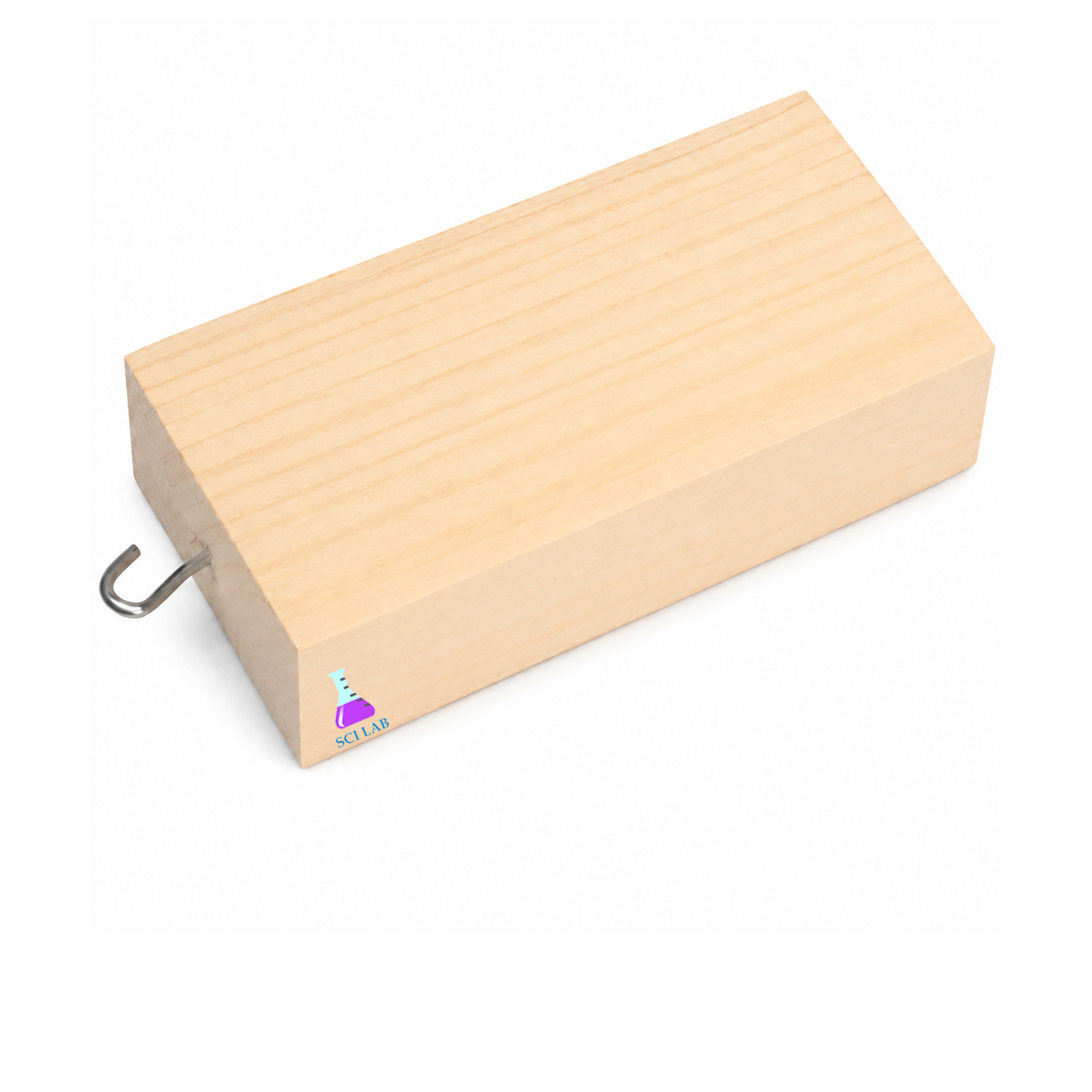
Product Code : SCL-CL-11860
Block with Hook (SKU SCL-CL-11860) is a 10 x 5 x 1 cm friction block with different surfaces and a metal hook, used to study friction and how objects move across different surfaces. Pulled with a spring balance on the hook, it shows that rough faces resist motion more than smooth ones and that extra weight on top raises friction. Science Lab Supplies dispatches it from Ambala, India to schools, colleges, institutes, tender contractors and distributors.
Specifications
The block measures 10 cm long, 5 cm wide and 1 cm thick, and its faces have different surfaces for friction investigation. A metal hook at one end connects it to a spring balance or string, so the force needed to pull the block can be measured directly.
| Parameter | Value |
|---|---|
| SKU | SCL-CL-11860 |
| Dimensions | 10 x 5 x 1 cm |
| Surfaces | Different surfaces for friction investigation |
| Hook | Metal, for spring balance or string |
| Demonstrates | Rough vs smooth surfaces; effect of added weight on friction |
| Supplied by | Science Lab Supplies, Ambala, India |
Applications and Experiments for the Block with Hook
The block is the moving body in most school friction practicals. Students pull it across a bench or track on each face, record the force, then add weights on top and repeat, showing how surface texture and normal force change friction. It is used from middle school to first-year college physics.
- NCERT Class 8 science, friction: comparing the pull needed on rough and smooth surfaces.
- CBSE Class 11 physics practical: relating limiting friction to normal reaction and finding the coefficient of friction.
- Inclined plane studies: finding the angle at which the block begins to slide.
- Diploma and B.Sc. mechanics: static and kinetic friction measurements.
Standard Scope of Supply
The Block with Hook is supplied as a single 10 x 5 x 1 cm block with its different surfaces and metal hook, as described above. Spring balances, weights, pulleys and tracks are separate items that can be added to the quotation.
Packing, MOQ and Lead Time
Order one block for a demonstration or a block for every pair of students. The quotation will state packing, delivery time and price for your quantity, and a dynamometer, weights or other chemistry lab equipment in India from the same range can be quoted with it.
Science Lab Supplies, which holds an Importer-Exporter Code, can ship to buyers in Ghana, Ethiopia, Tanzania, Uganda, the UAE and Saudi Arabia. Science Lab Supplies is registered for GST (GSTIN 06ADEPJ0574F2ZU). For prices, contact us on the contact page, add products to the enquiry cart, or see how tenders are handled on the lab tender page.
Frequently Asked Questions
What size is the friction block?
It measures 10 x 5 x 1 cm, large enough to carry extra weights on top and small enough to pull along a standard bench or laboratory track.
What does the experiment show?
Pulling the block on its different faces shows that rough surfaces create more resistance than smooth ones, and adding weight on top shows that a greater pulling force is then needed.
Who is the supplier of the Block with Hook?
Science Lab Supplies supplies it from Ambala, India, and includes it in quotations for school, college and contractor laboratory orders, working as a school laboratory equipment supplier in India.
How is the pulling force measured?
Attach a spring balance or dynamometer to the metal hook and pull steadily; alternatively run a string over a table-clamp pulley to hanging weights.
Related Friction Equipment
A friction block needs a force meter, loads and a surface to slide on. These four items make up a complete friction bench with the block and are usually ordered together for Class 8 to Class 11 practicals.
- Mechanical Dynamometer with Upper and Lower Hooks — reads the pulling force, 0–20 N.
- Laboratory Track (Inclined Plane) — 1.2 m track for sliding and incline work.
- Weights with Hooks — extra load on the block or hanging masses.
- Pulley with Table Clamp — string-and-weight pulling at the bench edge.
Browse the full Chemistry Lab range or all school lab equipment.
Last updated: 25 September 2026

.jpg)
50ml.jpg)