Atwood Machine
Product Code : SCL-PL-12394
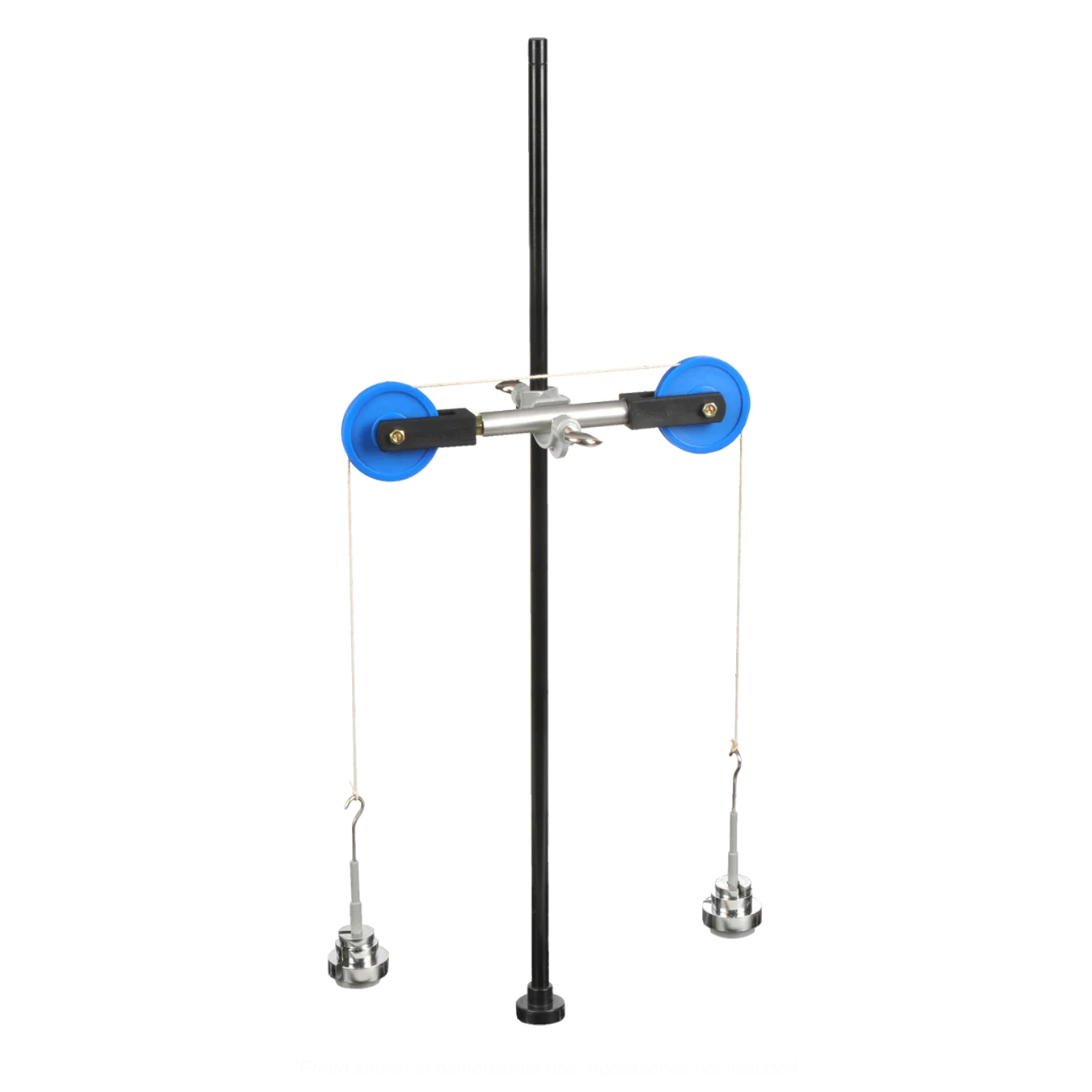
Atwood Machine (SKU SCL-PL-12394) hangs two unequal loads over a friction-minimised pulley so their acceleration is small enough to measure, letting students test Newton's second law and estimate g. It is used in Class 11 physics, B.Sc. mechanics and first-year engineering laboratories. Science Lab Supplies, which manufactures the machine at Plot 448, HSIIDC Industrial Area, Saha, Ambala, India, supplies it from the factory to schools, colleges, tender contractors and distributors.
Specifications
The pulley is mounted on stainless-steel support rods held by a table clamp that allows horizontal or vertical mounting, with a multi-clamp using two thumb screws. A braided cord carries four 5.0 g hangers and a fine mass set from 0.5 g to 100 g.
| Parameter | Value |
|---|---|
| SKU | SCL-PL-12394 |
| Pulley | Friction-minimised |
| Support rods | Stainless steel |
| Table clamp | Horizontal or vertical rod mounting |
| Multi-clamp | Two thumb screws |
| Cord | Braided |
| Hangers | 4 × 5.0 g |
| Slotted masses | 3 × 100 g, 3 × 50 g, 2 × 20 g, 2 × 10 g, 3 × 5.0 g, 3 × 2.0 g, 3 × 1.0 g, 3 × 0.5 g |
| Manufacturer | Science Lab Supplies, Saha, Ambala, Haryana |
| Country of origin | India |
Applications and Experiments for the Atwood Machine
The machine shows how acceleration depends on the difference between two hanging masses and on their total. Timing the fall over a measured distance gives the acceleration, from which students verify Newton's second law and calculate g, a standard experiment for mechanics lab equipment in India.
- Class 11 physics (laws of motion): a = (m1 − m2)g / (m1 + m2).
- Determining g from the measured acceleration.
- Moving masses between the two sides at constant total mass to show that acceleration follows net force.
Clamp the rod firmly to a sturdy bench and place a soft pad below the descending hanger.
Standard Scope of Supply
Each Atwood Machine includes the friction-minimised pulley, stainless-steel support rods, a table clamp for horizontal or vertical mounting, a multi-clamp with two thumb screws, braided cord, four 5.0 g hangers and the slotted mass set from 0.5 g to 100 g. Timers are quoted separately.
Packing, MOQ and Lead Time
The quotation can be for one Atwood Machine or a set per practical group, stating packing, delivery time and price for that quantity. Timers, extra masses and other school physics lab equipment from the range can be added before the quotation is issued.
Registered as an exporter under an Importer-Exporter Code, Science Lab Supplies can ship to buyers in Oman, the Philippines, Nepal, Bangladesh, Zambia and Rwanda. For pricing, contact the team from the contact page, send a list through the enquiry cart, or open the lab tender page for tenders.
Frequently Asked Questions
What masses come with the Atwood Machine?
Four 5.0 g hangers and slotted masses of 3 × 100 g, 3 × 50 g, 2 × 20 g, 2 × 10 g, 3 × 5.0 g, 3 × 2.0 g, 3 × 1.0 g and 3 × 0.5 g.
Is Science Lab Supplies the manufacturer or a trader?
Science Lab Supplies is the manufacturer, not a trader. The machine is made in the company’s factory at Saha, Ambala, India, which also prepares the quotation, so no agent stands between you and the maker.
How is it different from the Air-Bearing Rotational System?
The Atwood Machine studies linear acceleration of two hanging masses over a pulley. The Air-Bearing Rotational System studies rotation, turning a disk on an air bearing with torques of 0.05–0.60 mN·m.
Related Mechanics Apparatus
Timing and loading are what an Atwood experiment needs most, and the items below provide both: a larger hanger mass set, a simple fixed pulley, a photogate timer for accurate readings and a rotational system that extends Newton's second law to rotation.
- Mass Set with Hangers — steel masses from 10 g to 1000 g.
- Fixed Pulley — cast metal pulley with deep V-groove.
- Electronic Timer with Photogates — four photogates and a data-storing timer.
- Air-Bearing Rotational System — air-bearing disk for rotational dynamics.
Browse the full Physics Lab range or all physics lab equipment.
Last updated: 25 September 2026