Apparatus for Electrical Conductivity of Electrolytes
Product Code : SCL-CL-11447
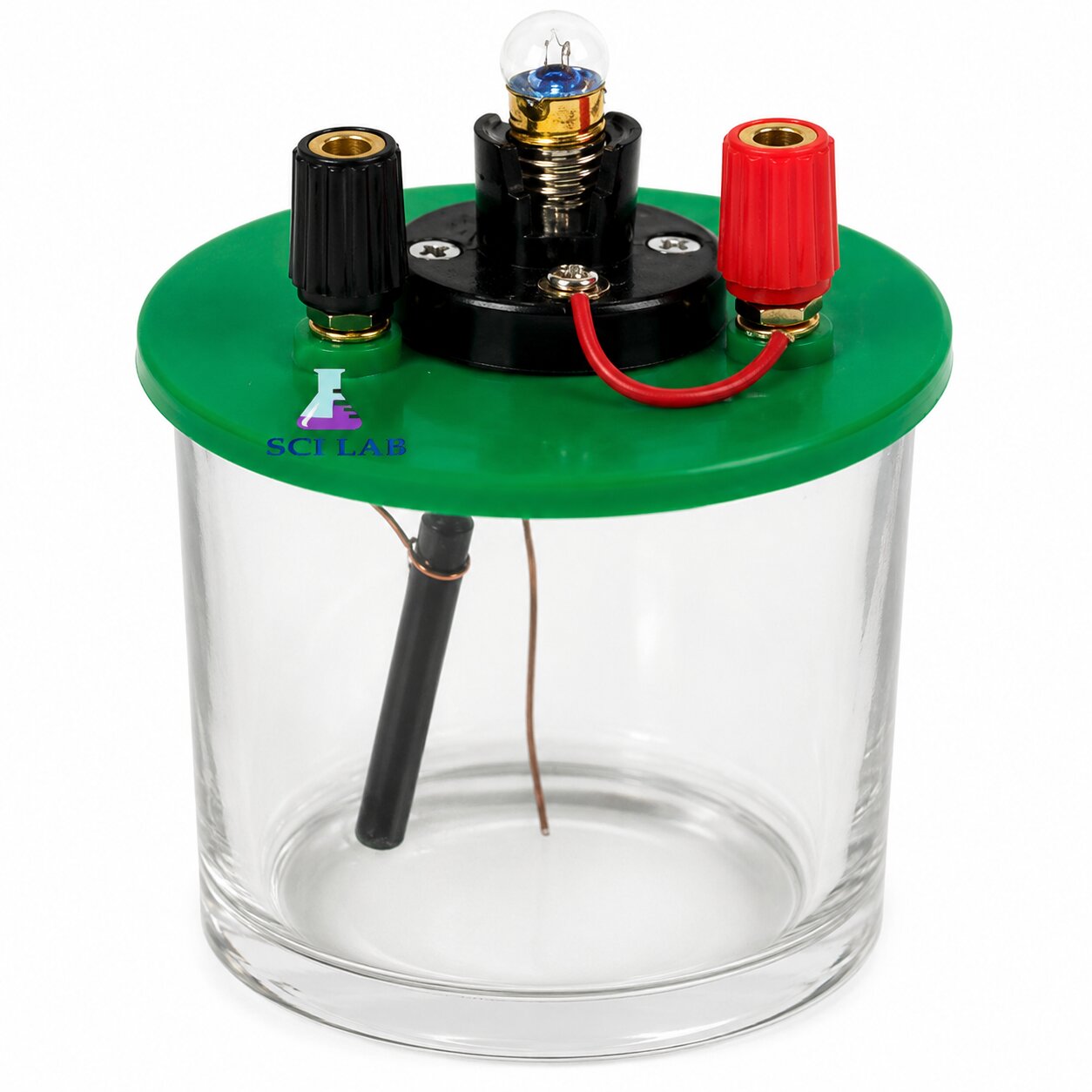
Apparatus for Electrical Conductivity of Electrolytes (SKU SCL-CL-11447) compares how well different solutions conduct electricity. Electrodes dip into four 250 ml cups, each wired to its own bulb, and the four bulbs are connected in parallel, so a class can see at a glance which solution makes its bulb glow brightest. It supports school and college lessons on strong, weak and non-electrolytes. Science Lab Supplies supplies the apparatus from Ambala, India, to schools, colleges, training institutes, tender contractors and distributors.
Specifications
The apparatus is built on a base that carries four 250 ml cups, in which the electrodes are immersed in the solutions under test, and four bulbs connected in parallel. Because each cup has its own bulb in a parallel circuit, all four solutions can be compared side by side at the same time.
| Parameter | Value |
|---|---|
| SKU | SCL-CL-11447 |
| Base | 1, carries cups and bulbs |
| Cups | 4 x 250 ml, electrodes immersed in the solutions |
| Indicators | 4 bulbs connected in parallel |
| Supplied by | Science Lab Supplies, Ambala, India |
Applications and Experiments for the Electrolyte Conductivity Apparatus
Filling the four cups with different solutions, for example a strong acid, a weak acid, a salt solution and sugar water, lets students rank them by bulb brightness. A bright bulb indicates a strong electrolyte, a dim bulb a weak one, and an unlit bulb a non-electrolyte.
- NCERT Class 10 science, Acids, Bases and Salts: showing that acids and bases in water conduct electricity.
- Class 11–12 chemistry: strong and weak electrolytes, ionisation and conductance of solutions.
- Comparing tap water, distilled water and salt solutions in environmental science lessons.
Switch off the supply before refilling or emptying the cups, keep liquids away from the wiring, and use the apparatus under teacher supervision.
Standard Scope of Supply
The apparatus comprises the base, four 250 ml cups with their electrodes and four bulbs wired in parallel, as listed in the specification. Test solutions are prepared by the laboratory. The power source is not described, so the quotation confirms what is included.
Packing, MOQ and Lead Time
One unit serves a teacher demonstration, while several suit group work in larger labs. Your quotation will detail packing, delivery time and price for the chosen quantity, and a power supply or spare bulbs can be priced alongside.
Science Lab Supplies holds an Importer-Exporter Code and is a registered exporter able to ship to buyers in Saudi Arabia, Oman, the Philippines, Nepal, Bangladesh and Zambia. Ask for a quote on the contact page, gather items in the enquiry cart, or send tender specifications through the lab tender page.
Frequently Asked Questions
How many solutions can be tested at once?
Four. The apparatus has four 250 ml cups, each linked to its own bulb, so four solutions can be compared side by side.
Why are the bulbs connected in parallel?
In parallel, each bulb responds only to the solution in its own cup, so a poorly conducting solution does not dim the others and comparisons stay fair.
Who supplies this conductivity apparatus?
Science Lab Supplies supplies it from Ambala, India, to schools, colleges, contractors and distributors, and can quote electrolysis apparatus with it.
What power supply does it need?
The specification does not state the supply. Please ask through the contact page and we will confirm the operating supply before quoting.
Related Electrochemistry Apparatus
These items take students from conductivity to electrolysis: two electrolysis sets that show what happens when current passes through a solution, a universal power supply for bench experiments, and spare light bulbs for circuit work.
- Apparatus for the Electrolysis of Salts — products of salt electrolysis.
- Apparatus for Demonstration of Electrolytic Processes — teacher demonstration set.
- Universal Power Supply or Power Driver — bench power for experiments.
- Light Bulb — for simple circuit work.
Browse the full Chemistry Lab range or all school lab equipment.
Last updated: 25 September 2026


.png)