Apparatus for Demonstrating the Free Fall of Bodies
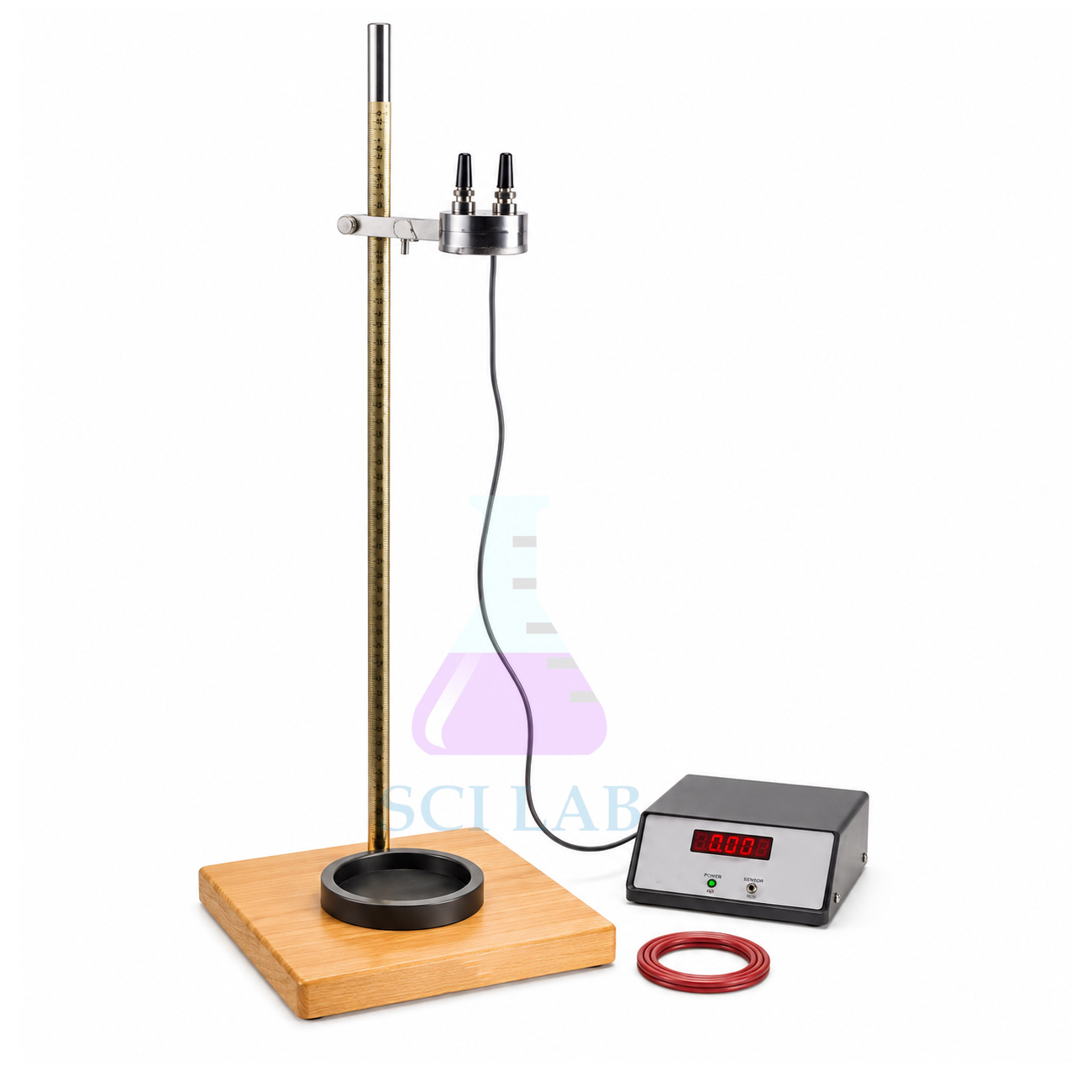
Product Code : SCL-PL-11803
Apparatus for Demonstrating the Free Fall of Bodies (SKU SCL-PL-11803) lets students watch spheres of different material fall side by side, showing that in free fall the motion does not depend on the mass of the body. It is a compact demonstration piece for middle-school and secondary physics lessons on gravity. Science Lab Supplies produces the apparatus at Plot 448, HSIIDC Industrial Area, Saha, Ambala, India, and delivers it to schools, colleges, tender contractors and distributors without intermediaries.
Specifications
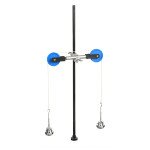
The spheres, made of steel or plastic with diameters between 20 and 30 mm, hang from a mounted steel frame. The whole mechanism is mounted on a wooden block measuring 17 x 6 cm, which forms the base of the unit for use on a bench or demonstration table.
| Parameter | Value |
|---|---|
| SKU | SCL-PL-11803 |
| Spheres | Steel or plastic |
| Sphere diameter | 20–30 mm |
| Frame | Mounted steel frame |
| Base | Wooden block, 17 x 6 cm |
| Manufacturer | Science Lab Supplies, Saha, Ambala, Haryana |
| Country of origin | India |
Applications and Experiments for the Free Fall Apparatus
The apparatus is used to show that bodies released together from the same height reach the ground together, whatever their mass, when air resistance is small. It supports gravitation lessons from NCERT Class 9 onward and gives teachers a quick, repeatable demonstration before quantitative work on the acceleration due to gravity.
- NCERT Class 9 science (Gravitation): free fall and acceleration due to gravity.
- Middle-school science: challenging the idea that heavier objects fall faster.
- NCERT Class 11 physics (Motion in a Straight Line): introducing uniformly accelerated motion.
- Comparing steel and plastic spheres to discuss mass and shape in free fall.
Standard Scope of Supply
Supply covers the mounted steel frame on its 17 x 6 cm wooden block with the steel or plastic spheres of 20–30 mm diameter described above. The unit is supplied as described above, and any optional items you ask for are itemised separately on the quotation.
Packing, MOQ and Lead Time
A quotation can cover one demonstration unit or a quantity for several classrooms, and it will state the packing, delivery time and price for the number you request. Related gravity and motion apparatus can be quoted together on the same document.
Registered with an Importer-Exporter Code, Science Lab Supplies is able to ship to buyers in Bangladesh, Zambia, Rwanda, South Africa, Qatar and Sri Lanka. You can place the apparatus in the enquiry cart, write to us through the contact page, or read about tender supply on the lab tender page.
Frequently Asked Questions
What does the free fall apparatus demonstrate?
It demonstrates that bodies dropped together from the same height fall together, so the acceleration of free fall does not depend on the mass of the body.
What sizes are the spheres?
The spheres are steel or plastic with diameters from 20 mm to 30 mm, hung from a steel frame on a 17 x 6 cm wooden block.
Is Science Lab Supplies the manufacturer or a trader?
The company is the manufacturer. Its Saha, Ambala factory in India builds this apparatus, and every quotation is issued by that same factory.
Can I measure g with this unit?
This unit is a qualitative demonstration. For timing a fall and calculating g, see the separate apparatus for determining g listed below, which includes a timer and measuring tape.
Related Gravity and Motion Apparatus
Free-fall demonstrations lead naturally to measuring g, timing motion and studying momentum. These four items from the Physics Lab range support that sequence of lessons and can be quoted together with this apparatus for a complete mechanics bench in a school laboratory.
- Apparatus for Determining g During Free Fall — timed drops of steel balls to calculate g.
- Mathematical Pendulum Demonstration Apparatus — pendulum studies of gravity and oscillation.
- Digital Stopwatch — for timing motion experiments.
- Newton's Cradle — five steel balls showing action, reaction and momentum.
Browse the full Physics Lab range or all physics lab equipment.
Last updated: 25 September 2026
 (1).png)