
Prism Calcite/Quartz
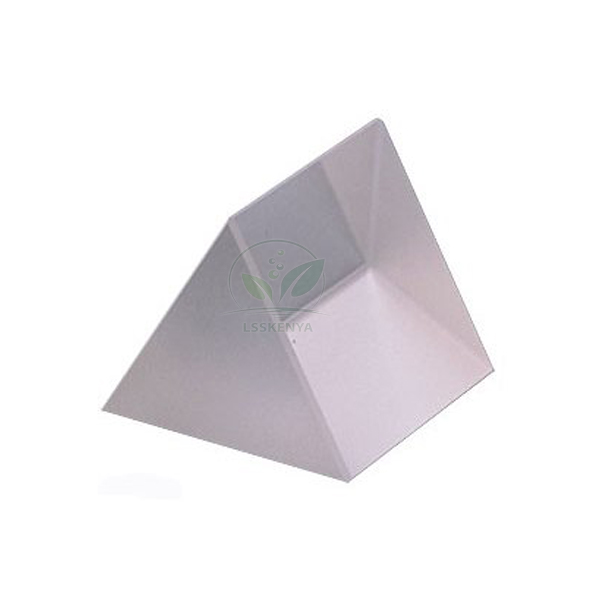
Product Code : LSK-LAO-11139
Prism Calcite/Quartz (SKU LSK-LAO-11139) is a polished crystal prism made of calcite or quartz, cut so that its optical axis has a defined direction for double refraction experiments. It is used on a spectrometer in B.Sc., M.Sc. and engineering physics labs to measure the refractive indices of the ordinary and extraordinary rays. Science Lab Supplies supplies it from Ambala, India to colleges, universities, training institutes, tender contractors and distributors.
Specifications
The table below captures every stated specification. Briefly, the prism is made of calcite or quartz with polished surfaces and is offered in two optical axis orientations: one with the axis parallel to the refracting edge, and one with the axis parallel to the base when the prism is set to minimum deviation.
| Specification | Value |
|---|---|
| SKU | LSK-LAO-11139 |
| Material | Calcite or quartz |
| Surfaces | Polished |
| Optical axis, version 1 | Parallel to the refracting edge |
| Optical axis, version 2 | Parallel to the base when adjusted to minimum deviation |
| Supplied by | Science Lab Supplies, Ambala, India |
Applications and Experiments for the Calcite/Quartz Prism
A calcite or quartz prism splits an incoming beam into two rays that travel at different speeds, so each ray gives its own angle of minimum deviation. Measuring both on a spectrometer gives the two principal refractive indices, a classic double refraction practical in undergraduate and postgraduate optics courses.
- B.Sc. and M.Sc. physics: finding the refractive indices of the ordinary and extraordinary rays on a Laboratory Spectrometer using a sodium or mercury light source.
- Showing that the two emerging rays are polarised at right angles to each other, checked by rotating a Polaroid Disc Mounted in front of the telescope.
- Comparing the birefringence of calcite and quartz when both prism versions are available in the lab.
- Engineering physics: introducing anisotropic crystals before work on wave plates and polarisers.
Calcite is a soft crystal; handle the prism by its edges, keep it away from water and solvents, and store it in a padded box between practicals.
Standard Scope of Supply
The Prism Calcite/Quartz is supplied as one polished crystal prism as described above. Please state the material, calcite or quartz, and the optical axis orientation you require, so that the quotation names the exact version; a spectrometer, light source and polarisers are separate items.
Packing, MOQ and Lead Time
Quotations are available for a single prism for one spectrometer, or for several prisms across a physics department. Science Lab Supplies states the packing, delivery time and price for the requested quantity and version, and the laboratory spectrometer price in India can be quoted on the same sheet.
Science Lab Supplies is a registered exporter with an Importer-Exporter Code and can ship to buyers in Saudi Arabia, Oman, the Philippines, Nepal, Bangladesh and Zambia. For quotations, use the contact page or the enquiry cart; the lab tender page covers tender submissions.
Frequently Asked Questions
What is the difference between the two optical axis versions?
In one version the optical axis runs parallel to the refracting edge. In the other it lies parallel to the base when the prism is at minimum deviation. Choose the orientation your practical manual specifies.
What experiment is a calcite prism used for?
It is used to study double refraction. On a spectrometer, the ordinary and extraordinary rays give separate minimum deviation readings, from which the two principal refractive indices of the crystal are calculated.
Can I order calcite and quartz separately?
Yes. The item covers prisms of calcite or of quartz, so mention the material and axis orientation for each prism you need, and the quotation will list them as separate lines.
Who supplies the Prism Calcite/Quartz?
Science Lab Supplies supplies this crystal prism from Ambala, India. It can be quoted alone or together with spectrometers, polarisers and other optics apparatus for a college physics laboratory.
Related Prisms and Polarisation Apparatus
These items support the same spectrometer and polarisation practicals, from glass prisms used for normal dispersion to polarising filters and interference apparatus, so an optics laboratory can assemble a full set of experiments on one quotation alongside this crystal prism.
- Polarizing Filters — linear polarizing filters in 35 mm square frames, for visible and near-infrared light.
- Spectrometer Prism Separates Light — dense flint glass equilateral prism for dispersion.
- Glass Prism (Equilateral, 50 × 50 mm) — optical glass prism for refractive index work.
- Prism Glass — equilateral and right-angle glass prisms in 38 and 50 mm.
- Hollow Glass Prism — plate glass prism for spectrometer work with liquids.
- Prism Different Angle — equilateral 60° triangular glass prism.
- Newton's Ring Apparatus — plano-convex lens on a flat glass plate, set by three thumbscrews.
Browse the full Light and Optics range, the Physics Lab range for further optics sets, or all physics lab equipment.
Last updated: 9 October 2026

.jpeg)
.jpg)

.jpg)

.jpeg)
