
Human Eye Model, 3x Enlarged, 6 Parts
Product Code : LSK-HAFM-11013
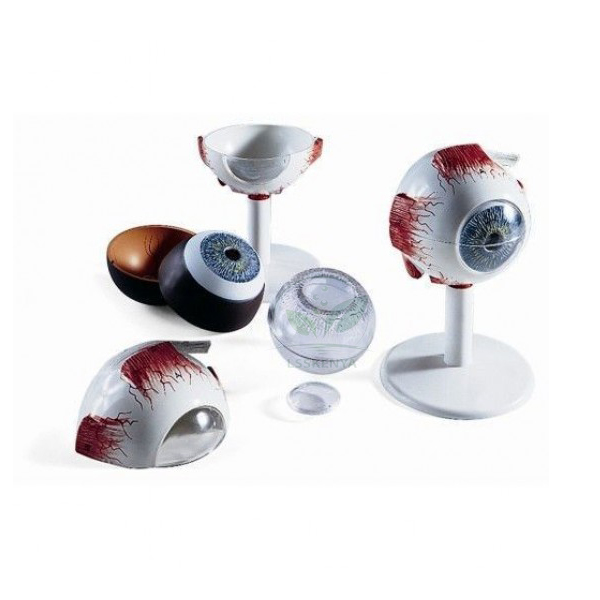
The Human Eye Model, 3x Enlarged, 6 Parts is a three-dimensional model of the human eyeball at three times life size that separates into six parts. The sclera and the choroid each come apart in two halves, showing the cornea, eye muscle attachments, iris, retina, lens and vitreous humour. It is hand-painted PVC on a stand, numbered with a key card.
Specifications of the Human Eye Model, 3x
| Specification | Value |
|---|---|
| Scale | 3 times life size |
| Number of parts | 6 |
| Separable parts | Sclera in two halves, with the cornea and eye muscle attachments; choroid in two halves, with the iris and retina; lens; vitreous humour |
| Material | PVC with non-toxic dyes |
| Finish | Hand-painted and coloured |
| Mounting | On a stand |
| Identification | Numbered, with key card |
| Manufacturer | Science Lab Supplies, Saha, Ambala, India |
Eye Structure and Vision Lessons with the 3x Eye
Students take the eye apart one layer at a time, name each part from the key card, and then rebuild it in the right order.
- Coats of the eye (Class 8 and 10): sclera and cornea outside, the choroid with the iris in the middle and the retina inside, then the lens and vitreous humour.
- Focusing and defects (Class 10): after naming the lens and retina, show focusing, short sight and long sight with the Functional Human Eye Model Kit.
- Eye movement: see how the eye muscles hold the eyeball in place on the Eye in Bony Orbit Model.
- Sense organs (Class 11 biology): compare the eye with hearing on the Human Ear Model, 3 Parts.
Common errors: mixing up the iris with the pupil, and placing the blind spot at the yellow spot, where vision is sharpest.
Frequently Asked Questions
Which parts of this eye model can be taken off?
The sclera comes apart in two halves that carry the cornea and the eye muscle attachments, and the choroid in two halves with the iris and retina. The lens and the vitreous humour lift out as well, giving six parts in all.
Is the eye model suitable for young children?
It has small removable parts such as the lens, so it is meant for supervised use in secondary classes. Keep it away from very young children, who could swallow the smaller pieces.
How much larger than a real eye is the model?
It is three times life size. At that scale the lens, iris and retina are easy to see at the bench, and the model is still small enough to pass round a group. The 5x eye models in the related list suit demonstrations to a whole class.
Why is there no vision at the blind spot?
The blind spot is where the optic nerve leaves the eyeball. That patch of retina has no rods or cones, so light falling on it sends no signal to the brain.
How does the eye focus on near and distant objects?
By accommodation. The ciliary muscles change the curvature of the lens: it becomes thicker for near objects and thinner for distant ones, so the image stays sharp on the retina.
Why does the pupil get smaller in bright light?
Muscles in the iris narrow the pupil to cut the light reaching the retina and protect it from glare. In dim light other iris muscles widen the pupil to let more light in.
Related Eye Models
- Human Eye Model with Eyelids: 5x enlarged eye with eyelids, bony orbit, tear duct and lachrymal gland.
- Human Eye Model: dissectable 6-part eye, about 3 times life size, 90 x 90 x 150 mm.
- Eye Ball Model: separates in a horizontal plane into 6 parts, on a 150 mm pedestal stand.
- Eye in Orbit, Magnified 5 Times, in 7 Parts: eye on the orbit bone, 18 x 18 x 20 cm.
- Functional Eye Model, Non-Liquid: flexible lens and a sliding retina screen to simulate myopia and hyperopia.
Eye and ear models are grouped in the Head and Facial Model range of the Biology Lab section, with further anatomy teaching aids under Biology Lab Equipment.
Under its Importer-Exporter Code, Science Lab Supplies sends the 3x eye model to schools and colleges in Rwanda, South Africa, Qatar, Sri Lanka, Vietnam and Malaysia. Quotation requests are taken on the contact page, and the enquiry cart can hold the model with other items.
Last updated: 19 November 2026


