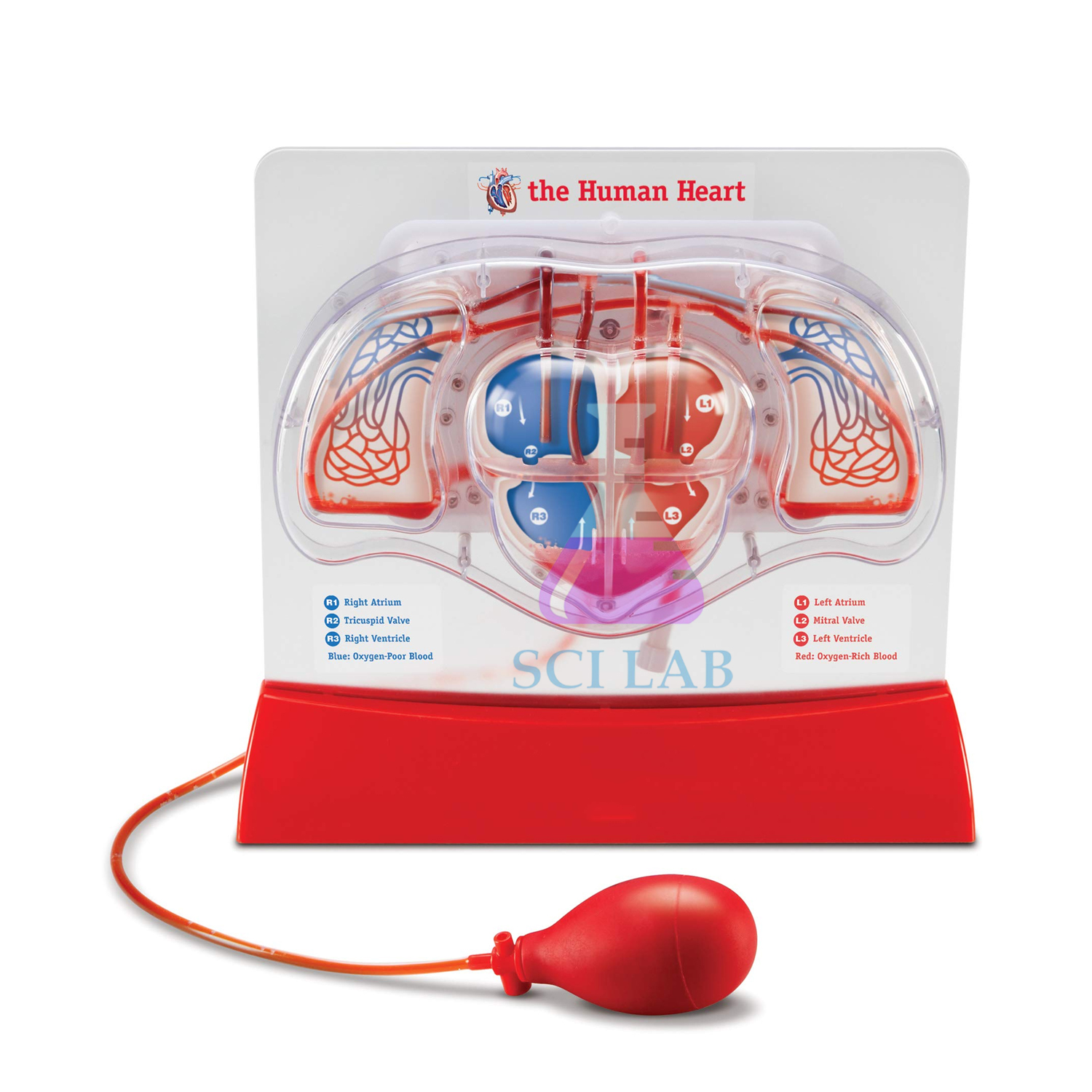
Heart Model with Hand Pump
Product Code : SCL-BLE-11782
The Heart Model with Hand Pump is a clearly labelled working model of the heart chambers, main artery, veins and lungs, about 280 x 180 x 160 mm, with a rigid clear moulded body on a plastic base. A removable hand bulb pushes liquid through flexible tubing to show blood flow through the heart and lungs, so students learn basic heart and pulmonary circulation by seeing and doing.
Specifications of the Heart Model with Hand Pump
| Specification | Value |
|---|---|
| Structures shown | Heart chambers, main artery, veins and lungs |
| Labelling | Clearly labelled |
| Size | Approx. 280 x 180 x 160 mm |
| Materials | Rigid clear moulded body, plastic base, flexible tubing |
| Operation | Simple hand pump with a removable hand bulb |
| Demonstrates | Basic heart and pulmonary blood flow |
| Design | Easy-to-use, multi-sensory model |
| Contents | Model on base, hand pump, tubing, two connectors, label key and setup guide |
| Supplied by | Science Lab Supplies, Ambala, India |
Circulation Lessons with the Hand Pump Heart
Join the tubing to the model with the two connectors as the setup guide shows. Then work the bulb slowly while students trace the route on the labels: from the veins into the heart, out to the lungs, back to the heart and out through the main artery. Then let students work the pump themselves.
- Pathway of blood (Class 7 and 10): students draw the route with coloured arrows on a worksheet while the model runs.
- Heart sounds: listen to a partner's heartbeat with a Stethoscope, Nursescope and link the two sounds to valves closing.
- Pulse and exercise: record pulse rate at rest and after exercise with a Digital Blood Pressure Meter, which reads 40 to 200 pulses per minute.
Class readings are for learning only and are not a health check.
Frequently Asked Questions
What should be checked before ordering a pumping heart model?
Check which structures are labelled (here: heart chambers, main artery, veins and lungs), the size (about 280 x 180 x 160 mm here), what is in the box (here the model on its base, hand pump, tubing, two connectors, a label key and a setup guide) and the liquid the demonstration needs.
Which classes can a distributor offer the heart model to?
It suits upper primary and lower secondary science, where heart and lung circulation is first taught, and works as a refresher in Class 10 and 11 biology. The hands-on pump also helps younger or less confident learners.
Why is double circulation more efficient than a single circuit?
Blood loses pressure as it passes through the lung capillaries. Returning it to the heart lets the left side pump it out again at high pressure to the body, and keeps oxygen-rich and oxygen-poor blood apart.
Is the blood in veins really blue?
No. Blood low in oxygen is dark red. Veins look blue through the skin because of the way skin scatters and absorbs light. Models and charts use blue only as a code for deoxygenated blood.
Does the heart work as one pump or two?
As two pumps side by side that beat together. The right atrium and ventricle send blood to the lungs; the left atrium and ventricle send it round the body. Each side has its own valves to keep the flow one way.
Related Heart and Circulation Models
- Pumping Heart Model: 320 x 250 x 65 mm, comes with instructions and needs assembling.
- Human Pumping Heart Model: squeeze bulb pumps simulated blood through clear heart chambers; with display stand.
- Human Heart Model, 3 Detachable Parts: PVC model at 3-4 times magnification.
- Human Lungs With Heart Model: dissectible in 4 parts, showing lungs, diaphragm and heart.
- Human Cardiac Beat And Blood Circulation Model: red and blue lights trace arteries and veins; needs a power supply.
- Human Blood Circulation Chart: laminated wall chart, 70 x 100 cm.
The hand-pump heart is grouped with lung, torso and other organ models in Human System Model, part of the Biology Lab section.
Shipments of the hand pump heart to Zambia, Rwanda, South Africa, Qatar, Sri Lanka and Vietnam can be arranged by Science Lab Supplies, which holds an Importer-Exporter Code. Open the contact page for a quotation, or keep a list of circulation models in the enquiry cart.
Last updated: 19 November 2026