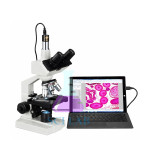
Digital Trinocular Microscope

Product Code : SCL-BLE-11613
The Digital Trinocular Microscope pairs a compound microscope with a trinocular head, a built-in 3 MP camera with USB output and a 10.1 inch Windows 11 tablet with capture software, so a group can watch and save the image. WF10x eyepieces and 4x, 10x, 40x and 100x oil objectives give 40x to 1000x. It has an NA 1.25 Abbe condenser with iris diaphragm, a dimmable LED below the stage and coaxial focusing.
Specifications of the Digital Trinocular Microscope
| Specification | Value |
|---|---|
| Head | Trinocular |
| Optics | WF10x eyepieces; 4x, 10x and 40x dry objectives and a 100x oil-immersion objective |
| Magnification | 40x to 1000x (optical) |
| Camera and display | Built-in 3 MP camera with a native 2048 x 1536 sensor; USB output to the 10.1 inch Windows 11 tablet or a computer, with capture software |
| Condenser | NA 1.25 Abbe condenser with iris diaphragm |
| Illumination | Transmitted (lower) LED light, dimmable |
| Focusing | Coaxial coarse and fine knobs on both sides |
| Mechanics | All-metal mechanical components |
| Power | AC/DC adapter, input 100–240 V |
| Supplied with | Tablet, mount, power leads, USB lead, capture software and a calibration slide |
| Manufacturer | Science Lab Supplies, Saha, Ambala, India |
Teaching with the Digital Trinocular Microscope
Focus with the 4x objective and the coarse knob, then refine with the fine knob, which sits on the same axis. Set the LED brightness first, then the condenser and iris diaphragm. The tablet shows the live image to the whole group and the capture software saves it.
- Cell division: find each stage of mitosis on the Onion Root Tip Mitosis, Longitudinal Section, Prepared Slide and save an image of each for class discussion.
- Protozoa: study cell shape and binary fission on the Amoeba Cell Division Prepared Slide and compare saved images side by side.
- Unstained specimens: practise closing the iris diaphragm a little to bring out detail in cheek cells or pond water.
- High power: place a drop of immersion oil on a stained smear, swing in the 100x objective and focus with the fine knob only; clean the oil off the lens straight after use.
- Measuring cells: image the calibration slide with each objective, set the scale in the capture software, then measure cells on the saved images.
- Practical records: pupils label saved images instead of copying from a textbook.
Frequently Asked Questions
Can the microscope run on 110 V and 230 V mains?
Yes. The AC/DC adapter accepts 100–240 V input, which covers both 110 V and 230 V markets. Check that the adapter plug matches local sockets, or use a suitable plug adapter.
How does a trinocular head differ from a binocular one?
A trinocular head has a third tube, so a camera can image the specimen while the eyepieces are in use. A binocular head has only the two eyepieces. This model has a trinocular head and, as a separate feature, a built-in 3 MP camera with USB output to the 10.1 inch Windows 11 tablet.
Does digital zoom count towards a microscope's magnification?
No. Optical magnification is the eyepiece power multiplied by the objective power: on this microscope the WF10x eyepieces give 40x, 100x, 400x and 1000x with the four objectives, and the 100x objective works only with immersion oil. Digital zoom enlarges the camera picture but adds no detail, so compare microscopes on their optical figures.
Why do unstained cells look washed out?
With the iris diaphragm wide open there is too little contrast for clear, colourless cells. Close the diaphragm slightly until edges appear, and use the LED control to restore brightness.
Why does closing the diaphragm too far blur fine detail?
A small aperture raises contrast but lowers resolution, so fine structures merge and the image darkens. Close it only as far as the specimen needs.
Should the condenser be lowered to dim the light?
No. Dim the image with the LED intensity control and keep the Abbe condenser raised near the slide for most work. Lowering the condenser to cut light also loses image quality.
Related Digital and Compound Microscopes
- Digital Binocular Microscope: built-in 3 MP camera and a 10.1 inch tablet PC that rotates through 360°.
- Biological Microscope: monocular compound microscope with a WF10x eyepiece and 4x, 10x and 40x plan achromatic objectives, 40x to 400x.
- Trinocular Research Microscope With Digital Microscopy Screen Camera: 45° inclined trinocular head that rotates through 360°.
- Digital Microscope: 2 MP camera at 1600 x 1280 with 10X and 25X eyepieces.
- Microscope Cover Glass, 20 x 20 mm (10 g): clear borosilicate cover slips for flat, even mounts.
Binocular and compound models can be compared with it in the Microscope category; prepared slides for class viewing are in Microscope Slides and Cameras.
Science Lab Supplies, registered with an Importer-Exporter Code, can ship this microscope to Peru, Egypt, Iraq, Nigeria, Kenya and Ghana. To receive a quotation, contact the team on the contact page or save the item in the enquiry cart.
Last updated: 20 November 2026