Corkscrew
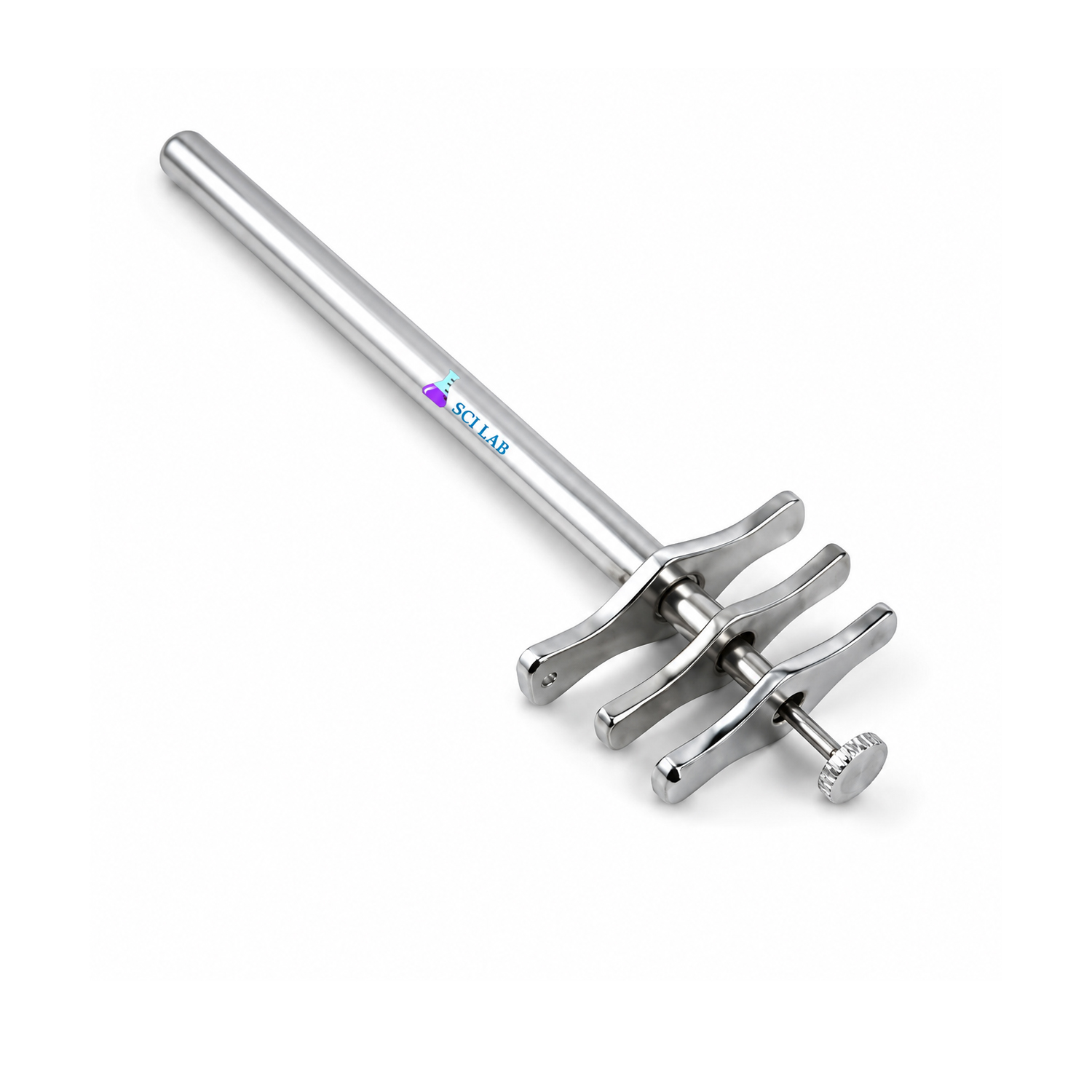
Product Code : SCL-CL-11559
This corkscrew is a small polished steel tool for drawing cork stoppers out of reagent bottles, specimen jars and flasks. It comes in three dimensions between 5 and 7.5 mm, and the steel is chemical resistant with a silver finish.
Specifications of the Corkscrew
| Specification | Value |
|---|---|
| Material | Steel, chemical resistant |
| Finish and colour | Polished, silver |
| Dimensions | Three dimensions, 5 to 7.5 mm |
| Supplied by | Science Lab Supplies, Ambala, India |
Opening Cork-Stoppered Containers in the Lab
Corks still close many specimen jars, bottles and flasks in school stores. Turn the spiral in along the centre of the cork, stop before the tip breaks through the bottom, then pull straight up while holding the neck of the container.
- Opening stored specimen or reagent containers before a practical, then resealing them with Rubber Stoppers Without Holes.
- Clearing old corks from flasks before fitting a bored stopper and a delivery tube cut from Glass Tubes of Different Diameters.
- Preparing used bottles for washing in the preparation room.
Precautions: do not push the spiral right through the cork, or crumbs fall into the contents; hold the bottle by its neck, not its shoulder; and wear eye protection when a stuck cork needs force.
Frequently Asked Questions
What if the cork crumbles or falls into the bottle?
Stop pulling and lift the loose pieces out with forceps or a hooked wire. Strain liquid contents if crumbs fell in, and replace the damaged cork with a new one of the right size.
Why does a stopper get stuck in the neck?
Corks swell with moisture and stick to the glass, and a container that has cooled can hold a slight vacuum. Some contents also leave a crust in the neck that bonds the stopper in place.
Can the corkscrew be used on rubber or glass stoppers?
It is meant for cork. A spiral tears rubber and cannot grip glass. Rubber stoppers are eased out by twisting, and a stuck glass stopper needs gentle methods such as warm water, not force.
How should a bottle be cleaned after the cork is removed?
Empty it into the correct waste container, wash it with detergent and a narrow bottle brush, rinse with tap water, then rinse with distilled water and let it air dry.
Related Stoppers and Bottle Tools
- Solid Red Rubber Stoppers, 3-20 mm: solid red rubber stoppers in sizes from 3 mm to 20 mm.
- Rubber Stoppers of Various Diameters with Holes: bored rubber stoppers with 11, 13, 14 and 15 mm bottom diameters.
- Cork Borer Set, 6 Heads (3-20 mm): six removable heads from 3 mm to 20 mm.
- Bottles of Colorless Glass with Stoppers for Reactants: clear glass bottles of 100 ml and 500 ml with tight-fitting stoppers.
- Amber Glass Reagent Bottles with Stoppers, 60-500 ml: amber glass in 60, 125, 250 and 500 ml for light-sensitive liquids.
- Brush for Washing Test Tubes: soft white nylon brush with a 12 mm diameter.
More stoppers, bottles and bench tools are in the Chemistry Lab range; the wider School Lab Equipments section covers physics and biology too.
Science Lab Supplies holds an Importer-Exporter Code and can ship to buyers in the Philippines, Nepal, Bangladesh, Zambia, Rwanda and South Africa. To ask for a quotation, use the contact page or the enquiry cart.
Last updated: 14 November 2026
.jpg)