Magnetic Compass, 90 mm
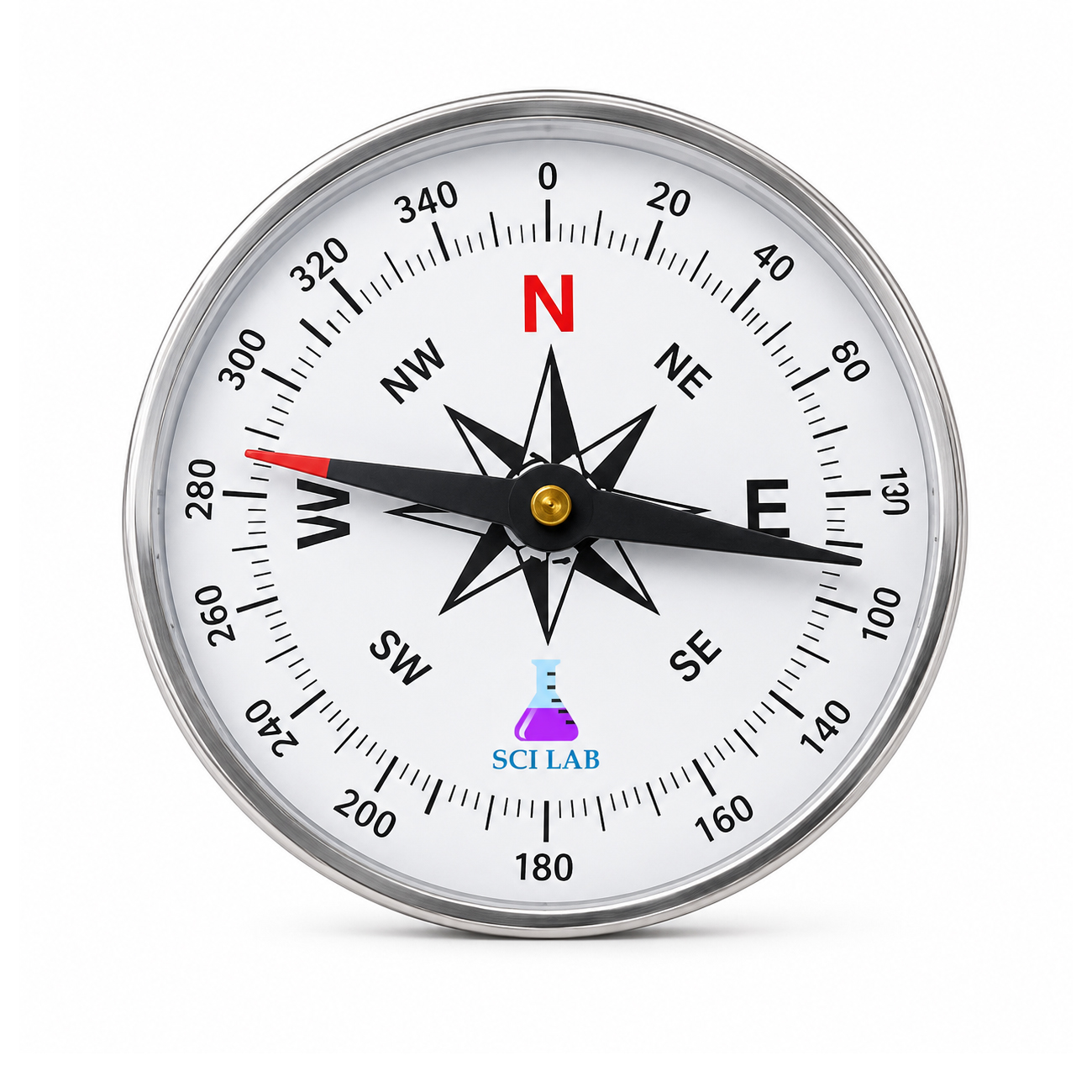
Product Code : SCL-BLE-11641
The Magnetic Compass is a 90 mm round direction finder for laboratory and field use. Its anodised aluminium case is 18 mm deep, and a clear polycarbonate cover protects a dial that shows the cardinal points. A balanced magnetised steel needle on a low-friction pivot turns freely to line up with the Earth's magnetic field.
Specifications of the 90 mm Magnetic Compass
| Specification | Value |
|---|---|
| Size | 90 mm outside diameter, 18 mm overall depth |
| Case | Anodised aluminium, round, silver |
| Dial | Shows the cardinal points |
| Needle | Magnetised steel, balanced on a low-friction pivot |
| Cover | Clear polycarbonate |
| Supplied by | Science Lab Supplies, Ambala, India |
Using the Magnetic Compass in Fieldwork and the Lab
Hold the compass flat, away from steel benches, keys and phones, and wait for the needle to settle. Turn the case until N on the dial sits under the north end of the needle; the other directions can then be read off the dial.
- Site orientation: record which way a slope, wall or hedge faces before comparing plant cover on its north and south sides.
- Transects: set a line in a fixed direction from a marker peg and measure along it with the Tape Measure.
- Magnetic fields: move the compass around one of the Bar Magnets and mark the needle direction at each point to trace the field lines.
Store it flat and away from magnets, which can weaken or reverse the needle.
Frequently Asked Questions
Does the needle behave the same way in every country?
Not always. The Earth's field dips at different angles at different latitudes, and a needle balanced for one region can tilt and rub against the dial far to the north or south. Importers serving distant markets should hold a sample level there and check that the needle swings freely and settles at the same point.
How should a school store compasses between lessons?
Keep each compass flat in a box or drawer, well away from bar magnets, loudspeakers and electromagnets. Strong fields can weaken or reverse the needle, and a fall can damage the pivot.
What should be checked on the compass before a field lesson?
Look for cracks or scratches in the polycarbonate cover and for dirt at the pivot, then check that the needle swings freely and comes to rest at the same point after each turn. A cracked cover lets dust and damp reach the needle.
Does the needle point to the geographic North Pole?
No. It lines up with the Earth's magnetic field and points to magnetic north, which lies some distance from the geographic pole. The difference, called declination, changes from place to place.
Why does the needle swing or stick during a reading?
Nearby iron, steel benches or electric cables pull the needle, and a tilted case lets it rub. Hold the compass level, move away from metal and tap the case gently so the needle settles freely.
Related Compasses and Magnetism Apparatus
- Plotting Compass: 16 mm compass in an aluminium case, glass-faced on one side, marked with cardinal and ordinal points.
- Pocket Compass: 45 mm brass compass in a metal case, marked in degrees with N and S.
- Magnetic Needle: balanced two-tone needle on a steel pivot above a pillar and round base.
- Bar Magnet Pair Chrome Steel: red and blue painted chrome steel pair with keepers, 75 x 12 x 5 mm.
Compasses and magnets are also listed in the Magnetism Physics range, with fieldwork items in the Biology Lab Equipment range.
For overseas schools, Science Lab Supplies exports under an Importer-Exporter Code and can route this compass to Ethiopia, Tanzania, Uganda, the UAE, Saudi Arabia and Oman. Send the number of compasses needed via the contact page, or save the compass in the enquiry cart, for a quotation.
Last updated: 19 November 2026