Apparatus for Studying Circuits for Series and Parallel Connections
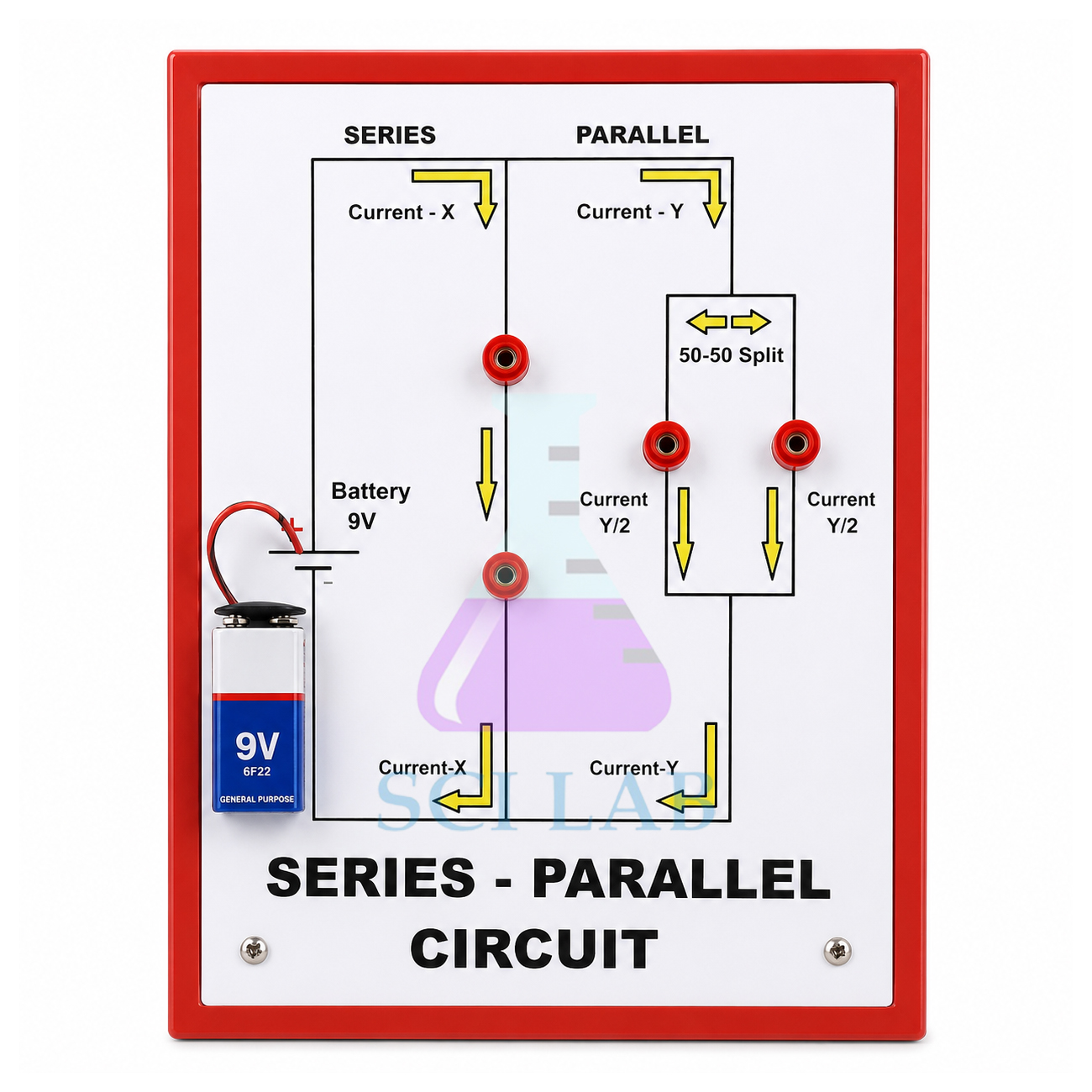
Product Code : SCL-PL-11827
Apparatus for Studying Circuits for Series and Parallel Connections (SKU SCL-PL-11827) is a magnetic-board circuit set with three bulbs, three cells in holders, a switch and a 0–50 Ω rheostat, used to compare series and parallel wiring by bulb brightness. It suits middle-school science and Class 10 electricity lessons. Science Lab Supplies manufactures it at Plot 448, HSIIDC Industrial Area, Saha, Ambala, India, and supplies schools, colleges, tender contractors and distributors from that factory.
Specifications
A magnetic board serves as the base for building the circuits. Power comes from three 3–4.5 V cells in their holders, switched by a DC switch rated 36 V and 0–3 A, and a 0–50 Ω, 1.5 A rheostat varies the current.
| Parameter | Value |
|---|---|
| SKU | SCL-PL-11827 |
| Cells | 3 cells, 3–4.5 V, with holders |
| Lamps | 3 bulbs |
| Switch | Power switch, 36 V DC, 0–3 A |
| Rheostat | 0–50 Ω, 1.5 A |
| Leads | 6 pairs, 25 cm, 4 mm, red and blue |
| Mounting | Magnetic board |
| Manufacturer | Science Lab Supplies, Saha, Ambala, Haryana |
| Country of origin | India |
Applications and Experiments for the Series and Parallel Circuit Apparatus
Students wire the bulbs first in series and then in parallel and compare brightness, see what happens when one bulb is removed, and dim a bulb with the rheostat. The set supports electric-circuit topics in CBSE/NCERT Class 6 science and series and parallel combinations in Class 10.
- Class 6 science: a simple closed circuit with a cell, switch and bulb.
- Class 10 science: bulbs in series and in parallel, and why house wiring is parallel.
- Adding cells in series to raise the voltage across the bulbs.
- Controlling current and brightness with the rheostat.
Standard Scope of Supply
The apparatus comes with three 3–4.5 V cells in their boxes, three bulbs, six pairs of 25 cm red and blue 4 mm leads, a DC power switch, the 0–50 Ω rheostat and the magnetic board. Meters for measuring current and voltage can be added on the quotation.
Packing, MOQ and Lead Time
Ask for a single set for teacher demonstration or one for every student group in the class. The quotation you receive states the packing, delivery time and price for that quantity, and a multimeter or the resistance-factors apparatus can be quoted alongside.
Science Lab Supplies is a registered exporter with an Importer-Exporter Code, so it can ship to buyers in Rwanda, South Africa, Qatar, Sri Lanka, Vietnam and Malaysia. Reach us from the contact page, gather products in the enquiry cart, or open the lab tender page for tender supply.
Frequently Asked Questions
What can students learn with the series and parallel apparatus?
They see that bulbs in series share the voltage and all go out if one is removed, while bulbs in parallel each get the full voltage and keep working independently.
Are meters included with this set?
No ammeter or voltmeter is part of the set; bulb brightness shows the effect of each arrangement. A digital multimeter can be added to the same quotation for measured readings.
Is Science Lab Supplies the manufacturer or a trader?
Science Lab Supplies is the manufacturer. This set is produced in Saha, Ambala, India, at the company's own plant, and the price you are quoted comes directly from there.
Related Circuit Apparatus
Series and parallel work leads straight into measuring resistance and cell behaviour. These four Physics Lab items continue the topic with resistance factors, EMF and internal resistance, measurement and spare bulb holders, and each can be added to the same quotation as this circuit set.
- Apparatus for Studying the Dependence of Electrical Resistance — 24 and 30 SWG test wires with meters.
- Apparatus for Studying f.e.m. and Internal Battery Resistance — cells, digital meters and rheostat.
- Digital Multimeter — battery-powered meter with diode and continuity tests for checking circuits.
- Circuits Kit Bulb Holder — panel-mounted spare bulb holder.
Browse the full Physics Lab range or all physics lab equipment.
Last updated: 25 September 2026